The habit you keep meaning to drop is not a character flaw, and shifting it is not a matter of wanting it more than you already do. Bad habits form because they once solved a problem for you, a quick way to feel better or fill a gap, and they stuck around because that solution worked often enough for your brain to keep it on hand. Once you can see how the thing took hold, changing it gets easier, because you stop fighting yourself and start reworking the machinery underneath.
That machinery is a loop. Something sets the behaviour off, you do the thing, you get something out of it, and the whole sequence runs again the next time the trigger shows up.
Why bad habits form in the first place
Almost every sticky habit runs on the same three parts: a cue, a routine and a reward. The cue is the trigger, often a time of day, a feeling, a place or the thing you did right before. The routine is the behaviour itself. The reward is whatever your brain got out of it, which might be relief from boredom, a hit of comfort, a moment of calm or a small escape from stress.
Habits form through repetition rather than through motivation or good intentions. When you repeat an action in a stable setting and it pays off, your brain learns to link the setting to the response, so the cue starts to pull the behaviour out of you before you have decided anything. Wendy Wood and David Neal, whose work sits at the centre of modern habit research, describe habits as learned associations between a context and a response, to the point where perceiving the context can trigger the response without any goal driving it. That is the strange thing about a habit you dislike. It is not sitting in the front of your mind waiting for a decision. It has been handed to the part of you that runs on autopilot, which is efficient and does not care whether the behaviour still serves you.
There is chemistry underneath this too. The National Institute on Drug Abuse explains that the basal ganglia form a key node of the brain's reward circuit, and that a burst of dopamine acts as a signal telling the brain something worth repeating has happened. That signal, in NIDA's words, makes it easier to repeat the activity "again and again without thinking about it, leading to the formation of habits." James Clear puts the everyday version plainly: most bad habits are driven by stress and boredom, and the behaviour is a way of coping with those feelings. Seeing your habit as learned rather than as proof of weakness matters, because it points you at the actual lever. You are a person carrying a loop that once made sense and now needs reworking.
Find your own trigger
Before you can change a habit you have to catch it in the act, and that means watching the cue rather than the behaviour. For a few days, each time you notice yourself doing the thing you want to change, make a quick note of what came right before it. Where were you? What time was it? What were you feeling? Who was around? Most habits turn out to be tied to one or two reliable triggers rather than firing at random, and naming yours takes the mystery out of it.
You are also looking for the reward, the reason the habit pays off. If you reach for your phone the moment you sit down, the payoff might be a break from a task you are dreading rather than anything on the screen. If the evening snack arrives at the same hour every night, the cue might be the shift from a busy day into an empty evening, and the reward a way to mark that change and unwind.
A short log makes the pattern obvious faster than memory does. Keep it rough, one line per slip, in a notebook or your phone.
Trigger log (blank)
When it happened: ______
What I felt beforehand: ______
What I did: ______
What I got out of it: ______
Filled in, a single entry might look like this.
Trigger log (example)
When it happened: 9pm, on the sofa
What I felt beforehand: flat and a bit bored
What I did: opened my phone and scrolled for an hour
What I got out of it: a break, something to fill the gap
Three or four of those and your loop stops being a vague failing and turns into something specific you can work on.
Replace the routine, do not try to erase it
Trying to delete a habit outright rarely holds, because the cue does not go anywhere. The stress still arrives, the kettle still boils, the sofa is still there at nine o'clock. What you can change is the middle part. As James Clear puts it, "you don't eliminate a bad habit, you replace it," and the replacement has to hand you a similar benefit to the one you were getting before.
The trick is to match the reward rather than grit your teeth through something worse. If the phone gives you a break, a two-minute walk to the window and back gives you a break too. If the biscuit is about a pause with your tea, the pause is the point, so keep the tea and the sit-down and change only what is in your other hand. A swap that ignores what the old habit was doing for you tends to collapse, because the itch it was scratching is still there. Deciding your replacement in advance helps, so that when the cue arrives you already have a response ready instead of a decision to make on the spot. This is also why attaching the new behaviour to something you already do works well. The American Heart Association suggests linking a new action to a routine that already happens, so the better behaviour rides along on a moment your day already contains.
Make the wrong thing harder and the right thing easier
Willpower is a weak tool here, because the whole problem is that the habit runs before willpower turns up. Reshaping the space around you works better and asks less of you in the moment. Wood's research points the same way, towards redesigning your environment rather than relying on motivation, because motivation comes and goes while your surroundings are there every day. The move is to add a few seconds of friction to the habit you want less of, and to strip friction away from the one you want more of.
Adding friction can be small and still count. Keep the phone in another room while you eat. Log out of the app so it asks for a password. Put the biscuits on a high shelf and the fruit at eye level. None of this makes the old habit impossible, and it does not need to. It only has to introduce a pause long enough for the autopilot to hand control back to you, so the behaviour becomes a choice again rather than a reflex.
Removing friction is the same move in reverse. Lay out your trainers the night before. Fill the water bottle and leave it where you sit. Keep the book on the pillow so it is easier to pick up than the phone. You are quietly rigging the room so the better option is the one nearest to hand. If you are building a good habit to stand in for the bad one, starting far smaller than feels necessary tends to stick better, an idea worth reading more about in our piece on tiny habits.
Slips are part of it, so plan for them
You will fall back into the old habit sometimes, and that is ordinary rather than a sign the whole thing has failed. A single lapse does not undo the work behind it. In the real-world habit study covered by the British Psychological Society, a single missed day had little impact on later progress, so one miss is not the derailment it can feel like. That same study found the time to reach automaticity ranged from 18 days to a predicted 254, which is worth remembering on the days you feel behind. There is no schedule you are failing to keep, and if the question of how long change takes is nagging at you, we go into it properly in how long it takes to break a habit.
Most of the damage after a slip comes from the story that follows it, the sense of having blown it that turns one bad evening into a fortnight of not bothering. Treat yourself the way you would treat a friend who slipped, with a shrug and a fresh start, and decide in advance what a hard day looks like so you have a smaller version to fall back on. If the plan was a walk after dinner, the hard-day version is stepping out the door for two minutes. If it was cooking instead of ordering in, the hard-day version is assembling something from the freezer. Shrinking the behaviour keeps the loop alive on the days the full version is beyond you, and a loop that is still running is far easier to build on tomorrow.
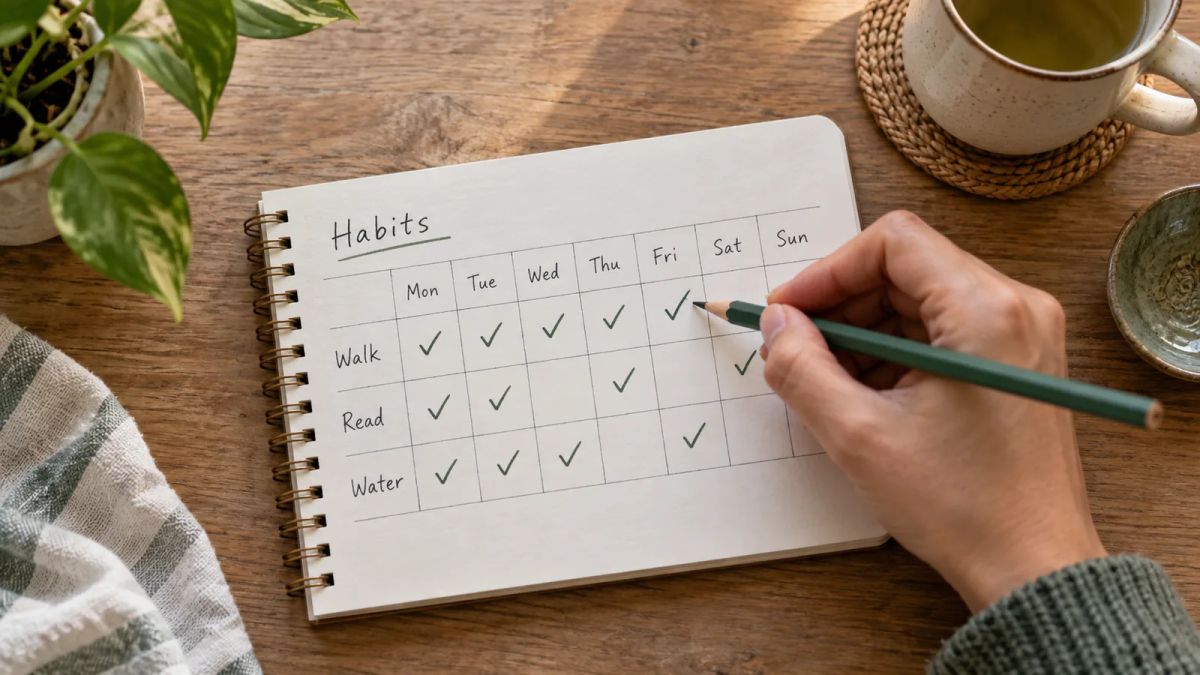
Watching your own progress helps more than it looks like it should. A meta-analysis of 138 studies found that prompting people to monitor how they were doing towards a goal improved how often they reached it. The goals varied a great deal, so a tick cannot promise to fix any one habit. Even so, noticing whether you did the thing tends to help rather than feeling like busywork. A mark on the kitchen calendar, a line in a notebook or a tap in an app all do the same core job, and our guide to using a habit tracker covers how to set one up without it becoming another chore.
Meadow, without the streak
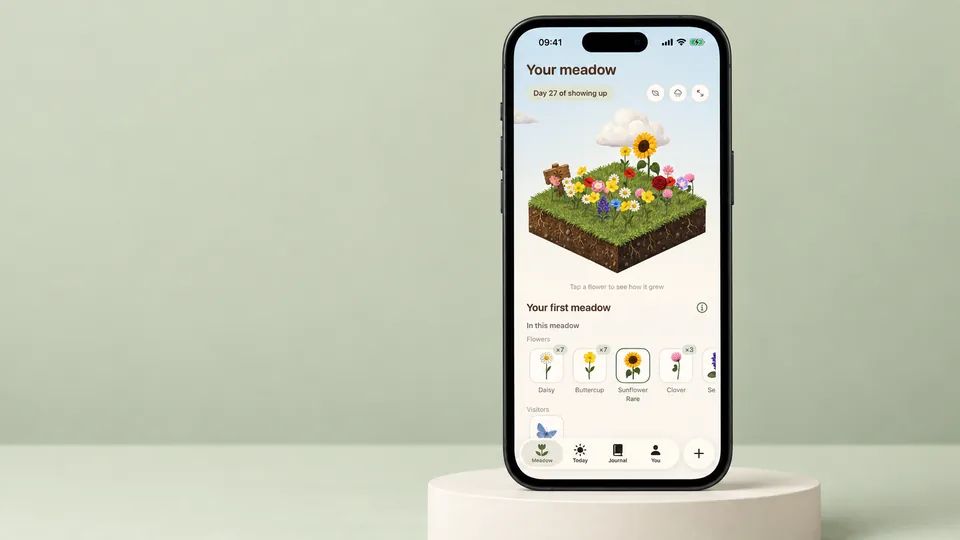
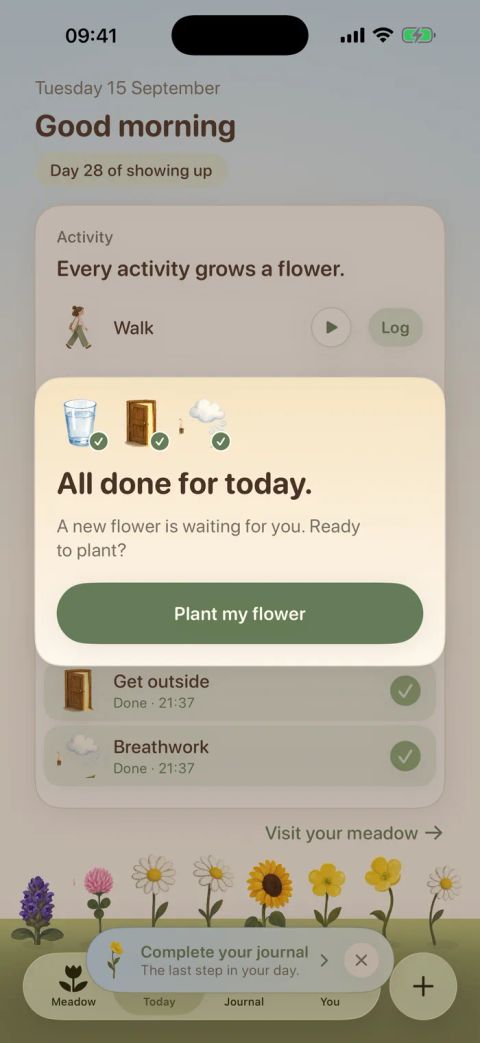
Another app worth checking out is Meadow, because it is built around the pick-it-back-up approach rather than punishing a gap. It is a gentle habit tracker for iPhone, made by Wildcard Wellness. You tick off small daily habits and log movement you enjoy, a walk, a dance, a little yoga, and you can note your mood, a daily win and a daily affirmation. Every day you show up grows a wildflower, with rare flowers and the odd animal visitor turning up over time. There are no streaks, so if you miss a day nothing resets and your flowers never wilt, which suits the reality of changing a habit far better than a counter that punishes you for one off night. It costs $39.99 a year or $9.99 a month after a seven-day free trial.
When a habit has become something more
Some habits stop responding to swaps and friction because they have tipped into dependence, and that is a different thing that deserves different help. The reward circuit that builds ordinary habits is the same one that drugs, alcohol, nicotine and gambling hijack, and NIDA notes that with repeated exposure the circuit adapts and loses sensitivity, so the behaviour stops being a choice in the way an evening scroll is.
If you have tried to cut down and cannot, if the behaviour is doing real harm to your health, money or relationships, or if stopping brings on physical or emotional symptoms you cannot ride out, that is worth taking to your GP. There is no shame in it and no failure in asking. A GP can point you towards the right support, and reaching out early tends to make the whole thing easier rather than harder.
Frequently asked questions
Why are bad habits so hard to break?
Because they run automatically. Once a cue and a behaviour have been paired enough times, the behaviour fires before conscious thought gets involved, so trying to stop it by willpower alone means arriving late to your own decision. Reworking the cue, the routine and the space around you gets ahead of that.
Is it better to quit a bad habit cold or replace it?
Replacing tends to hold better than quitting outright, because the cue and the underlying need are still there after you stop. Giving the cue a new routine that meets a similar reward gives the loop somewhere to go.
How long will it take?
There is no fixed number, whatever the popular figures suggest. The research shows a wide range from person to person and habit to habit, with simpler behaviours settling faster than complex ones. Consistency matters more than counting days.
What should I do when I slip?
Treat it as one data point, not a verdict. Note what triggered it, drop back to a smaller version of the new behaviour, and carry on. A single miss does little damage. The spiral of giving up afterwards does far more.
One thing to do today
Pick the single habit you most want to change and, for the rest of today, do nothing but watch it. When it happens, note what came right before and take one guess at what you got out of it, in the shape "when this happens, I feel this, so I do that". You are not changing anything yet. You are finding the cue, and once you can see it clearly the swap becomes obvious and the whole thing stops feeling like a fight with yourself.
Every little bit counts
Five minutes counts. So does a dance in the kitchen.
Log the movement you enjoy and the small habits that help you feel good, and watch them bloom into something you can see.
Join the Meadow waitlist