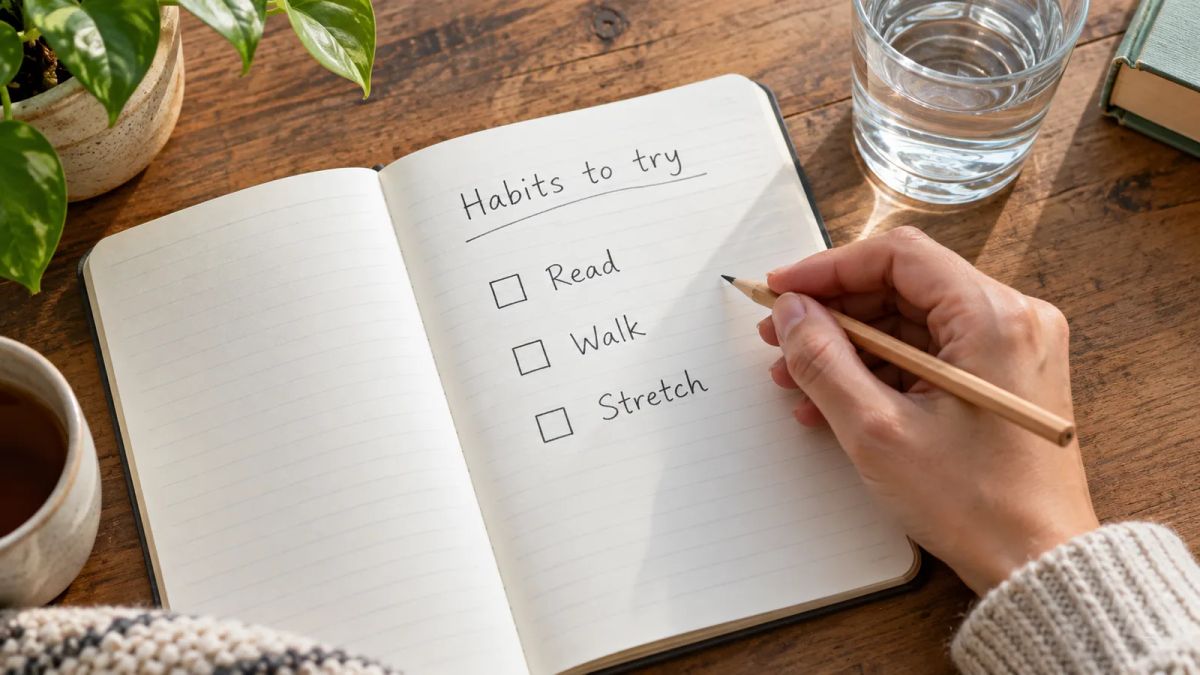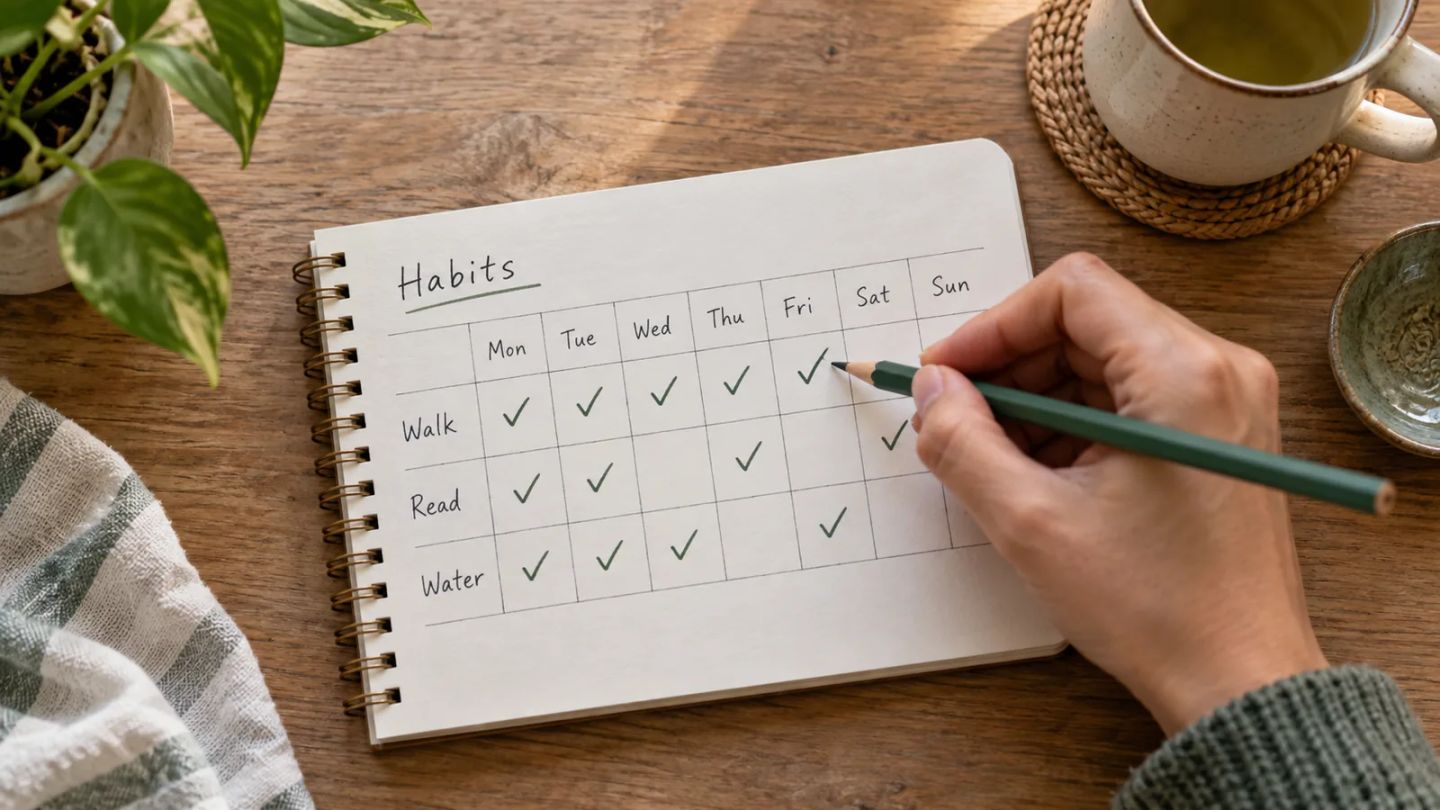
A habit tracker is a record of whether you did the small thing you meant to do today. You cross off the day you go for a walk, tick a box when you take your tablets, or shade in a square after ten minutes with a book. That is the whole mechanism, and it works better than something so basic has any right to.
The reason is speed. Most habits pay off slowly. You walk for three weeks and the mirror looks the same. You read a few pages a night and the stack by the bed barely shrinks. A tracker hands you a reward you can see today, long before the real results turn up, and that small daily flash of progress is often the thing that carries you through the dull middle stretch where new habits usually die.
This guide covers what to track, how to set a tracker up in any format from a torn-off scrap of paper to an app, a template you can copy in the next minute, and how to keep it going once the novelty wears off.
Why tracking works, and what the evidence shows
Something changes when you start writing a behaviour down, and it has been measured.
A 2016 review in Psychological Bulletin pooled 138 studies and found that people who monitored their progress towards a goal were consistently more likely to reach it, and that the more often they checked in, the better they did (Harkin and colleagues). The act of noticing is doing work on its own.
The effect shows up in the messiest corner of behaviour change, which is food. In a weight-loss study of nearly 1,700 adults, the people who kept a daily food diary lost around twice as much as the people who kept no record (Hollis and colleagues). Nobody changed the diet advice between the groups. One group wrote things down.
Part of it is honesty. Most of us remember our week more kindly than we lived it, and a row of blank squares is harder to argue with than a vague sense that you have "mostly" kept it up.
Part of it is momentum. James Clear, who wrote Atomic Habits, points out that a run of ticks becomes something you want to protect (Clear's habit tracker guide). The empty box for today quietly nags at you. Nobody wants to be the one to break a good streak, and that mild reluctance to lose your progress can be enough to get you off the sofa.
And part of it is the plain pleasure of marking the box. It feels good. When something feels good you come back to it, and coming back is the entire game.
Start with one or two habits, kept small
The most common way to wreck a tracker is to fill it on day one with every good intention you have ever had. Ten habits is ten chances to feel like you failed by breakfast.
Pick one habit. Two at a stretch.
Then shrink each one until it is almost too small to skip. Clear calls this the two-minute rule, and it is the difference between a habit you keep and a resolution you abandon. "Read one page" beats "read for an hour". "Put my trainers on" beats "run 5k". You are not trying to get fit in a fortnight. You are trying to become the sort of person who shows up, and showing up is easier to do when the bar is on the floor.
Tie the habit to something already fixed in your day. The pattern is "after I do X, I will do Y". After I put the kettle on, I do one minute of stretches. After I brush my teeth at night, I write down one good thing about the day. An existing routine is the most reliable reminder you own, far steadier than a phone alert you will learn to swipe away.
One thing worth saying: there is no need to track a habit that already runs by itself. If you have brushed your teeth every morning for twenty years, leave it off. A tracker earns its place with the habits that wobble, not the ones already welded into your day.
Pick a format you will open
The best tracker is the one you will look at without being nagged. Format matters less than that.
Paper and a wall calendar. Cheap, visible, and hard to ignore. A calendar on the fridge or a notebook by the kettle puts the record where the habit happens. Many people never need anything more.
A bullet journal. If you already keep one, a habit grid fits neatly beside your week and lets you jot a line about why a day went sideways, which is the sort of note that helps you fix the pattern later.
A spreadsheet or Notion. Good if you like to see totals and completion rates add up, and easy to shape exactly how you want. It rewards people who enjoy the numbers and gets ignored by people who do not.
A dedicated app. Apps carry the record in your pocket, remind you, and keep the history tidy. Options range from the very simple to the very detailed, from Streaks to a page in Notion or a habit built into Apple Health. If you want the full rundown, we compared several in our guide to the best habit tracker apps for iPhone.
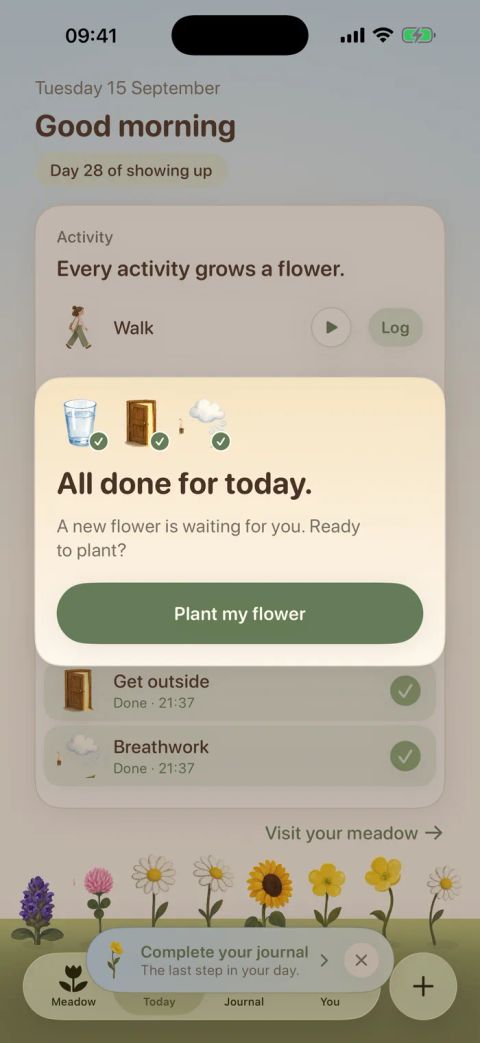
Meadow, without the streak

Another app worth checking out is Meadow, because it takes a different line on the very thing that trips people up. Instead of a streak you live in fear of breaking, each day you show up grows a wildflower in your own meadow, and a missed day never resets anything. You log a walk, a little yoga or a few minutes of movement, tick off small habits like drinking water or getting outside, and note your mood as you go. It costs $39.99 a year or $9.99 a month after a seven-day free trial. The no-streak idea matters more than it sounds, and the next section is about why.
A tracker you can copy right now
Here is a weekly layout that takes a minute to recreate on paper or in a notes app. Write the habit and its cue on one line, then a box for each day.
Habit: Drink a glass of water Cue: after I brush my teeth Smaller version: one sip
Mon ☐ Tue ☐ Wed ☐ Thu ☐ Fri ☐ Sat ☐ Sun ☐
Add a second row if you have a second habit, and no more than that to begin with.
Habit: Ten minutes of reading Cue: once I am in bed Smaller version: one page
Mon ☐ Tue ☐ Wed ☐ Thu ☐ Fri ☐ Sat ☐ Sun ☐
Filled in after a real, imperfect week, it might look like this, with a tick for the full habit and a dot for the smaller version you fell back on.
Habit: Ten minutes of reading Cue: once I am in bed
Mon ✓ Tue ✓ Wed • Thu ✓ Fri ✗ Sat ✓ Sun ✓
That single ✗ is not a verdict. It is one data point in a good week, and the dot on Wednesday shows the night you were shattered and read a single page rather than nothing. Keep the record that honest and it becomes useful, because it tells you where the habit strains.
To rule up a full month instead, draw a grid with the days 1 to 31 across the top and your one or two habits down the side. That is the classic printable, and you have made your own in less time than it takes to find one online.
How to use it so it helps
Mark the box soon after you do the habit, while it is fresh. Leave it too long and you are guessing, and a guessed record is worse than none because you stop trusting it.
Once a week, read it back before you change anything. A week is a handy rhythm, not a magic number. Look for the pattern rather than the perfect run. If Wednesdays keep going blank, the problem is probably the cue, not your character, so move the habit to a point in the day that holds. If you keep reaching for the smaller version, make that your actual plan for next week. If logging has become a chore in its own right, strip the record back to a date and a tick.
The tracker is there to help you make those small decisions. The moment it turns into another stick to beat yourself with, you are using it wrong.
What to do about a missed day
You will miss days. Everyone does. What decides whether the habit survives is what you do next, and here the popular fear of "breaking the chain" does real harm.
The research is reassuring. In a study that followed people forming everyday habits, missing a single opportunity made no meaningful dent in the process (Lally and colleagues). One skipped day is a rounding error. The danger is not the miss. It is the story you tell yourself afterwards, the one where a single blank square means you have blown it, so you may as well stop.
A better rule, borrowed from Clear, is to never miss twice. One day off is life. Two in a row is the start of a new, worse habit. So you let the gap go without a lecture and you show up the next day, even for the two-minute version.
This is the reason Meadow drops streaks altogether. When the whole design punishes a single slip, one bad day can undo months of goodwill. A tracker that keeps your progress visible whether you miss a day, a week or a month takes the fear out of falling behind, and the fear is usually what does the damage.
The mistakes that sink most trackers
Tracking too many habits at once, so every day feels like a test you half-failed.
Tracking something vague, like "eat better", that you cannot fairly tick or not tick. Choose a habit with a clear yes or no.
Chasing a spotless record, then quitting the first time it breaks. A tracker with a few gaps that you kept for three months beats a flawless one you abandoned in week two.
And treating the tracker as the point. The box is a signal, not the achievement. The reading is the achievement.
A few common questions
How many habits should I track at once? One to three while you are starting. You can add more once the first ones run on their own.
Paper or an app? Whichever you will look at without being reminded. Paper wins on visibility, apps win on portability and history. There is no prize for the sophisticated choice.
How long until it feels automatic? Longer than the "21 days" you have heard, and it varies enormously from person to person, from a few weeks to the better part of a year in the research. That is exactly why you track, rather than waiting to feel different. We go into this in how long it takes to build a habit.
Pick one habit, shrink it to two minutes, and draw a seven-box row for it before you close this page. Then tick tomorrow's box.
Every little bit counts
Five minutes counts. So does a dance in the kitchen.
Log the movement you enjoy and the small habits that help you feel good, and watch them bloom into something you can see.
Join the Meadow waitlist