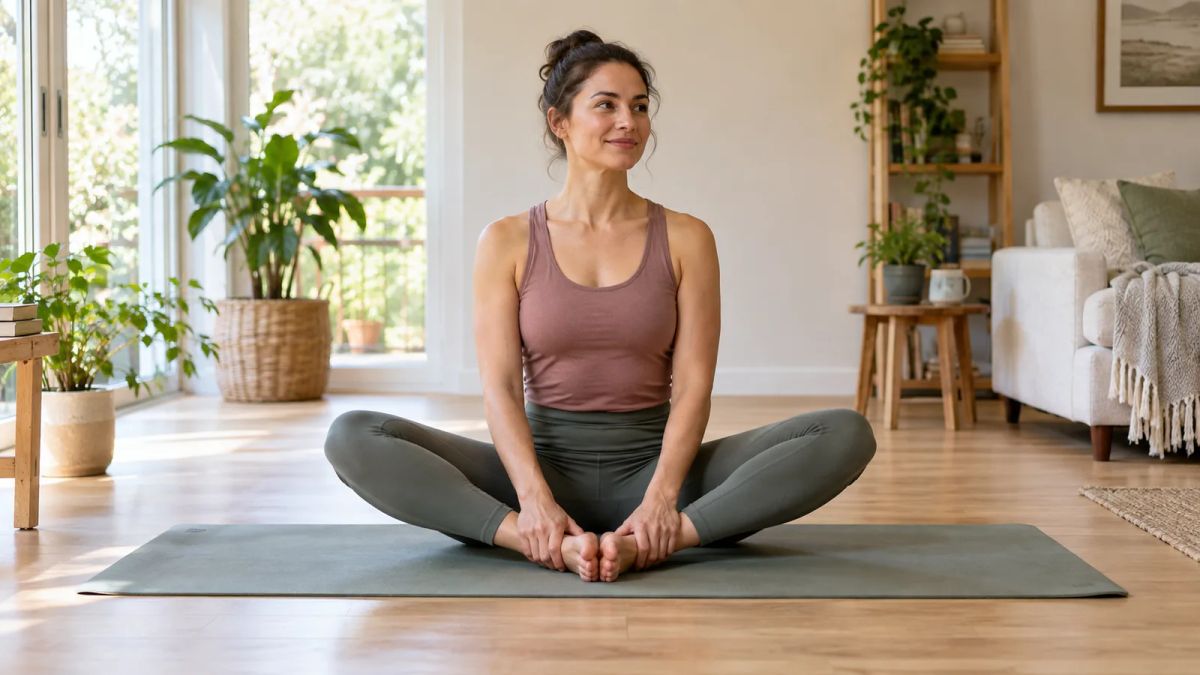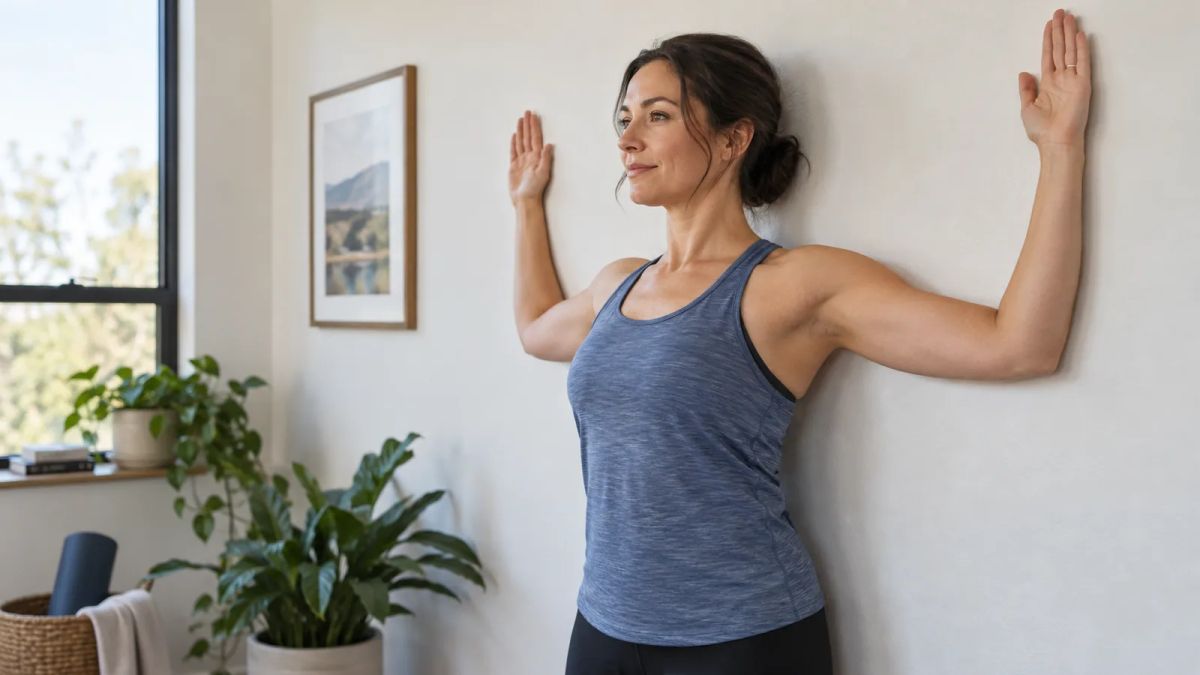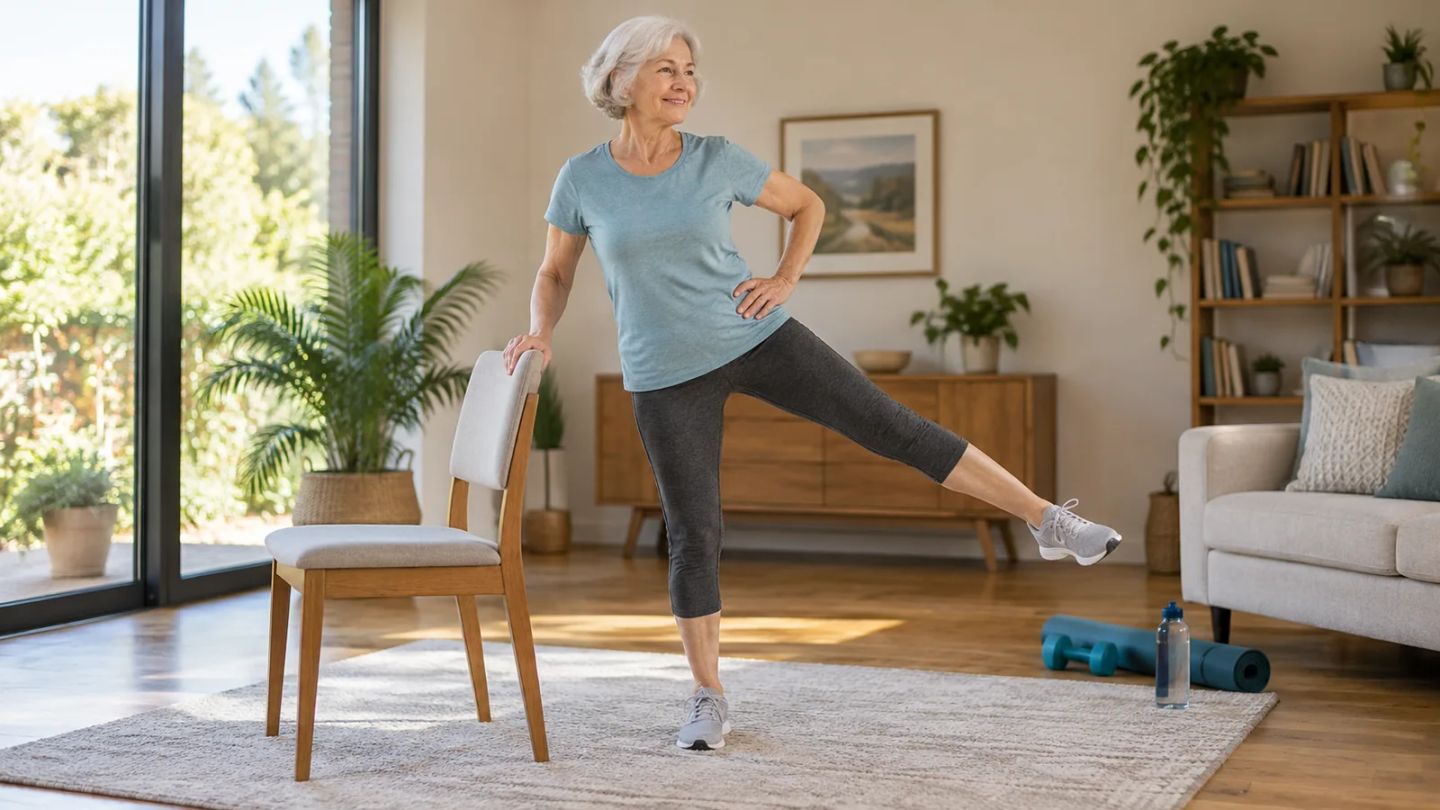
Mobility exercises keep your joints moving freely through their range, and this is a gentle full-body routine built for older adults. It works from your neck down to your ankles, takes about ten to fifteen minutes, and needs no equipment beyond a sturdy chair. You can do it standing with a hand on the chair for support, or sitting down the whole way through.
Good mobility is what lets ordinary things stay easy. Turning to check the road, reaching a top shelf, getting in and out of a car, standing up from a low sofa. When your joints move well and the muscles around them stay supple, none of that asks much of you. When they stiffen, the effort creeps up, and you start planning your day around the movements you would rather avoid.
This routine is built to keep that range topped up, a little at a time.
Below you will find what changes in the body with age and what the research does and does not promise, how to set up safely and when to check with your GP, a numbered routine you can start today with a seated option for every move, a short piece of balance work, and a way to keep it going.
What happens to mobility as you get older
Joints and muscles change with age, and some stiffness is a normal part of that. A physiotherapist writing for Hinge Health puts it plainly. Natural changes make joints a little stiffer and muscles a little less pliable, and if you move less as a result, your flexibility and mobility drop further. It is a case of use it or lose it.
Sitting speeds it along. Harvard Health explains that without regular stretching the muscles shorten and become tight, and when a tight muscle is asked to work it cannot extend fully. Hours in a chair leave the hips and hamstrings short, and standing tall and striding out slowly turns into an effort.
The good news is that movement pushes back. Both the NHS and the CDC put balance and strength alongside walking for exactly this reason.
The CDC recommends that adults aged 65 and over aim for at least 150 minutes of moderate activity a week, muscle strengthening on at least 2 days, and balance work such as standing on one foot, and it says doing all three types together lowers the risk of a fall and of injury from one. The NHS gives the same steer, and adds that if you have fallen or worry about falling, working on strength, balance and flexibility helps you feel steadier on your feet.
Falls are where this gets serious, and the evidence is encouraging while still being honest about its limits. A 2025 systematic review of 27 trials found that structured exercise consistently reduced how often older adults fell, with balance-focused programmes like tai chi cutting falls by roughly 31 to 58 per cent and mixed strength-and-balance training by around 20 to 45 per cent, alongside faster sit-to-stand and walking times. The reviewers were careful to say the studies varied too much to pool into one tidy figure, so read those numbers as a direction of travel, not a guarantee for any one person. What comes through is steady and worth having. Keep moving the joints and training a little balance, and you give yourself a fair chance of staying steadier for longer.
Setting up safely, and when to check first
Warm up before you stretch anything hard. Harvard Health warns that stretching cold muscles can hurt them, which is why the routine opens with easy movement and not a deep hold.
Get your chair right. For any seated work the NHS advises a solid, stable chair without wheels, and not an armchair, with your feet flat on the floor. If you will be standing, keep the chair in front of you so its back is there to hold.
Stay inside a comfortable range. Kristin Vinci, a physiotherapist at Hinge Health, makes the point that you do not have to push into a deep stretch or feel pain for it to help, and a good check is whether you can still breathe smoothly and keep your face relaxed. If you cannot, ease off. Small movements count, and they grow.
One conversation is worth having up front. The NHS advises you to speak to a GP first if you have not exercised for a while, or if you have a health condition. A physiotherapist can tailor any of these moves to a hip replacement, arthritis, low blood pressure or a balance problem far better than a printed routine can. Stop anything that brings sharp or radiating pain, and never bounce into a stretch.
The routine: nine gentle moves from head to toe
Work through these in order, breathing slowly and moving smoothly. Standing with a hand on the chair is the default, and a seated version follows each move, so you can mix the two or stay seated throughout. The whole thing takes ten to fifteen minutes.
1. Warm up on the spot
Stand tall behind your chair and march gently, lifting each knee in turn, while you swing your arms easily by your sides. Keep it going for about a minute until you feel a little warmer. Seated, march your feet and lift alternate knees while you swing your arms. This wakes the whole body up so nothing that follows starts cold.
2. Neck turns and tilts
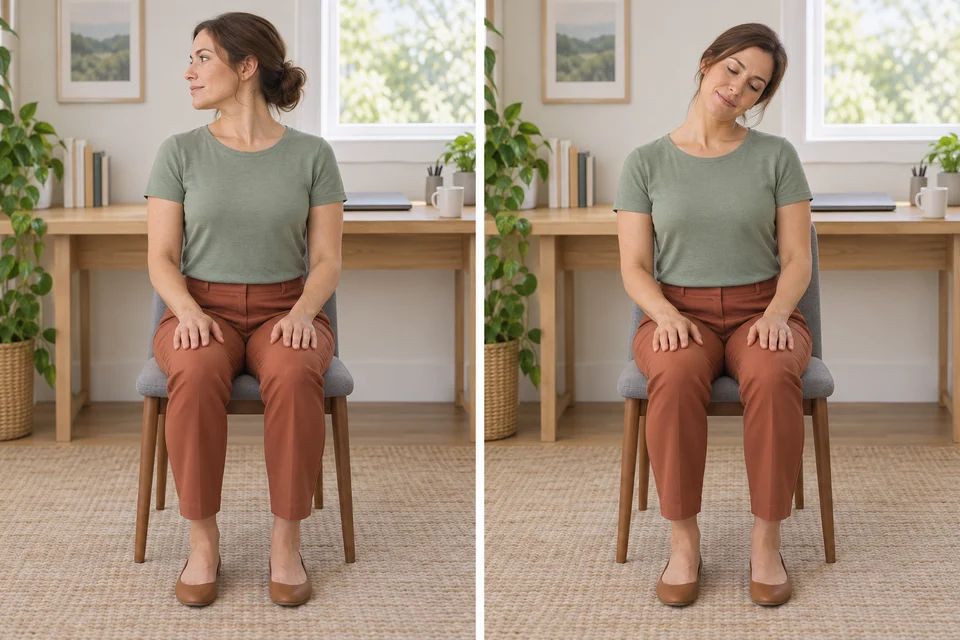
Sitting or standing tall, turn your head slowly to look over one shoulder, back to the middle, then to the other, three or four times each way. Then tilt one ear gently towards that shoulder, back to centre, and over to the other side. Move only as far as feels easy and keep your shoulders down. Stiff necks respond well to this small, regular attention.
3. Shoulder rolls and reaches
Roll both shoulders up towards your ears and back down in slow circles, five or six each way. Then reach both arms forward and gently up as far as is comfortable, and lower them. This keeps the shoulders free for reaching and dressing, and it feels good after a hunched hour with a book. Seated works the same.
4. Seated or standing cat-cow
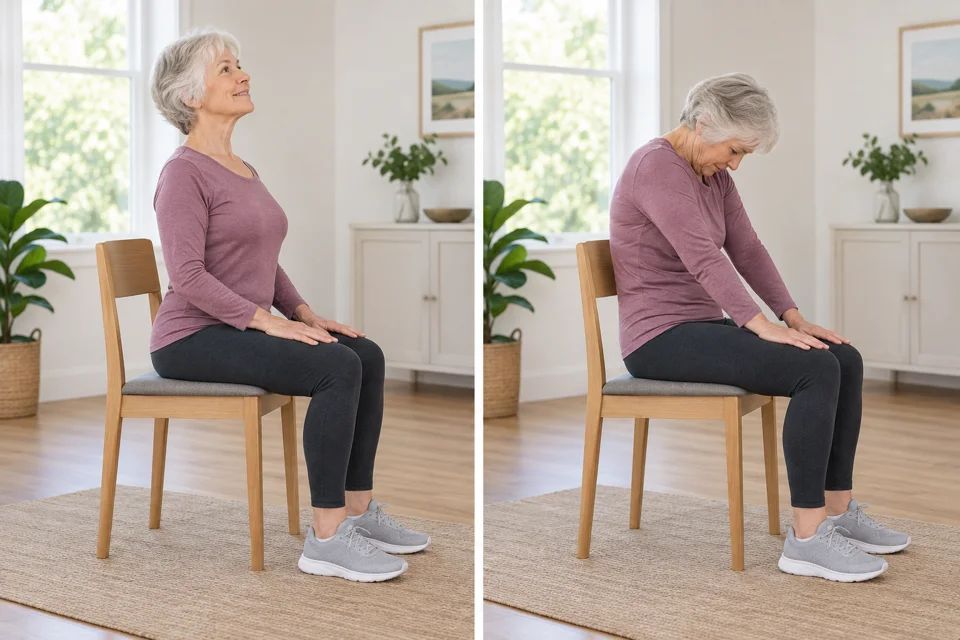
Rest your hands on your thighs. Breathe in and lift your chest, rolling your shoulders back and looking slightly up so your back gently arches. Breathe out and round the other way, tucking your chin and drawing your navel back. Flow slowly through six to eight rounds. It is one of the kindest moves for a stiff spine, and the pelvis tipping back and forth loosens the lower back too.
5. Seated spine twist

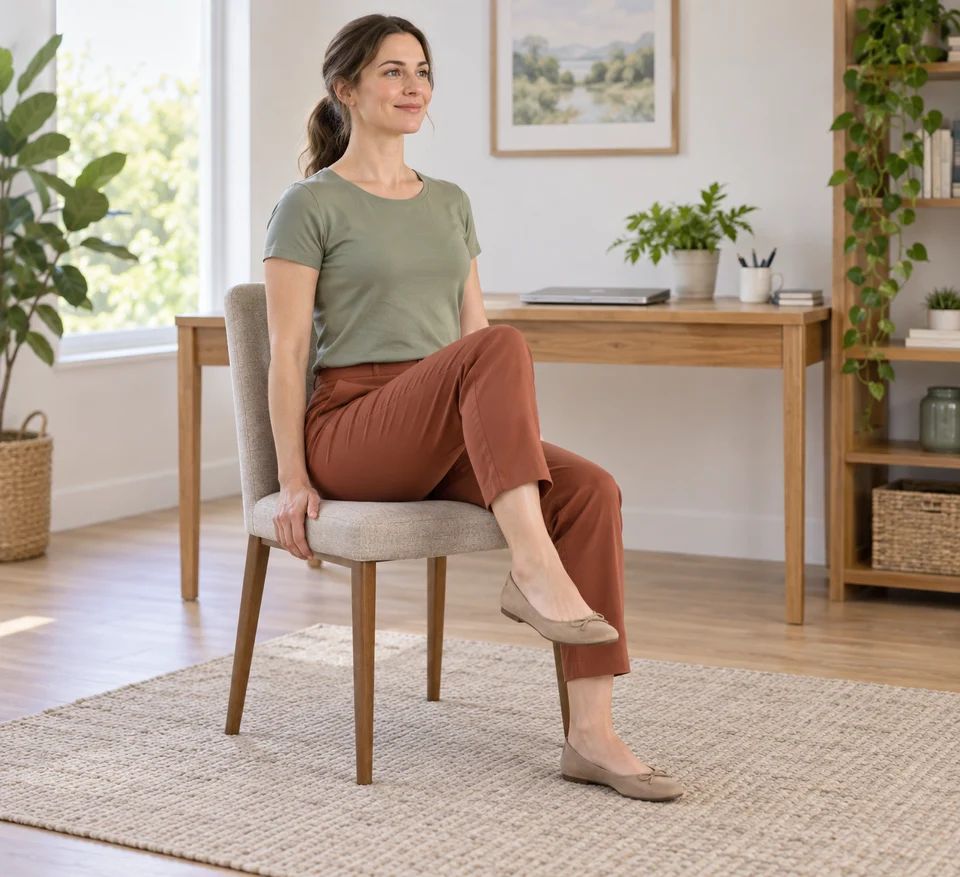
Sit tall with your feet flat. Place your left hand on your right knee and your right hand on the seat or chair back beside you. Breathe in to lengthen, breathe out to turn gently towards the right, keeping your hips facing forward. Hold for two or three breaths, come back to the middle, then twist the other way. Standing, hold the chair back and turn the same way. This is the movement you use to look behind you.
6. Side reach
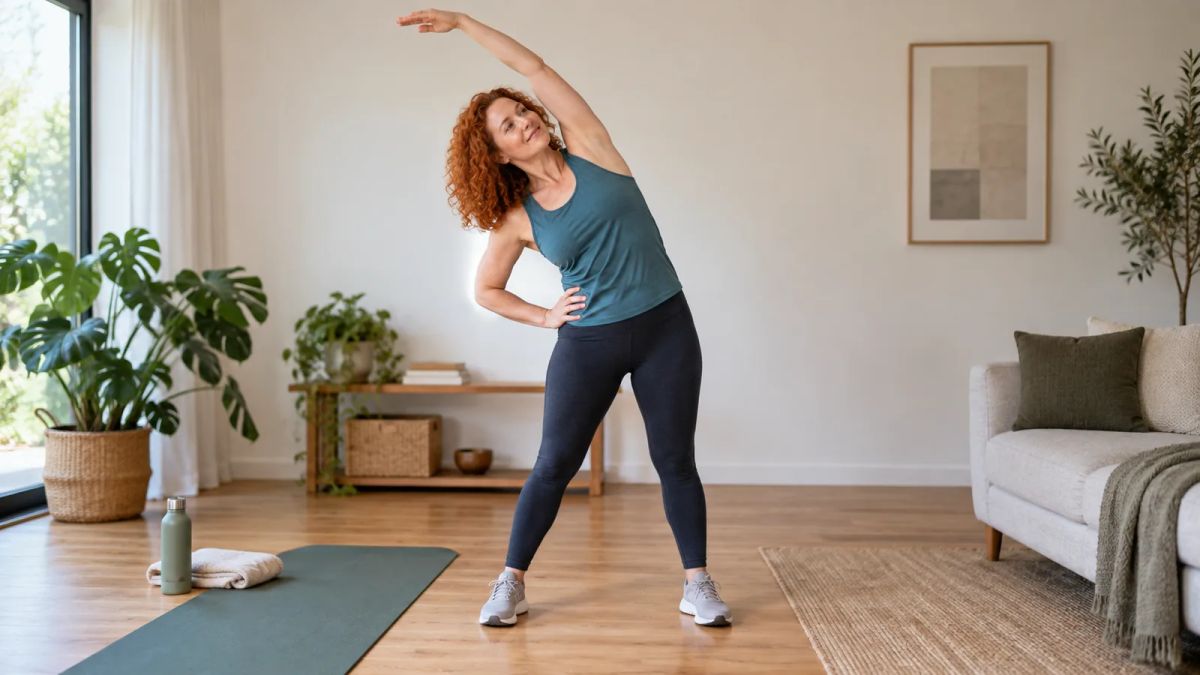
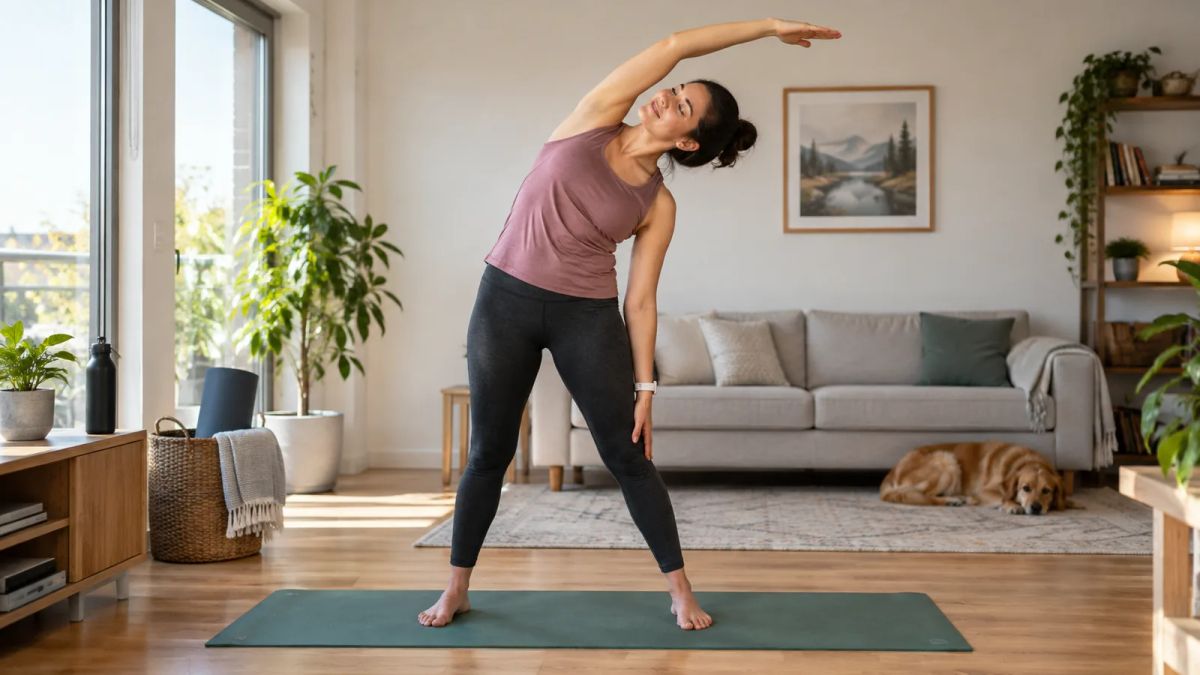
Sitting or standing tall, let one arm hang or hold the chair, and reach the other arm up and over towards the opposite side until you feel a long stretch down your ribs. Come back up and change sides. Keep it gentle and do not collapse into it. Two or three each way is plenty.
7. Hip marching and knee lifts
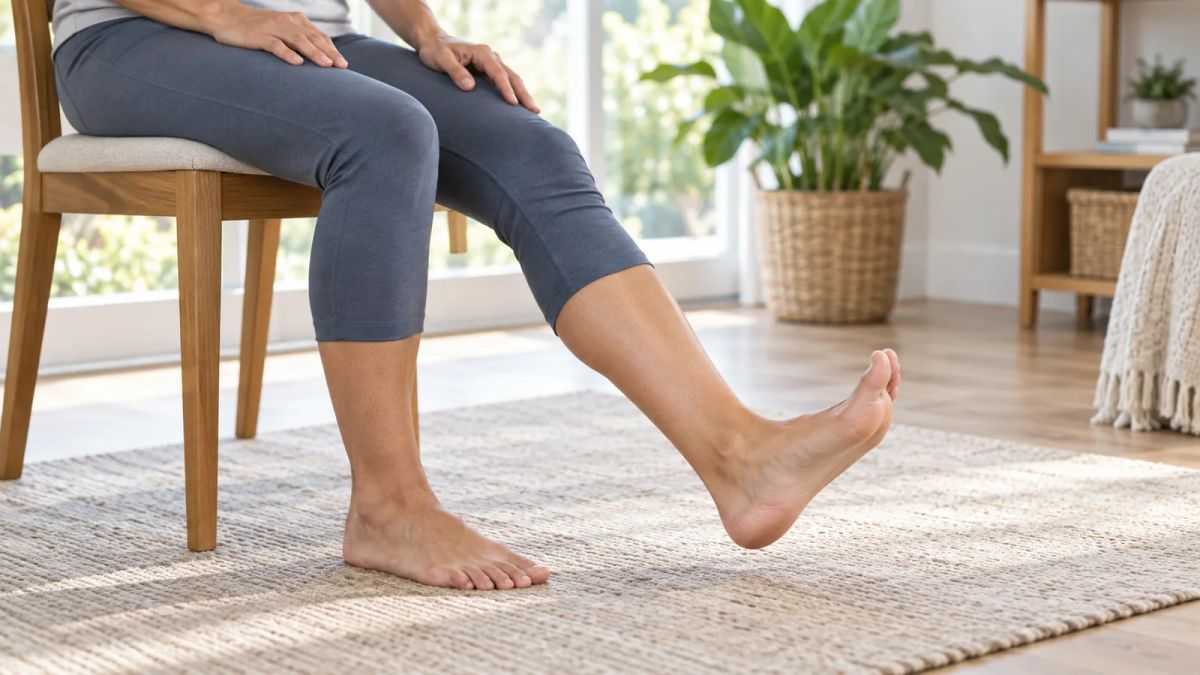
Holding the chair, lift one knee towards hip height, lower it, and swap, like a slow march, eight to ten each side. Then, standing on one leg with the chair held firmly, take the other leg out to the side a short way and back, keeping your body upright. Seated, lift each knee in turn and, if you can, straighten and lower each leg. This keeps the hips moving in the directions a chair keeps quiet.
8. Ankle circles and heel-toe raises
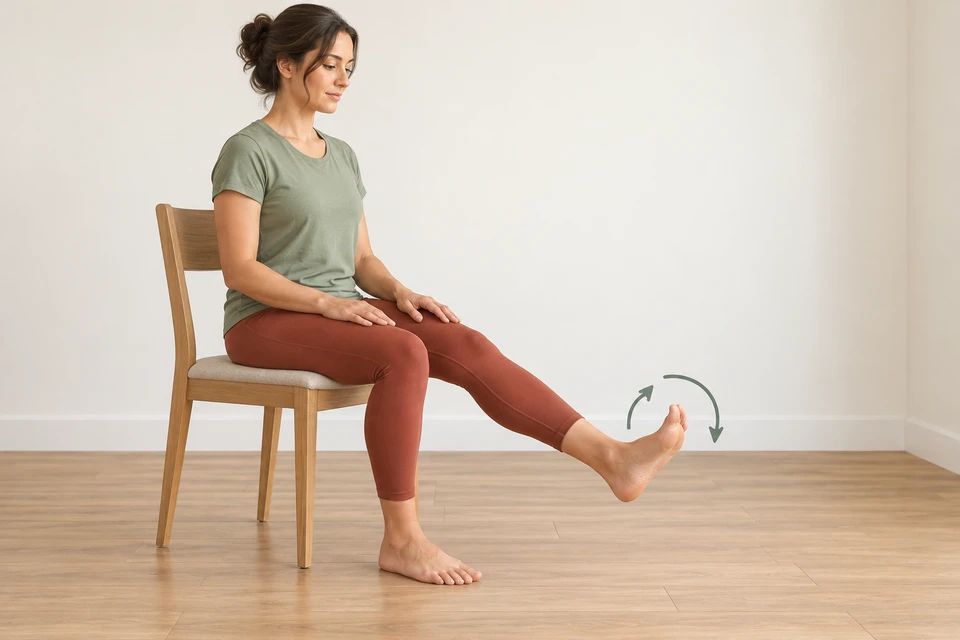
Lift one foot slightly and circle the ankle slowly, several times each way, then swap. Then, holding the chair, rise onto your toes and lower, then rock back onto your heels and lift your toes, eight to ten times. Seated, do the circles as described and press the balls of your feet down and lift your toes. Supple ankles help both your balance and your walking.
9. Sit-to-stand
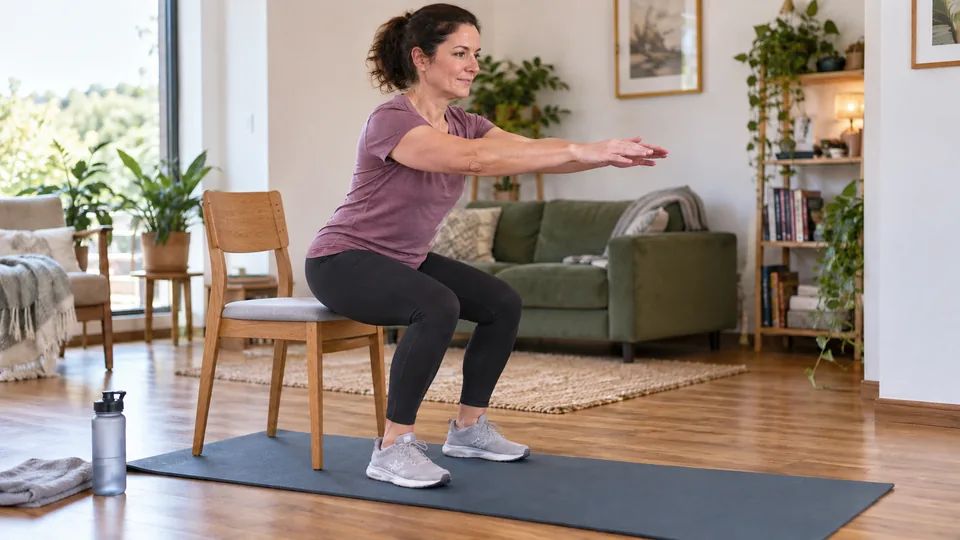
From a sturdy chair, feet flat and a little back, lean forward and stand up, using your hands on the chair or your thighs only as much as you need, then lower yourself down with control. Do five to eight, resting whenever you like. This is the one move here that also builds leg strength, and it is the exact skill you use dozens of times a day.
Finish with a few slow breaths and a gentle shake of the arms and legs. If you would like more spine and shoulder work in a similar spirit, our morning stretch routine runs from neck to calves, and for deeper work on the biggest joints you own, our hip mobility exercises routine goes further.
A little balance to go with it
Since balance is what keeps you upright when the ground surprises you, it earns a couple of minutes of its own. The CDC and NHS both suggest simple balance practice on at least a couple of days a week.
Stand behind your chair, hold the back, and try standing on one leg for a few seconds, then the other. Build the time slowly as you steady, and rest a fingertip on the chair rather than a full grip once you feel safe to. If you take to this side of things, the flowing, weight-shifting movement of tai chi is one of the better-studied ways to train it, and gentle seated practices like chair yoga build a surprising amount of steadiness too.
Never practise balance without something solid to hold. The point is to challenge it safely, not to test your luck.
Keeping it going
Open our free printable: Habit Tracker (PDF). Save or print it to use alongside this guide. No sign-up needed.
A routine you mean to fit in somewhere tends to disappear. One tied to a moment that already happens tends to stay.
Anchor it to a fixed point in your day. "After my morning cup of tea, I do my mobility routine by the kitchen chair" gives the habit a home and a cue, which holds far better than a loose plan to do it sometime. Pick a moment that comes round on its own, most days, without you having to remember.
Decide your shorter version now, before a stiff or busy morning arrives. Three neck turns, a set of shoulder rolls, some cat-cow and a few sit-to-stands still counts as showing up, and a couple of minutes keeps the thread going. Keeping the thread going is what turns this from a plan into something your body expects.
If you miss a day, or a fortnight, you have undone nothing. Stiffness after a gap is the natural result of staying still, not a mark against you, and the fix is the one you already know. Pick the next day, start with the warm-up, and go gently.
A small record helps you see it becoming part of the week. Keep one by the kettle if that suits you. Write the move and its cue, then tick the days you show up.
Move: Mobility routine Cue: after my morning tea
Mon ☐ Tue ☐ Wed ☐ Thu ☐ Fri ☐ Sat ☐ Sun ☐
A real week has gaps in it, and that is fine.
Move: Mobility routine Cue: after my morning tea
Mon ☑ Tue ☑ Wed ☐ Thu ☑ Fri ☐ Sat ☑ Sun ☑
A gentler way to keep track

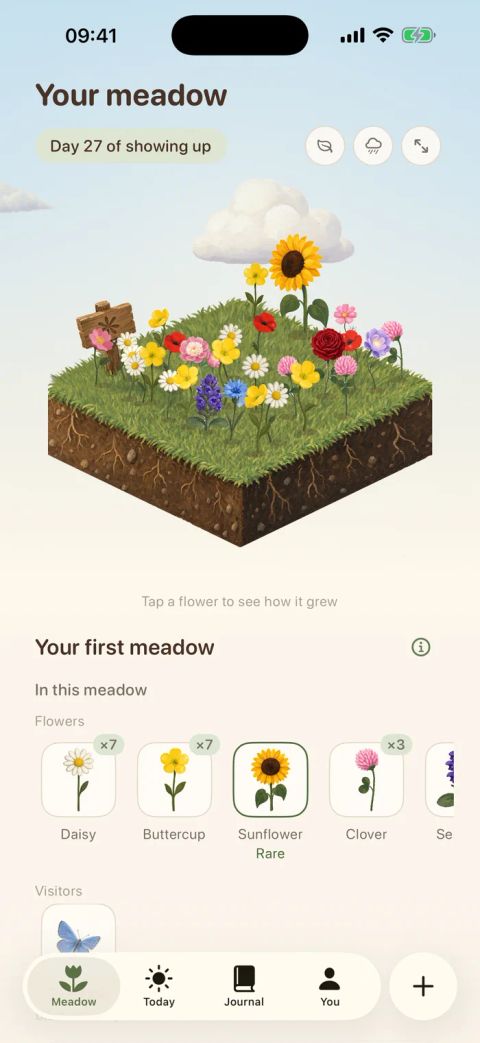
Some mornings the routine happens without a thought and some slip by, and Meadow is made to make the movement easy to come back to. It is a gentle movement and habit app for iPhone. You log the movement you do with a timer, whether that is this routine, a short walk or a few minutes of stretching, tick off small daily habits, and note your mood, energy and one good thing about the day. Each day you show up grows a wildflower in a meadow that is yours, and there are no streaks, so a day you skip resets nothing and your flowers never wilt.
Today, pick your cue and do only the first three moves, the marching warm-up, some neck turns and a few shoulder rolls, while it happens. That is a start, and it is enough.
AUTHOR
Co-founder of Meadow.
Ash is co-founder of Meadow, a habit and movement tracking app that turns small acts of self-care into a growing wildflower meadow.
Little and often, with Meadow
Consistency, not intensity.
Meadow turns the movement you enjoy and the habits that help you feel good into a meadow of wildflowers. No streaks to break, and your flowers never wilt.
Download Meadow