The best morning routine is the one you will still be doing in a month, which means it has to fit the morning you wake up to, not the one in a highlight reel. Building it is an exercise in design: a few small actions, placed where your day already has room for them, so the next hour runs a little easier.
This is the how-to. If you want a ready-made list to copy or a menu of ideas to pick from, those live elsewhere on the site. Here we cover why a routine helps at all, what the first hour of the day is quietly doing to your body and mood, how to design one around your own life, and how to keep it going once the novelty wears off.
Why a morning routine is worth the effort
A routine does something dull and useful. It takes decisions you would otherwise make half-asleep and turns them into a path you can follow without thinking.
This helps at the start of the day, when you have the least spare attention. When the first move is already decided, you spend nothing deciding it. James Clear, who wrote Atomic Habits, describes the way a settled habit runs on autopilot: "by linking your new habits to a cycle that is already built into your brain, you make it more likely that you'll stick to the new behavior". A morning routine is that idea applied to the hardest hour to think in.
There is a mood payoff too, and it does not take much. Harvard Health notes that even a twenty-minute stroll can clear the mind and reduce stress, because movement lowers stress hormones like cortisol and prompts the release of the brain's own mood-lifting chemicals. Fold a short walk or a stretch into the start of the day and you have banked some of that before the demands arrive.
None of this requires an early alarm or a long list. A morning where you did one useful thing on purpose counts. That is the whole bar.
The science of the first hour
The first hour after waking is not neutral time. A few of the things you do in it feed straight into how alert you feel now and how well you sleep tonight. That makes the first hour worth a little planning.
Light, as early as you can
Of everything on this list, morning light has the strongest evidence behind it. Light is the main signal your body uses to keep its internal clock in step with the day. As the US National Institute of General Medical Sciences puts it, "light and dark have the biggest influence on circadian rhythms", the roughly twenty-four-hour cycle that governs when you feel awake and when you feel tired.
Catching light soon after you wake nudges that clock in the direction of an earlier, steadier rhythm. In one controlled study, young people who spent a couple of hours in bright morning light shifted their body clock about an hour earlier over a single weekend, more than those who stayed in ordinary room light. You do not need two hours or a lightbox to borrow the principle. The Sleep Foundation advises that if you want to wake up earlier, you should get light exposure shortly after you wake up, because our rhythms evolved around bright days and dark nights.
Outside is best. A minute on the doorstep or in the garden beats a minute at the window, and a grey morning outdoors still carries far more light than a bright indoor room. On a day when leaving the house is not on offer, opening the curtains wide and standing at the brightest window is the smaller version of the same move.
Then a little movement
Movement is the natural partner to light, and the two often happen in the same minute if your daylight comes from a short walk. It does not have to be exercise in any formal sense. A lap of the kitchen while the toast browns, a few stretches by the bed, the walk to drop off a child, all of it counts towards the mood and stress benefits above.
The point of putting it early is timing, not intensity. Mornings tend to fill up, so a habit pinned to the start of the day survives better than one you keep meaning to fit in later.
Leave the phone for a few minutes
Here the advice is gentler and more about protecting the two things above. The moment you pick up your phone, the quiet window is gone, and light and movement tend to get skipped in favour of a scroll that leaves most people feeling more frayed, not less.
You do not have to ban it. Delaying the first look until after your water, your daylight or your first few breaths is usually enough to keep the calm part of the morning intact. Decide the trigger for picking it up in advance, so the choice is already made when you are half-awake and reaching for it out of habit.
How to design a routine around your life
A routine you copy wholesale from someone else tends to buckle the first time your morning does not match theirs. One you build from your own morning bends instead. Four steps get you there.
1. Start from the morning you have. Not the ideal one. Notice where the fixed points already are: the kettle, the shower, the school run, the commute, the first cup of coffee. These are the pegs you will hang everything on, and they are already reliable because you do them without thinking.
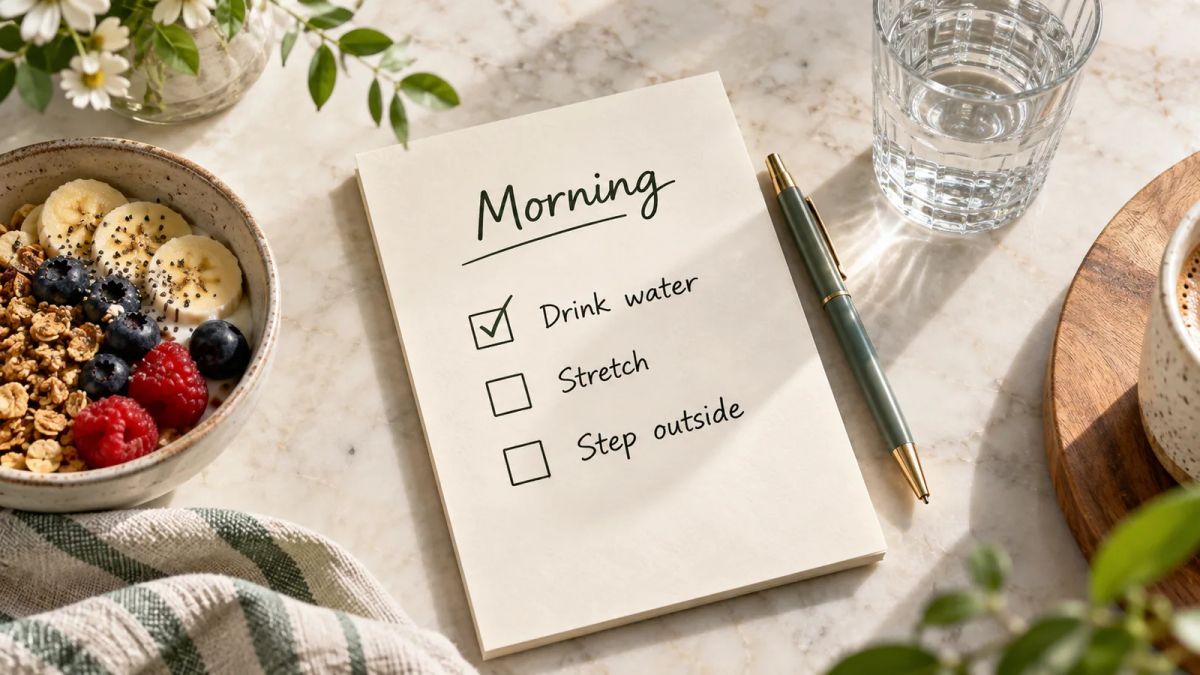
2. Pick one anchor action to begin. One, not six. Choose from what the first hour rewards: a glass of water, a minute of daylight, a short walk, a few slow breaths. Weight it towards a gap in your day. If you sit at a desk from nine, lean into movement and light while you have the chance.
3. Tie it to an existing cue. This is the part that makes it stick. James Clear calls it habit stacking, and the shape is plain: after I do a current habit, I will do the new one. "Stand at the window" evaporates. "When the kettle clicks off, I stand at the window" tends to happen, because the kettle turns up every morning and good intentions do not.
4. Decide the tiny version now. Choose the shrunken action for bad mornings while things are calm, so you are not making the call when you are already behind. One sip instead of a glass. One minute of light instead of ten.
Write your first one down as a single sentence. Here is a blank to fill in and a worked example.
My anchor: After I ________, I will ________.
The tiny version, for a hard morning: ________.
My anchor: After I brush my teeth, I will drink a full glass of water.
The tiny version, for a hard morning: two sips while the kettle boils.
Add to it slowly. A routine that grows one anchor at a time, each piece bedded in before the next, outlasts one you assemble all at once. Our guide to tiny habits goes deeper on starting small enough to succeed.
Example routines to adapt
Two worked examples, both built from a handful of anchors and pinned to daily moments, not clock times. Take one as it is or swap the parts around.
A five-minute routine, for a tight morning:
- Drink a glass of water while the kettle boils.
- Step outside or to an open window for one minute of daylight.
- Take five slow breaths before you look at your phone.
A twenty-minute routine, for a slower start:
- Glass of water on waking.
- Ten minutes outside, a short walk or coffee on the step, for daylight and movement at once.
- Five minutes of gentle stretching to loosen a stiff body.
- Two minutes with a notebook: one thing you are grateful for, one thing that matters today.
For a wider set of options to build from, the morning routine ideas piece is a menu you can pick from, and if you would rather work from a tick-box list, the morning routine checklist gives you one to copy. The movement piece has its own short sequence in the morning stretch routine.
Making it stick
Designing the routine is the easy half. Keeping it alive through ordinary, frazzled mornings is where most plans come apart, and a few facts about how habits form take the pressure off.
There is no magic number of days. Research on how habits are formed found that the time it takes for an action to feel automatic varies widely from one person to the next, with simple actions bedding in faster than elaborate ones. Treat the early weeks as practice rather than a test you can fail.
Keeping a light eye on how it is going helps. A meta-analysis of 138 studies found that monitoring your progress towards a goal makes you more likely to reach it, and the effect was stronger when people wrote it down somewhere. A tick on a calendar is plenty.
You will miss mornings. A broken night, a poorly child, a shift that swallowed the day. The same habit research found that missing a single day did not stop the habit forming, so there is no streak to mourn and nothing to rebuild from zero. Pick it up again at the next natural chance, usually the following morning, with no attempt to make up the gap. No double walk, no penance. The ordinary small action goes back in its usual spot, and that is enough. If low mood or exhaustion is wearing you down over weeks, not days, it is worth raising with your GP.
See the routine take root
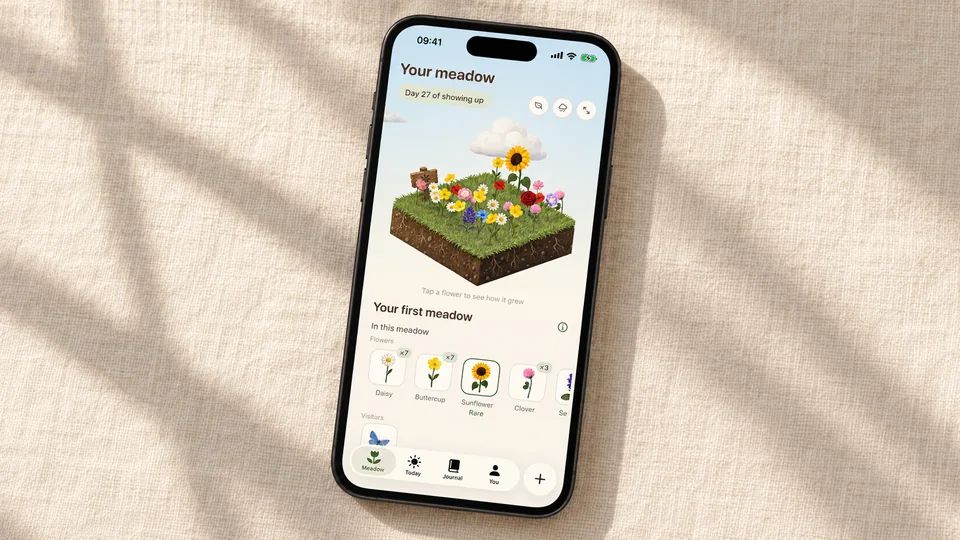
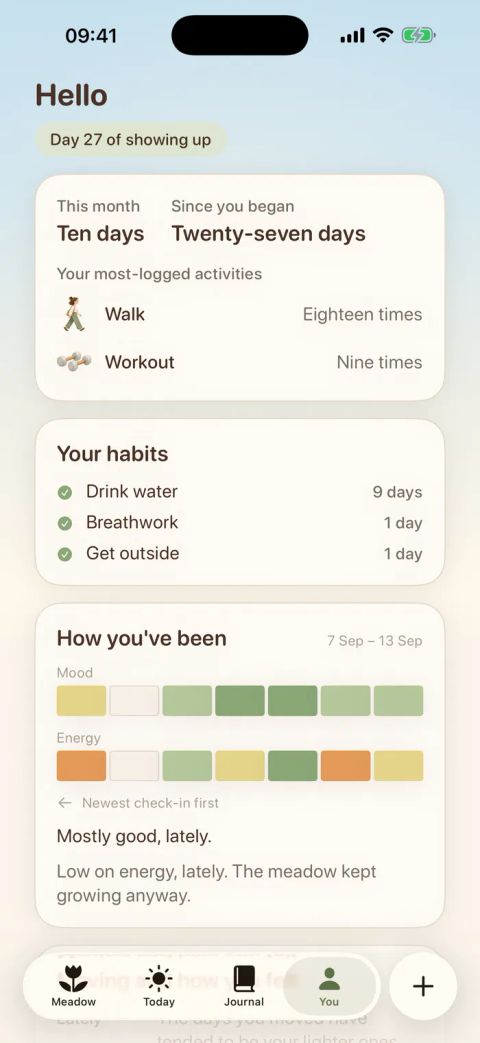
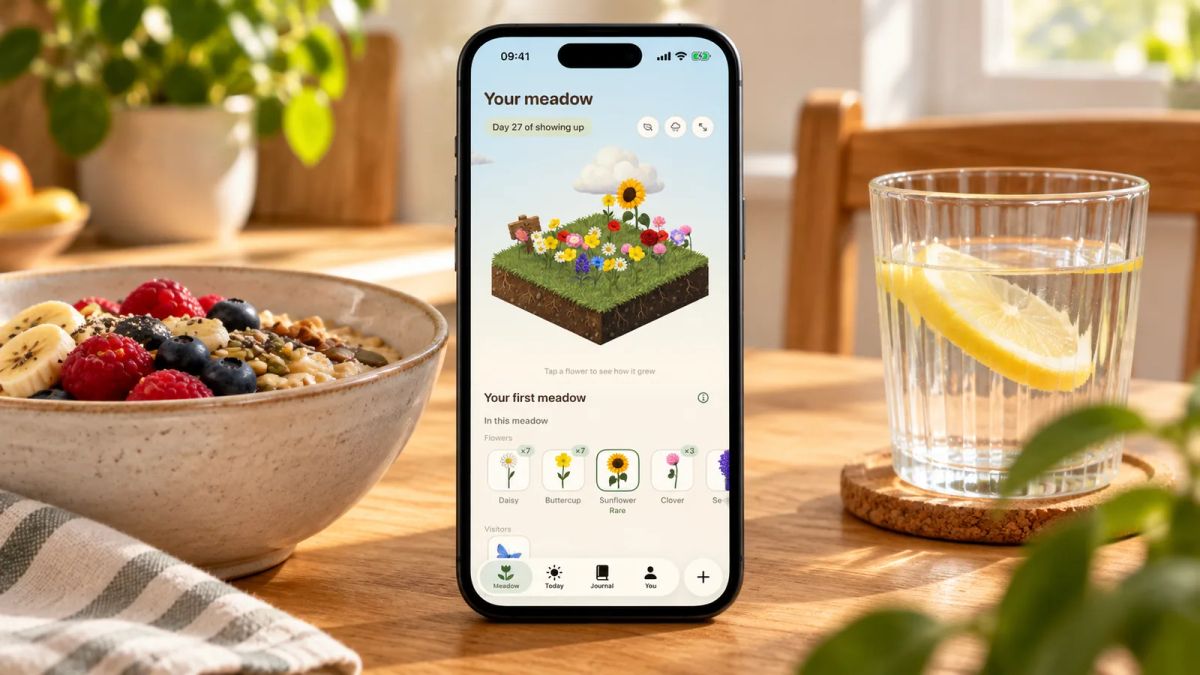
Some mornings run to plan and some fall apart, and Meadow is built for both. It is a gentle habit app for iPhone from Wildcard Wellness where you log the movement you enjoy and tick off small daily habits like drinking water or getting outside, note your mood and energy, and add a daily win and an affirmation. Each day you show up grows a wildflower in your own meadow, with rare flowers and little animal visitors turning up as it fills in. There are no streaks, so a missed morning resets nothing and your flowers never wilt.
Common questions
What is the best way to start a morning routine? Pick one small action, tie it to something you already do every morning, and decide its tiny version for bad days. One anchor, done most mornings, beats a long list you drop by Wednesday.
Do I have to wake up early? No. A consistent wake time does more for how you feel than an early one, and for shift workers even that is negotiable. Design around your real waking hour, whenever it lands.
How long should a morning routine take? As long as your actual mornings allow. Five minutes done daily beats forty minutes done twice a week.
What should I do first thing? Light and water are two easy, well-supported choices, and both take under a minute. Getting outside for daylight also helps you sleep better that night.
Why does everything say not to check your phone? Because the phone tends to swallow the quiet window where light, movement and a clear head fit. You do not have to ban it, only delay the first look until the useful part of the morning is done.
Tonight, before you sleep, write one sentence: after I do something you already do tomorrow morning, you will do one small new thing. That single line, decided in advance, is your morning routine, and you can grow it from there.
AUTHOR
Co-founder of Meadow.
Ash is co-founder of Meadow, a habit and movement tracking app that turns small acts of self-care into a growing wildflower meadow.
See how far you've come
Your habits, moods and little wins, all in one place
Meadow keeps track of the walks, the water and the good days, so you can look back and watch your effort add up.
Download Meadow