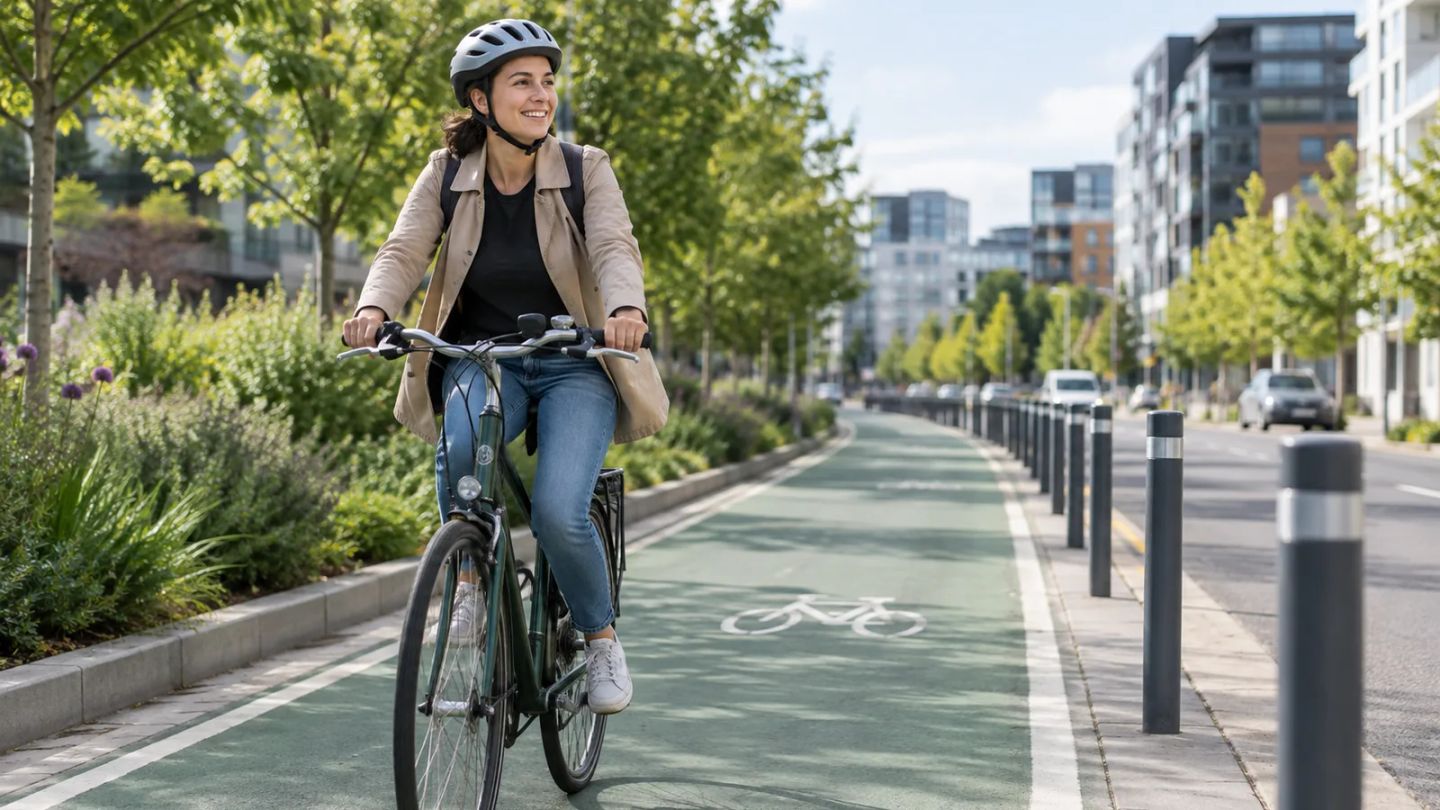
Cycling is one of the most joint-friendly ways to get real exercise, and riding regularly is linked to a stronger heart, steadier blood sugar and a lower risk of several serious illnesses. It asks far less of your knees than running, it can double as the way you get to work, and you can keep it up indoors when the weather turns.
This is the plain version. What riding does well, what it cannot do on its own, indoor versus outdoor, whether an e-bike counts, staying safe on the roads, and how to build the habit from a standing start.
What cycling does for your body
Start with the heart, because that is where the numbers are strongest. A UK Biobank study of 263,540 adults, published in the BMJ, followed people for a median of five years and compared how they got to work. Those who cycled to work had about a 41% lower risk of dying during the study, a 52% lower risk of dying from cardiovascular disease and a 45% lower risk of being diagnosed with cancer, set against people who drove or took public transport. This is observational work, so it cannot prove the cycling caused the difference. People who cycle to work may be healthier or better off to begin with, and the researchers adjusted for a lot of that, but not all of it can be stripped out.
Your legs do most of the work, and it shows. Cleveland Clinic describes each pedal stroke as loading the big muscles of the lower body, with the hamstrings and quadriceps each working at roughly 17% of their effort and the glutes at 15 to 17%, while your core holds you steady and your arms take some of the load. Push the pace or add a hill and those muscles work harder.
Here is the part that pulls people in. Cycling is gentle on the joints. Your body weight goes through the saddle and the pedals instead of pounding down through your knees and hips with every step, so it is one of the few forms of proper cardio that a sore knee will usually tolerate. Cleveland Clinic notes that the movement draws more fluid into the joint and increases blood supply, which helps lubricate it and can ease pain.
The joint evidence goes further than comfort. Harvard Health reported on an analysis of 217 trials of people with knee osteoarthritis, which found that lower-impact aerobic exercise, walking, cycling and swimming, came out best for easing pain and improving day-to-day function and quality of life. The researchers rated the strength of that evidence as moderate and called for longer studies, so treat it as a strong signal, not a settled fact.
Blood sugar and metabolism respond too. Australia's Better Health Channel notes that cycling raises your metabolic rate, builds muscle and burns fat, that steady riding uses around 300 calories an hour, and that people cycling for more than 30 minutes a day showed a 40% lower risk of developing diabetes in one study. As with the heart figures, these are associations across groups, not a promise about your particular week.
What cycling does for your mind
The mental side is well worth having, though the evidence for it is softer than the evidence for your heart. Both Cleveland Clinic and the Better Health Channel link regular cycling with lower anxiety and less depression, and a ride outdoors tends to take the edge off a stressful day and leave you calmer than you started.
Your brain may get something out of it too. A 2025 study in JAMA Network Open followed almost 480,000 UK Biobank adults for a median of 13 years. People who mainly cycled for everyday journeys had a 19% lower risk of dementia and a 22% lower risk of Alzheimer's disease than those who went by car, bus or train, and brain scans linked cycling with a slightly larger hippocampus, the area tied to memory. It's observational, and it relied on people reporting how they travelled. So it points to a link. It can't show the bike protected anyone's memory.
A bike ride won't fix a hard week, and it is no replacement for treatment when you are struggling. What it tends to be is a small, repeatable thing that helps a little. If low mood or anxiety hangs around, speak to your GP alongside anything you do for yourself.
What the evidence does and does not show
Cycling gets sold as a way to lose weight, and that is where the claims tend to run ahead of the science. Riding burns energy, but body weight turns on far more than that, including how you eat, how you sleep, your medication and health conditions you don't control. Movement is one piece of it. Ride because it makes your week feel steadier and your legs stronger, and let any change on the scales be a side effect, not the reason you keep going.
Be fair about the ceiling, too. A bike is easy on the joints, which is its great strength, but it isn't weight-bearing through the legs the way walking or lifting is, so it does less for bone density. That's one reason the official advice pairs any cardio with strengthening work, and our guide to strength training for beginners shows how to start at home. If you're a woman weighing up bones, hormones and riding, our piece on the benefits of cycling for women goes into those questions. None of that is a reason to skip a ride. It's a reason to keep your expectations honest, so a good habit doesn't start to feel like failure when it can't do a job it was never going to do alone.
Indoor or outdoor
Both count, and the best one is the one you'll keep doing. An indoor bike, whether that's a turbo trainer under your own bike or a spin bike, removes the two things that most often cancel a ride: bad weather and traffic. You can pedal for twenty minutes while a programme is on and never think about a pothole. The catch is that it can get dull, so a playlist, a show or an online class helps the time pass.
Riding outdoors gives you daylight, fresh air and a change of scene, and it turns exercise into transport when you ride to the shops or to work. The Better Health Channel points out that cyclists tend to breathe in two to three times less pollution than people sitting in cars in the same traffic. Against that, you have weather, road safety and the faff of getting the bike out. Many people do both.
Staying safe on the road
Confidence on the road is a skill, and it builds fastest on quiet ground. If you haven't cycled in years, start on a traffic-free path or a park loop and get used to braking, signalling and looking over your shoulder before you take on busy streets.
Traffic is the worry that stops most people, so it helps to see the trade-off in numbers. A Dutch analysis in Environmental Health Perspectives estimated that for people swapping the car for the bike on short trips, the life gained from extra activity (roughly 3 to 14 months) outweighed the life lost to extra air pollution and crashes by about nine to one. It was modelled on Dutch data, so it may not map neatly onto your roads. Treat it as a sense of scale, not a guarantee for your route.
A few basics carry most of the safety. Wear a helmet that fits, use a white front light and a red rear light in the dark or in poor weather (in the UK the Highway Code says your bike must have both lit at night, plus a red rear reflector), and make yourself easy to see with bright or reflective clothing. Keep the bike roadworthy: check the tyres are pumped up and the brakes bite before you set off. Ride a little away from the kerb so you're visible and have room to avoid drains and debris, and assume drivers haven't seen you until you know they have.
Here is a quick pre-ride check to run through until it becomes second nature.
Before you ride
☐ Tyres pumped up and no obvious cuts
☐ Both brakes working
☐ Front and rear lights on if it's dark or grey
☐ Helmet on and clipped
☐ Phone, keys, water
How much to aim for, and how to start
For the week as a whole, the CDC suggests adults get at least 150 minutes of moderate activity or 75 minutes of vigorous activity, plus muscle-strengthening work on two or more days. Cycling on the flat or with a few hills counts as moderate, and riding fast or up hills counts as vigorous, judged by the old talk test: moderate is when you can talk but not sing, vigorous is when you can't say more than a few words without a breath. Three half-hour rides a week cover most of the moderate target on their own.
The Better Health Channel puts a friendly floor on it and says two to four hours of cycling a week is enough for a general lift to your health. If you've been inactive for a while or you live with a health condition, have a word with your GP before you build up hard, because a general target can't account for your situation.
Most new riders go too far on day one, ache for three days and quietly stop. Build up instead, with a gentle four-week ramp you can bend around your own fitness.
- Week one: two or three easy rides of 10 to 15 minutes on flat, quiet ground. The aim is to get comfortable on the bike, not to get fit.
- Week two: keep the same number of rides and stretch one or two of them to 20 minutes. Add a gentle rise if it feels fine.
- Week three: push your longest ride to 30 minutes and try riding on two days back to back to see how your legs recover.
- Week four: aim for three rides of around 30 minutes, one of them a little brisker, so you're building toward the weekly guideline without a jump in soreness.
If a week goes sideways, repeat it instead of forcing the next one. Slower and still riding beats faster and stopped.
To make the ride happen at all, tie it to something already fixed in your day. James Clear calls this habit stacking: you attach a new action to an existing routine so the old habit becomes the cue. A short ride straight after the school drop-off, or the commute you were making anyway, asks less of your willpower than a ride you have to summon from nowhere. If you want more on making a movement habit stick, our guide to healthy habits goes deeper, and if cycling is one strand of a broader plan, so does our piece on building an active lifestyle.
See your rides add up
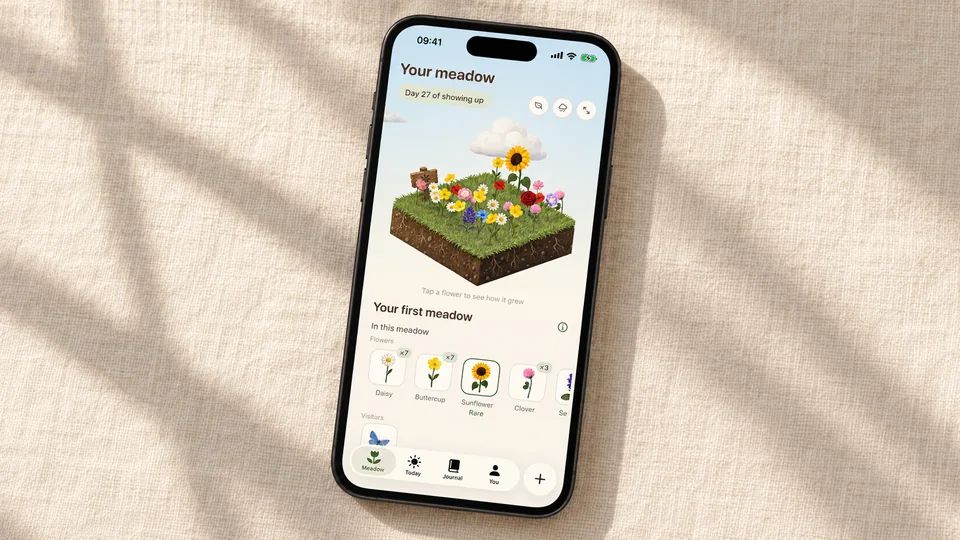
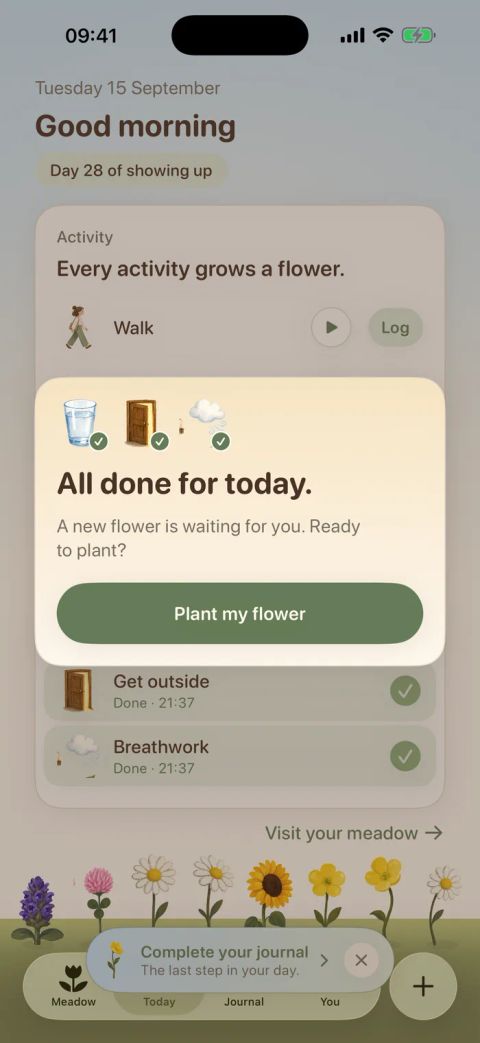
Watching the rides stack up can be the thing that keeps you in the saddle, and a simple record does most of that work. A record like that is what Meadow keeps for you. It's a movement and habit app for iPhone from Wildcard Wellness where you log a ride with a timer, tick off small daily habits, and note your mood and energy, and a new wildflower blooms for each day you move. It counts consistency, not a perfect run, so there are no streaks to protect and a rained-off day resets nothing you've built.
When you miss a few rides
A gap counts for far less than people fear. The weather closes in or the bike needs a new tube, and a week slips by. Take the next chance instead of trying to win back the lost miles in one heroic ride. A short spin round the block gets you going again, and getting going again is the whole game.
On a stretched day, shrink the ride instead of dropping it. Ten minutes on the indoor bike, or a slow loop to the end of the road and back, keeps the habit alive on the days that would otherwise break it.
Common questions
Is cycling enough exercise on its own?
For a lot of people, most of the time, regular riding does most of the heavy lifting for your heart and lungs. It can carry you to the weekly 150 minutes of moderate activity that health bodies suggest, and it supports mood and blood sugar along the way. The gap is muscle and bone strength, which cycling helps but doesn't fully cover, so the guidance adds strengthening on two days a week. A couple of short sessions of bodyweight moves, or carrying the shopping upstairs, sits neatly beside your rides.
Is cycling better than walking?
Neither wins in the abstract. They suit different bodies and different days. Cycling covers more ground for the same effort and is easy on the joints, while walking needs no kit, loads your bones a little more, and slots into almost any gap in the day. If you like both, our guide to the benefits of walking sets out what a daily walk does, and there's no reason to pick only one.
Is 30 minutes of cycling a day enough?
For general health, it's a good amount for most adults. Half an hour on five days gives you the 150 weekly minutes the CDC suggests, and the Better Health Channel's two to four hours a week sits in the same range. It won't cover your strength work, so add two short strengthening sessions. The CDC also says the minutes can be spread out in shorter bouts, so two 15-minute rides on a busy day still count.
Can cycling reduce belly fat?
It can help, though not in the targeted way the question hopes. Harvard Health notes that aerobic exercise and strength training can trim visceral fat, the deeper fat around your organs, even when the scales barely move, while spot exercises like sit-ups tighten muscle without touching that fat. Cycling sits in the aerobic group. You can't choose where fat comes off first, and food, sleep and stress all play a part, so treat a smaller waist as a possible side effect of regular riding. If weight is your main reason for getting on the bike, our comparison of walking or biking for weight loss goes through the trade-offs.
Does an e-bike still count as exercise?
Yes, and possibly more than you'd expect. A survey of over 10,000 people in seven European cities, part of the PASTA project, found that e-bike riders logged similar weekly physical activity to people on ordinary bikes. The motor does some of the work on each trip, but the e-bikers rode further, around 9.4 km a trip against 4.8 km. People who swapped a car or public transport for an e-bike gained the most. The figures are self-reported, so read them as a rough guide.
Is an exercise bike as good as a real bike?
For your heart, lungs and legs, a stationary bike gives you much the same workout, and it's a solid choice if you're wary of traffic or of falling. What it doesn't give you is the balance and bike-handling of the road, or the daylight and transport that come with riding outside. Plenty of people use the indoor bike for guaranteed minutes and save the outdoor ride for when they have the time.
How long before I see any benefit?
Some things shift within a few weeks. Easy rides start to feel easier, and many people sleep better and feel less stressed early on. The bigger returns, the ones tied to your heart and your long-term risk, build over months and years of showing up, which is why an easy pace you can keep beats a hard one you abandon.
One thing to do today
Pump up the tyres and take a 10-minute ride around your neighbourhood on quiet roads, no target. That is a cycling habit starting, with none of the pressure a big goal would bring.
AUTHOR
Co-founder of Meadow.
Ash is co-founder of Meadow, a habit and movement tracking app that turns small acts of self-care into a growing wildflower meadow.
Every little bit counts
Five minutes counts. So does a dance in the kitchen.
Log the movement you enjoy and the small habits that help you feel good, and watch them bloom into something you can see.
Download Meadow