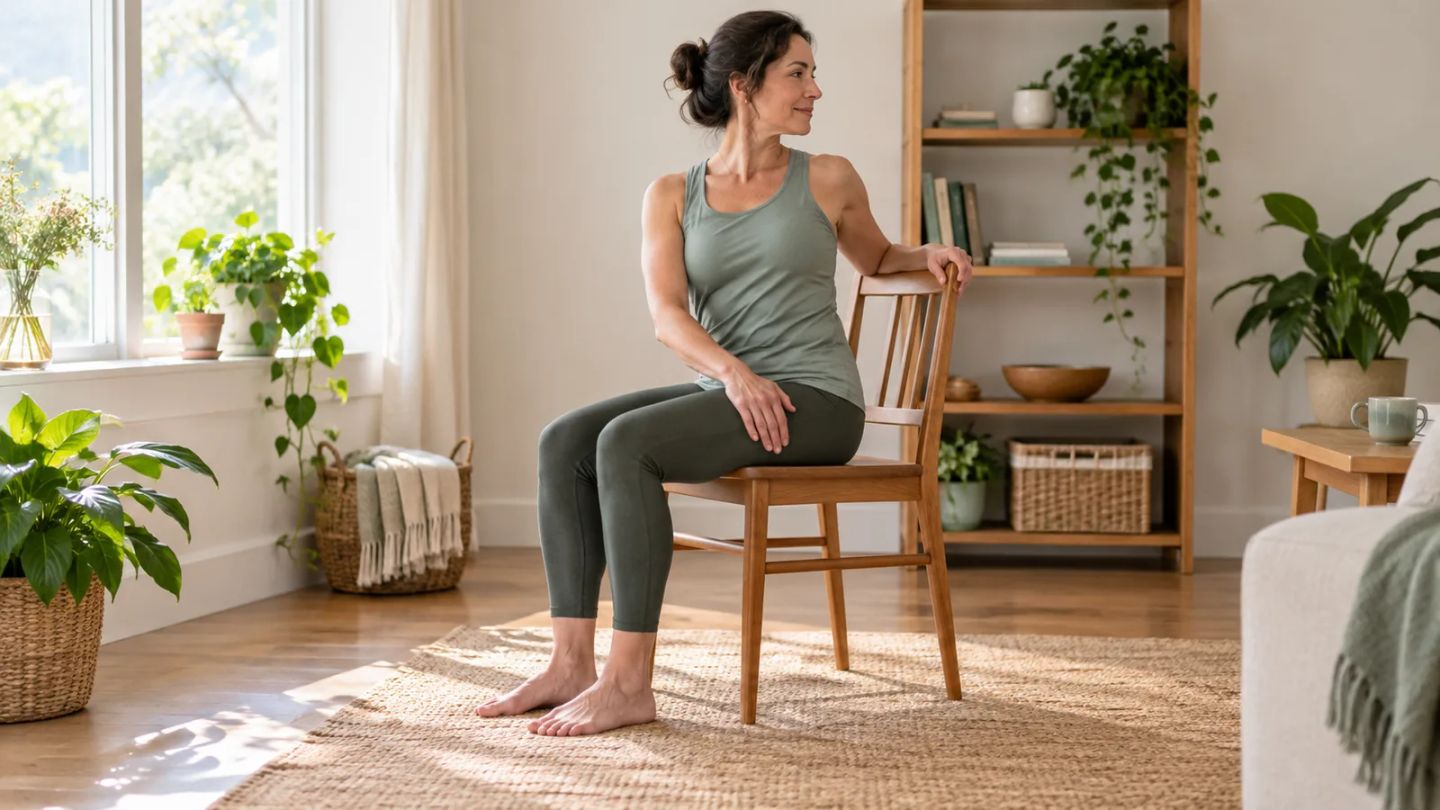
Chair yoga is yoga done sitting down, or standing with a hand on a chair for support, so you get the stretching, breathing and slow strength work without lowering yourself to a mat and pushing back up. If your balance has changed, if a full standing class feels like too much, or if you are easing back into movement after a break, a chair gives you a real practice with a much smaller barrier to getting started.
It suits a wide range of people, and older adults in particular, which is why so many classes carry the label "chair yoga for seniors". That label stretches across quite different sessions, so a little care up front saves you booking the wrong thing.
This guide covers what chair yoga is, what the research does and does not promise, how to set up safely, a handful of moves you can try today, and two free ways to start this week.
What chair yoga is
The term gets used two ways. Harvard Health explains that chair yoga can mean a practice done entirely seated, or a standing practice where the chair is there for balance and support. Both are common, and a class advertised as "chair yoga" might be either.
That distinction matters when you book. If you want to stay seated the whole time, read the class description or ask the teacher first, because a class billed as "gentle" can still include standing poses. It is a small question to ask, and the answer tells you straight away whether the session fits what your body wants to do that day.
What stays the same in both versions is the shape of the practice. You move slowly, you pair movement with breath, and you work within your own range rather than forcing anything. Nobody is watching to see how far you can fold.
What it can and cannot do for you
Chair yoga has been studied in older adults, and the honest summary is that it may help with some things and has not been shown to fix others. The ranking pages tend to list benefits with confidence. The evidence is more measured than that.
The first randomised trial on the subject, run at Florida Atlantic University and reported in 2017, put 131 older adults with lower-limb osteoarthritis, none of whom could manage standing exercise, into either a chair-yoga programme or a health-education group. Sessions ran 45 minutes, twice a week, for eight weeks. The chair-yoga group reported less pain and less pain interference, meaning pain got in the way of daily life a little less, and that reduction in interference held for about three months after the programme ended. Gait speed and fatigue improved during the sessions but not lasting afterwards, and balance did not improve. It was a small, early study in a specific group, so it points a direction rather than settling the question.
A larger 2024 trial gives a more sober counterweight. Researchers followed 454 adults with an average age of 73, each living with a median of three long-term conditions, through a twelve-week chair-based yoga programme added on top of usual care. Over the following year there was no significant improvement in overall quality of life and no reduction in falls, though some pain measures did improve and no serious related side effects were reported.
Put the two together and you get good reasons to try chair yoga and no grounds to expect a guaranteed result. The wider evidence on yoga points the same way. The US National Center for Complementary and Integrative Health summarises modest benefits for low-back and neck pain, some improvement in balance for older adults who live independently, and reasonable support for stress, sleep and general wellbeing.
So the fair pitch is this. You might take up chair yoga because the movement feels good, because a teacher explains things in a way that lands for you, or because sitting down to stretch and breathe is a calmer start than you have had in a while. Those are reasons enough, without any promise about your knees.
Setting up safely
A stable base does most of the safety work. Both Harvard Health and the NHS recommend a solid chair that will not tip, roll or wobble, and one without arms so your movement is not boxed in. The NHS sitting-exercises page adds that the seat should be low enough for your feet to rest flat on the floor with your knees at roughly a right angle. Wear loose clothing and keep some water within reach.
One caution is worth taking seriously. NCCIH notes that the rate of yoga-related injuries treated in emergency departments is higher in people aged 65 and over than in younger adults, and it advises anyone with a health condition to talk their needs over with a GP and with the teacher before starting. A recorded video cannot adjust a pose for your hip, your back or your blood pressure, so if anything about your health gives you pause, a real conversation with an instructor is the sensible first move. Stop any movement that brings sharp pain, and never force a deeper stretch.
Moves you can try today
You can get a feel for chair yoga in ten minutes with the moves below. Sit toward the front of the chair unless a move says otherwise, keep your feet flat and hip-width, and let your breath stay slow throughout. Do each one only as far as feels comfortable.
- Centre and breathe. Sit tall, hands resting on your thighs, and lengthen up through the crown of your head as your shoulders drop. Breathe in slowly through the nose, then out through the nose, for four or five rounds. This settles you and sets the pace for everything after it.
- Neck and shoulder release. Turn your head slowly toward one shoulder, back to centre, then toward the other, three times each way. Then roll your shoulders up toward your ears and back down, a few slow circles in each direction.
- Seated cat-cow. With your hands on your thighs, breathe in and arch gently, lifting your chest and rolling your shoulders back as you look slightly up. Breathe out and round the other way, tucking your chin and drawing your navel back so your upper back curves. Move with your breath for six to eight slow rounds. It is one of the best moves for a stiff spine.
- Seated twist. Sitting tall, place your left hand on your right knee and your right hand on the seat or back of the chair behind you. Breathe in to grow taller, breathe out to turn gently toward the right and look over your shoulder, keeping your hips facing forward. Hold for three or four breaths, return to centre, then repeat on the other side.
- Ankle and wrist circles. Lift one foot a little off the floor and circle the ankle slowly, several times each way, then swap feet. Follow with the wrists, circling both together in each direction. Small joints stiffen easily, and this wakes them up.
- Seated forward fold. Hands on your thighs, breathe in and lengthen your spine, then breathe out and hinge forward from the hips, sliding your hands down your shins toward the floor and letting your head hang heavy. Rest for a breath or two, then roll up slowly. Keep it shallow, or skip it, if you have back trouble or your blood pressure tends to drop when you stand.
- Seated chest opener. Move toward the front edge of the seat and hold the sides of the chair, or interlace your hands behind your back if that is comfortable. Draw your shoulder blades together, lift your chest, and breathe into the front of your body for a few breaths. It is a good undoing of a day spent hunched over a phone or a book.
Finish the way you began, with a few slow breaths and hands resting on your thighs. If you want a fuller sequence built for beginners, our yoga for beginners guide walks through the basics, and the morning stretch routine covers gentle mobility you can do standing or seated.
Two free ways to start this week
You do not need a studio or a subscription to begin. Two reliable, no-cost options let you find out whether chair yoga suits you.
The US Department of Veterans Affairs has a free nine-minute chair-yoga video led by Mandie Johnson, one of its yoga instructors. Nine minutes is short enough to fit into a morning without rearranging your day, and short enough to repeat, which matters more than length when you are building something new.
If you would rather read than follow a screen, the NHS sitting-exercises page gives free written instructions for gentle seated movement, including neck turns, upper-body twists, ankle stretches and marching. It sits outside the yoga label, yet it covers the same ground of easing stiff joints within your range, and the chair-setup advice applies to any seated practice you try.
When you look for a class beyond these, weigh the description more than the headline. A clear account of what a session involves, who teaches it and how to join tells you far more than the word "best" in a title. Local leisure centres, libraries and community groups often run seated classes, and many are aimed squarely at beginners.
The part that decides whether it sticks
Finding a good ten minutes of chair yoga is the easy bit. Doing it often enough to feel a difference is where most plans quietly come apart, and that has little to do with willpower.
Anchor the practice to something you already do. "After I make my morning tea, I sit down for the nine-minute video" gives the habit a home in your day, which works better than a loose plan to fit it in somewhere. Pick a cue that happens anyway, most days, without you having to think about it.
Decide your smaller version now, before you need it. On a stiff or busy morning, two minutes of seated cat-cow and a few slow breaths still counts. A short practice keeps the thread going, and keeping the thread going is what builds a habit. If you miss a day, you have undone nothing. Choose the next morning and pick it back up.
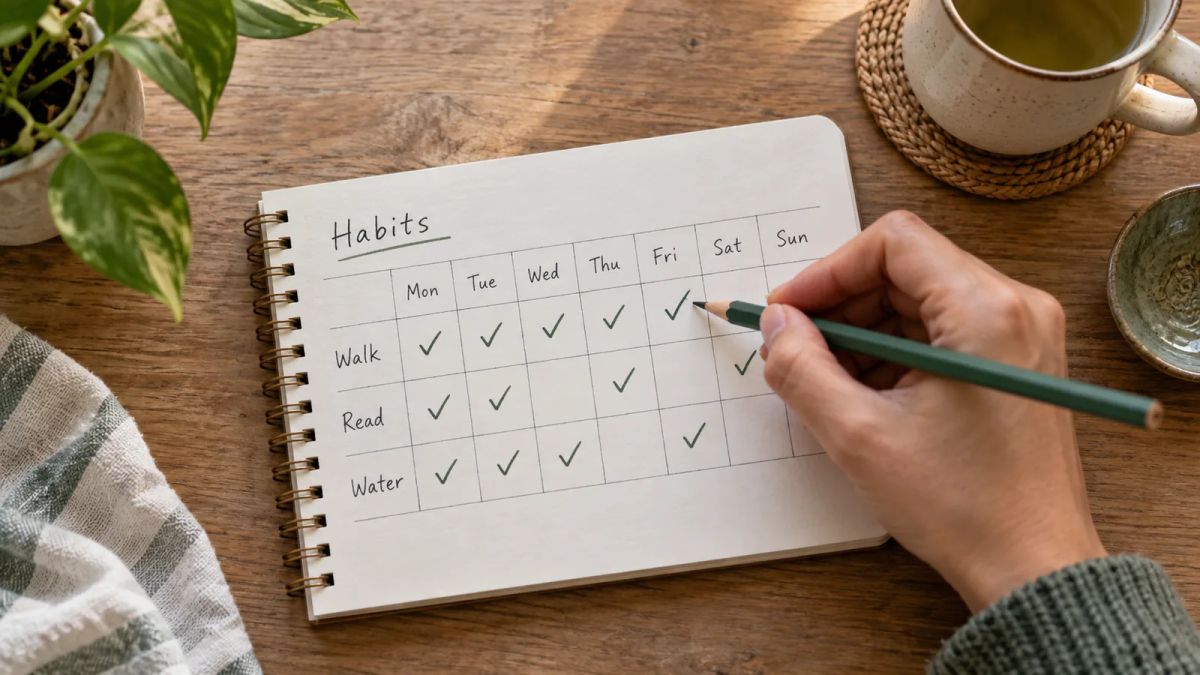
A small record helps you notice the practice becoming part of your week. Keep one on paper if you like. Write down the move and its cue, then tick the days you show up.
Move: Chair yoga Cue: after my morning tea
Mon ☐ Tue ☐ Wed ☐ Thu ☐ Fri ☐ Sat ☐ Sun ☐
A filled week might look like this, with a couple of gaps and no drama about them.
Move: Chair yoga (9-min video) Cue: after my morning tea
Mon ☑ Tue ☑ Wed ☐ Thu ☑ Fri ☐ Sat ☑ Sun ☑
If a paper grid is not your thing, our habit tracker guide covers other ways to keep score without turning it into a chore.
Meadow, without the streak

Another app worth checking out is Meadow, because it treats a missed day gently, which is exactly what a new movement habit needs. It is a habit tracker for iPhone made by Wildcard Wellness, with yoga as one of its built-in activities, so you can tick it off after your chosen cue alongside notes on your mood, a daily win and an affirmation. Every day you show up grows a wildflower, and rare flowers and small animal visitors turn up over time. There are no streaks to break, so if you skip a day nothing resets and your flowers never wilt. It costs $39.99 a year or $9.99 a month after a seven-day free trial.
Open the nine-minute video, check it plays on your device, and decide which everyday moment tomorrow it will follow.
See how far you've come
Your habits, moods and little wins, all in one place
Meadow keeps track of the walks, the water and the good days, so you can look back and watch your effort add up.
Join the Meadow waitlist