Motivation is a feeling, and feelings come and go, which is why hanging your exercise on it tends to fall apart. The way to start moving and keep moving is to lean less on how you feel and more on a small system: an activity you like, a cue that reminds you, a version tiny enough for a bad day, and some way to watch the progress add up.
That is the honest answer to how you get motivated to exercise. You stop waiting to feel motivated, and you build a setup that carries you on the days the feeling never shows.
Most advice tells you to want it more. This guide takes the opposite view, because the people who stay active for years are rarely the most motivated. They are the ones who made moving easy, tied it to something they enjoy, and stopped treating one missed week as the end.
Why motivation lets you down
Behaviour scientist BJ Fogg sums up why we do anything with a short equation he calls B=MAP: a Behaviour happens when Motivation, Ability and a Prompt arrive at the same moment. Miss any one of the three and the behaviour does not happen, however hard you are trying.
Motivation is the part you cannot count on. It runs high when you are fresh, rested and a bit inspired, and it drains away by a wet Tuesday evening when you are tired and the sofa is warm. If your whole plan rests on that dial, your plan works on your good days and collapses on the rest, and the rest are most days.
So the trick is to stop relying on the dial you cannot control and turn up the two you can. Make the action easier, and give yourself a reliable prompt. That is the difference between willpower, which you burn through, and a system, which keeps working when the willpower is gone.
The kind of motivation that lasts
There are two broad reasons people exercise. One comes from outside: to lose weight, to look a certain way, to hit a number someone else set. The other comes from inside: because moving feels good, clears your head, or you like being the sort of person who walks every morning. Psychologists call these extrinsic and intrinsic motivation.
A large review of self-determination theory and exercise, covering 66 studies, found that more self-directed, intrinsic reasons were tied to sticking with activity over the long run, while outcome-focused motives were weaker predictors of lasting adherence. In plain terms, chasing a number can get you started, but enjoying the thing keeps you coming back.
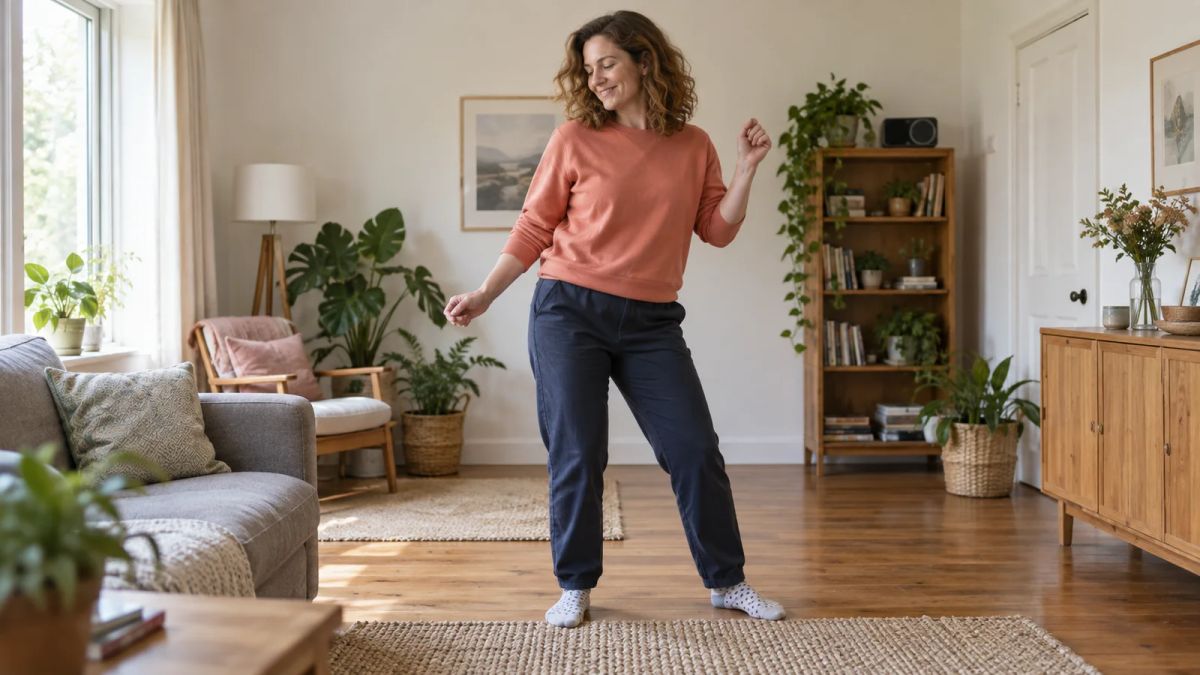
This is why the most useful question to ask yourself is which activity you would show up for week after week, rather than which one burns the most calories. A swim you look forward to beats a run you dread. A dance class you laugh through beats a gym session you endure. The best exercise is the one you will still be doing in six months, and enjoyment is what buys you those six months.
None of this means the outside reasons are wrong. Wanting to feel stronger or move more easily is a fine place to begin. Over time, let the doing become its own reward, so the activity earns its place in your week on its own merits, not on a distant goal.
Make it so easy you can barely say no
Remember the ability dial. The lower the effort to start, the more likely you go, so shrink the starting version until it is almost too small to skip.
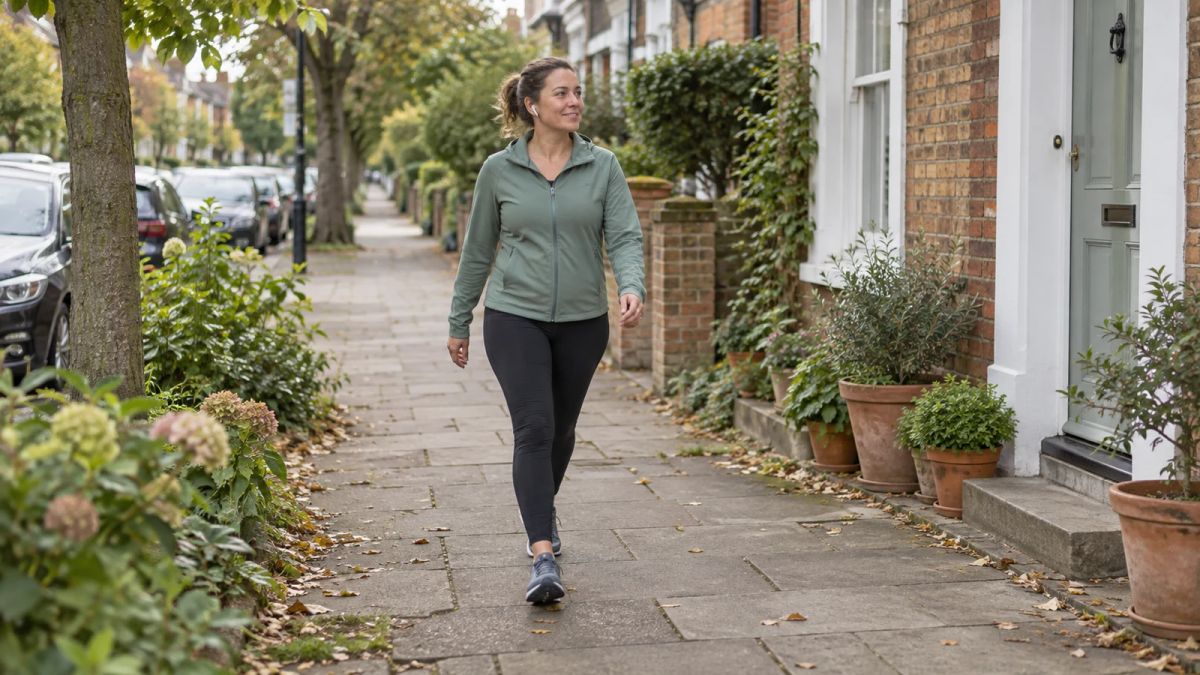
Not an hour at the gym but ten minutes round the block. Not a full workout but putting your trainers on and stepping outside. Once you are out of the door, more often follows on its own, and on the days it does not, you have still moved and still kept the habit alive.
The American Heart Association gives a simple way to build the prompt: attach the new action to a routine you already have. After the morning coffee, a short walk. After you close the laptop, ten minutes of stretching. The existing routine becomes the reminder, so you are not depending on a spare bit of motivation to nudge you.
Keep the official target small even when you could do more. The day you decide success means the full hour, you have rebuilt the wall you knocked down, and the first hard day sends you back to nothing. Treat anything above the tiny version as a bonus, not the bar. If you want a fuller method for this, our guide to tiny habits walks through it step by step.
Make it enjoyable, then bundle the temptation
There is a neat behavioural trick called temptation bundling: pair the thing you should do with a thing you love, so the pull of one carries the other. Only let yourself watch the next episode while you are on the exercise bike. Save the gripping podcast for your walk.
Researchers tested exactly this by giving people access to tempting audiobooks only at the gym. Those with gym-only access visited the gym far more often at first, though the effect faded over the weeks, especially around a holiday. So it is a strong way in, and a temporary one. It works best alongside an activity you would half-choose anyway.
There is also a reward built into movement itself, if you give it a chance to land. Harvard Health notes that hard activity releases endorphins, the chemicals behind the feelings of relaxation and optimism that follow a good session, and describes rhythmic activity like walking as a kind of moving meditation that quiets a busy mind. Notice that lift afterwards, the way you feel once the session is done, and the enjoyment starts to pull its weight.
Become someone who moves
James Clear, who wrote Atomic Habits, argues that the habits that stick are the ones tied to who you believe you are, not the results you are chasing. His line is that every action is a small vote for the type of person you want to become.
The shift is quiet but it changes a lot. Instead of "I'm trying to get fit", you tell yourself "I'm someone who moves every day", and then a ten-minute walk is not a chore to grind out but proof of who you already are. Each time you show up, you cast another vote, and the votes build a self-image that keeps voting for itself.
This is why skipping the number can help. You do not need to run a marathon to be a runner. You need to lace up often enough that "I'm active" starts to feel true, and once it feels true, the behaviour follows the belief. Our piece on building an active lifestyle has more on weaving movement through an ordinary day, the small kind you barely notice.
Seeing progress keeps you going
A quiet driver of motivation is watching the effort stack up. When you can see the days you moved, each one becomes a small reason to keep the run going, and the record itself does some of the pulling for you.
This is not wishful thinking. A meta-analysis of 138 studies found that prompting people to monitor their progress towards a goal improved how often they reached it. A tick, a mark, a filled square does real work here, because it turns an invisible effort into something you can look at.
The catch is the wrong kind of tracking, the sort that punishes a gap. A long streak counter feels great until you miss once, and then a broken number can wipe out weeks of goodwill in a single evening. The record should show what you have built, not shame you for one blank day.
Let the progress pull you back

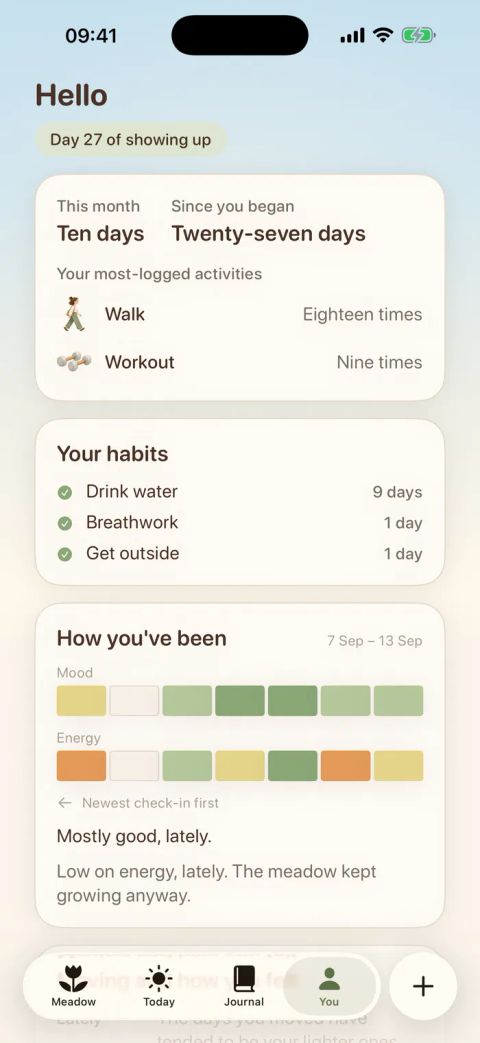
Motivation tends to follow visible progress, and Meadow turns each day you move into something you can watch grow. It is a gentle movement and habit app for iPhone. You log movement you enjoy with a timer, tick off small daily habits, and note your mood, energy and a daily win, and every day you show up grows a wildflower, with rare flowers and small animal visitors turning up over time. There are no streaks, so slipping for a day resets nothing and your flowers never wilt, which suits the way motivation tends to ebb and flow.
What to do when you miss a week
You will miss. A cold, a deadline, a flat fortnight where nothing happens. The people who stay active are not the ones who never stop, but the ones who restart and refuse to make it a crisis.
Real-world habit research is reassuring here. When people were building a new daily habit, a single missed day made little difference to how automatic the behaviour eventually became. One gap does not undo the weeks behind it. The damage comes from the story afterwards, the "I've ruined it now" that turns one skipped session into a month on the sofa.
Two things make restarting easier. First, decide in advance what your bad-day version looks like, the one you can do with a headache and a full inbox. Maybe it is a walk to the end of the road, or five minutes of stretching. Second, do it at the very next chance. Don't wait for Monday, because there is nothing special about Monday except how long it makes you wait.
A simple plan you can fill in today
Open our free Exercise Motivation Planner (PDF). Save or print this one-page worksheet with space for your activity, cue, smallest version and bundle, plus a weekly tracker. No sign-up needed.
Motivation gets easier when the decisions are already made. Fill in these four lines once and you have a plan that survives a low-energy day.
My activity: ________ (something I would half-look-forward to)
My cue: after I ________ (an everyday moment I already have)
My smallest version: ________ (doable on my worst day)
My bundle: only while I ________ (a small treat I save for moving)
Here is one filled in, so you can see the shape of it:
My activity: a walk with a podcast
My cue: after I drop the kids at school
My smallest version: to the end of the road and back
My bundle: I only listen to my crime podcast while walking
Keep it somewhere you will see it, and mark the days you move. If you want a wider set of small starting points to build around, our list of healthy habits is full of actions that fit this template.
Before you begin any new activity, it is worth a word with your GP if you have a health condition, an injury, or have been inactive for a long time. General guidance for adults aged 19 to 64 is around 150 minutes of moderate activity a week, spread across the week, plus strengthening on two days, though any movement counts and building up slowly is the point.
Common questions
How do I get motivated to exercise when I have no energy? Do the smallest version and nothing more. Put your shoes on and walk to the end of the road. Low energy is precisely when the tiny version earns its keep, because it asks almost nothing of you and still keeps the thread going.
Why do I lose motivation after a couple of weeks? The early buzz of a new plan is extrinsic and it fades, so if nothing takes its place the whole thing sags. Give the enjoyable side time to grow, pick activities you like, the ones you'd choose anyway, and lean on your cue and your record to carry the weeks when the novelty has worn off.
Is it better to work out in the morning? The best time is the one you will keep. Morning suits people whose day fills up and derails good intentions by evening. If evenings are calmer for you, use those. Consistency beats the clock.
How long until exercise feels automatic? There is no honest fixed number, and anyone quoting a tidy figure is guessing. Simple actions settle in faster than demanding ones, so judge yourself by whether you are still showing up, not by whether it has clicked yet.
What if I can only manage five minutes? Five minutes counts. It keeps the identity alive, it often turns into more once you have started, and it is far better than the nothing you get from waiting for a free hour that never comes.
Right now, fill in the four-line plan above with a real activity, a real cue and a version small enough for your worst day. Then do the smallest version once, today, before the motivation has a chance to fade.
AUTHOR
Co-founder of Meadow.
Ash is co-founder of Meadow, a habit and movement tracking app that turns small acts of self-care into a growing wildflower meadow.
See how far you've come
Your habits, moods and little wins, all in one place
Meadow keeps track of the walks, the water and the good days, so you can look back and watch your effort add up.
Download Meadow