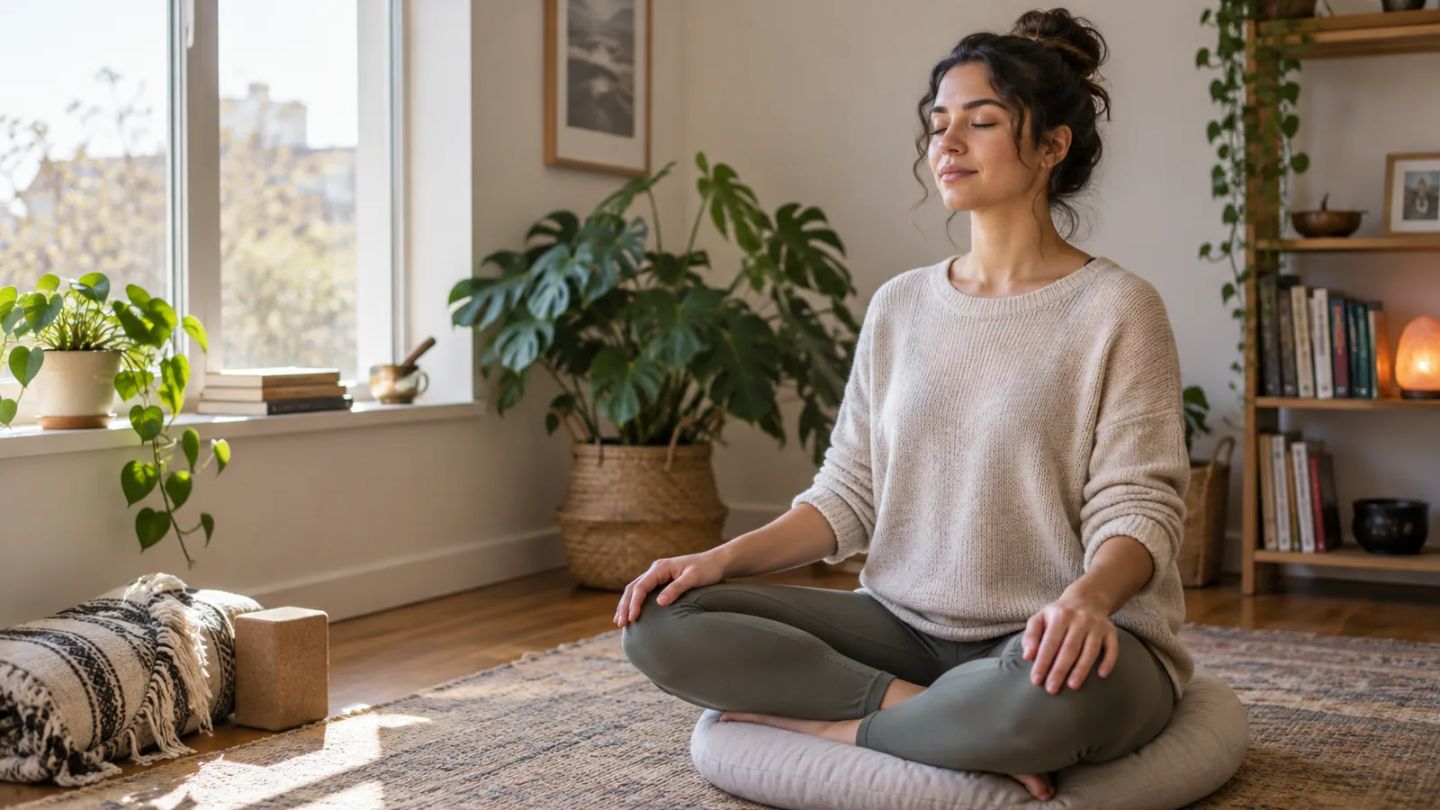
Mindfulness is paying attention to what's happening right now, on purpose, without picking it apart or telling yourself off for it. To start as a beginner, you don't need a cushion, an app or a spare half hour. You need one minute and a bit of willingness to notice what you'd normally skip past.
Try the smallest version now. Sit or stand where you are, take one slow breath, and notice three things: the air going in and out, the feeling of your feet on the floor, and one sound in the room. That's a minute of mindfulness. You've already done the thing.
The NHS describes mindfulness as "paying attention to what is going on inside and outside ourselves, moment by moment", which is a better working definition than most of the mystique the word carries.
This guide covers what mindfulness is in plain terms, three beginner practices you can do today, what the evidence does and doesn't back up, an honest note on when it isn't the right fit, and how to build it into a small daily habit that survives a busy week.
What mindfulness is, in plain terms
Your attention spends most of the day somewhere other than now. You're eating lunch while scrolling, walking to the station while rehearsing an argument, or lying in bed while tomorrow plays on a loop. Mindfulness is the practice of bringing your attention back to what's in front of you, and doing it again when it drifts off, which it will.
The second half of the definition does a lot of work: without judgment. You're not trying to have pleasant thoughts or a blank head. You're noticing whatever's there, including the boredom and the itch and the shopping list, and letting it be there without grading it.
The NHS puts the benefit plainly. Becoming aware of the present moment can help you "stand back from our thoughts and start to see their patterns", and to notice that thoughts are "mental events that do not have to control us". A worry turns up. You clock it as a worry passing through, not an instruction you have to obey.
That's the whole idea. Everything below is a way to practise it.
A one-minute breathing practice
Breath-focused attention is the most portable place to start, because your breath is always with you and needs no setup.
- Sit comfortably, on a chair or the edge of the sofa, back reasonably upright and hands in your lap.
- Set a timer for one minute so you're not tempted to keep checking.
- Let your eyes close, or lower your gaze to the floor a couple of feet ahead.
- Find your breath and let it move at its own pace. Don't deepen it or slow it on purpose. Follow it.
- Rest your attention on one spot where you feel it most, the cool air at your nostrils or the rise and fall of your chest.
- When your mind wanders off, and it will within seconds, notice where it went and walk your attention back to the breath. That return is the practice, not a sign you've failed.
When the timer goes, take one slower breath and carry on with your day. Do it again tomorrow. A minute you repeat beats ten minutes you do once and abandon.
If you want to build the breathing side further, our guide to breathwork walks through slower, structured patterns once the one-minute version feels familiar.
The body scan
A body scan swaps the breath for physical sensation as your anchor. You move your attention slowly through the body, noticing what's there, which tends to settle a racing head because it gives it a concrete job.
- Lie down or sit somewhere you won't be disturbed. If you're lying, a pillow under the knees helps.
- Start with a few breaths, noticing the weight of your body where it meets the bed, chair or floor.
- Bring your attention to your feet. Notice whatever's there, warmth, tingling, pressure, or nothing much. You're not trying to relax them or change them, only to feel them.
- Move up slowly, a region at a time: lower legs, knees, hips, belly, back, hands, arms, shoulders, neck, face.
- When you notice you've drifted into thinking, which happens to everyone, gently bring your attention back to the last part of the body you remember.
- Finish by feeling the whole body at once for a breath or two, then open your eyes.
Mindful.org, which teaches this practice, is blunt about the wandering. When you notice you've drifted, "gently and kindly direct your attention back". A full body scan can run 30 minutes, but a five-minute version, feet to head, is plenty when you're learning.
Everyday mindfulness, with no extra time
You don't have to carve out a session at all. The most sustainable mindfulness for a lot of beginners is folding attention into things you already do.
Pick one routine action and give it your full attention for its whole duration. The NHS suggests noticing "the sensations of things, like the food we eat or the air moving past the body as we walk".
- Brushing your teeth. Feel the bristles, the taste, the weight of the brush, for the full two minutes, instead of planning your morning.
- The first cup of tea or coffee. The heat of the mug, the smell, the first taste, before you pick up your phone.
- Washing up. The temperature of the water, the sound, your hands moving.
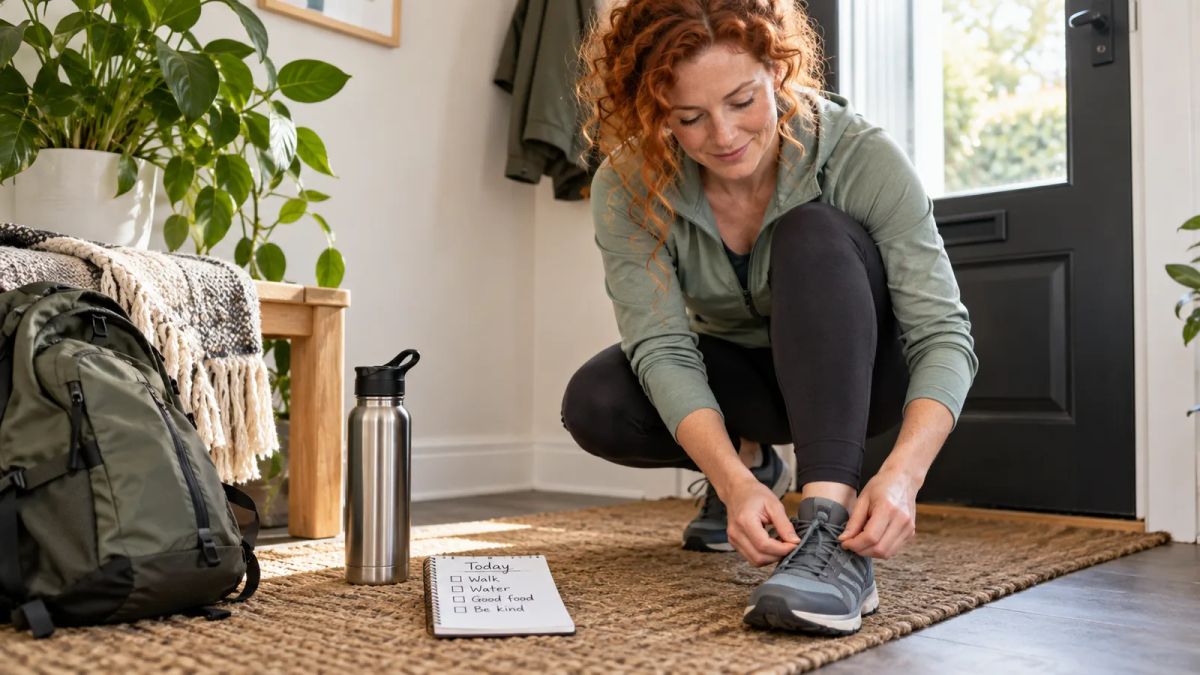
- A short walk. Your feet meeting the ground, the air on your face, what you can hear, one street at a time.
The rule is the same as the sitting practices. Your mind will wander, you notice, you come back. You're teaching your attention to stay put, and everyday actions give you dozens of free reps a day.
What the evidence shows, and what it doesn't
Mindfulness has real research behind it and it's also badly oversold, so it helps to hold both at once.
The best-known review pooled 47 well-designed trials with about 3,515 people and found mindfulness meditation produced small to moderate improvements in anxiety, depression and pain. The authors described the size of the effect as "comparable with what would be expected from the use of an antidepressant in a primary care population but without the associated toxicities". Worth having. The programmes behind those numbers weren't a one-minute habit, though. They "typically provided 20 to 27.5 hours of training during 8 weeks", so this is what sustained practice can do.
The wider view from the US National Center for Complementary and Integrative Health is more mixed. Mindfulness-based approaches worked "as well as the evidence-based therapies" for anxiety and depression, showed a benefit for blood pressure in people with health conditions, and improved sleep quality more than education-based treatments. They were "no different than" cognitive behavioural therapy or exercise, and the NCCIH is frank that "most of the studies included in the review were of poor quality and had a high risk of bias". Small to moderate, on wobbly evidence, is the honest summary.
There's a safety note that rarely makes the app adverts. The same NCCIH review found "about 8 percent of participants had a negative effect from practicing meditation", most often more anxiety or low mood. Mindfulness isn't a treatment for a mental health condition, and it isn't a cure for stress. It's a low-cost habit that takes a bit of the edge off for most people. If sitting with your thoughts leaves you more agitated than settled, it's fine to stop, shorten it, or leave it for another time. And if low mood, anxiety or worry hangs around for weeks or gets in the way of ordinary life, talk to your GP. That's a sensible next step, not a sign the practice let you down.
Building it into a small daily habit
The length of your practice counts for far less than whether you come back tomorrow, so set the bar low enough that you'll clear it on a bad day.
The reliable trick is to pin the new habit to one you already have. The American Heart Association's advice on making habits stick is to attach the new action to an existing routine so the old habit becomes the reminder. James Clear calls the same move habit stacking, with the formula "After [current habit], I will [new habit]". Your existing routines are already wired in, so the new one borrows their reliability.
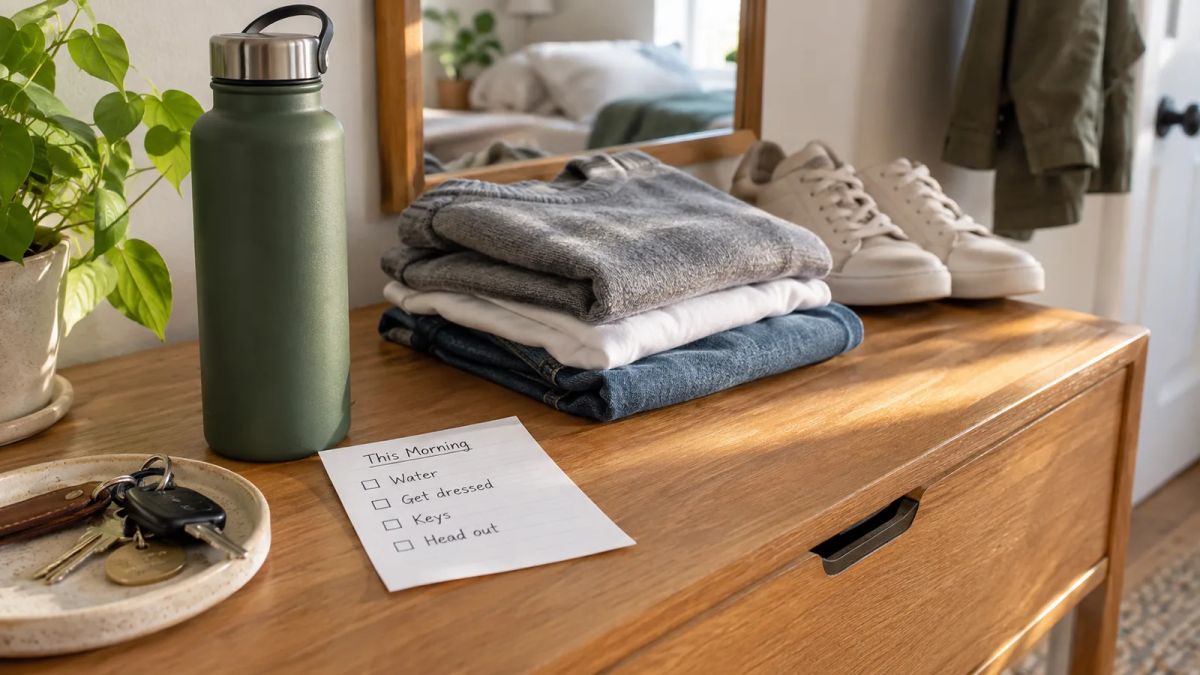
Pick one cue that happens every day and put your minute of mindfulness right up against it.
After I switch the kettle on, I will follow one minute of breathing while it boils.
After I get into bed, I will do a short body scan from my feet up.
A light record helps you see the habit forming in the weeks before it feels automatic. Nothing clever, a sheet on the fridge does it.
Habit: One minute of mindful breathing Cue: after the kettle goes on
Mon ☐ Tue ☐ Wed ☐ Thu ☐ Fri ☐ Sat ☐ Sun ☐
A real week has gaps in it, and that's fine. Ticked off, a normal one might look like this.
Habit: One minute of mindful breathing Cue: after the kettle goes on
Mon ☑ Tue ☑ Wed ☐ Thu ☑ Fri ☑ Sat ☐ Sun ☑
You'll miss days. It changes nothing as long as you start again the next day, so decide your smaller version now, before a hard day makes the choice for you. When a full minute feels beyond you, one slow breath with your eyes closed still counts. If you've drifted for a fortnight, skip the guilt and the grand restart, and do one minute today at your usual cue. For more on making a habit small enough to stick, our guide to tiny habits covers the mechanics, and how to start a daily meditation habit goes deeper on formal sitting once you're ready for longer sessions.
A place to check in day to day
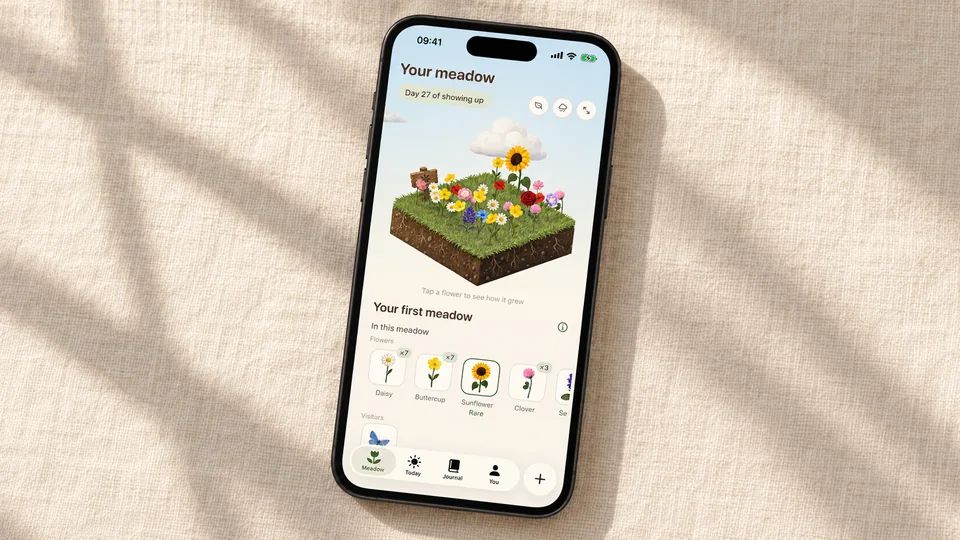
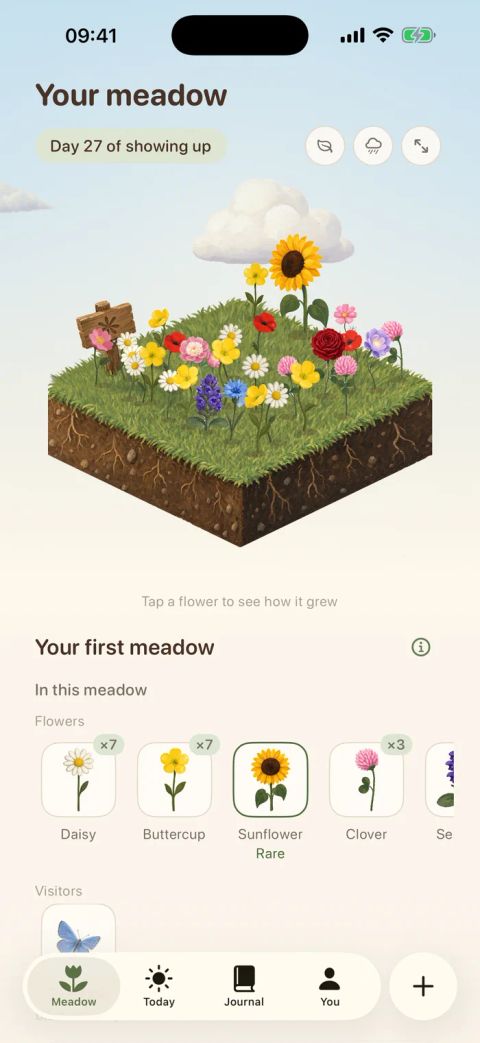
If you'd like the practice to live on your phone, Meadow lets you note how you're doing and tick off a small daily habit like your minute of breathing. Meadow is a movement and habit app for iPhone with a mood and energy check-in, a spot to jot one good thing from the day, and a built-in breathwork feature you use alongside a wildflower meadow you grow by showing up. Each day you turn up, a new flower blooms. There are no streaks, so a day you forget to slow down resets nothing and the flowers never wilt.
Frequently asked questions
What's the difference between mindfulness and meditation?
Mindfulness is the skill of paying attention to the present without judging it. Meditation is one way to practise that skill, usually by sitting quietly and resting your attention on the breath. You can also be mindful while walking, eating or washing up, with no formal sitting at all.
How long should a beginner practise?
One to three minutes a day to start. In the early weeks, showing up daily builds the habit more reliably than a long session you do occasionally, so keep it short and stretch it later once turning up is automatic.
Do I have to empty my mind?
No, and you can't. A busy mind isn't a failed practice. Noticing that your attention has wandered and bringing it back is the actual exercise, and you'll do it many times in a single minute.
Is mindfulness religious?
It doesn't have to be. The breath and body practices here are secular and used widely in healthcare, though mindfulness also has roots in various contemplative traditions if you want to follow that path.
Can mindfulness make you feel worse?
For some people, yes. The NHS notes that mindfulness "does not help them or that it can make them feel worse" for a minority, and research has recorded adverse effects in a small share of people. If it leaves you more anxious, ease off or stop, and speak to your GP if difficult feelings persist.
The one thing to do today is small. Choose the daily cue your minute of mindfulness will follow, then take one slow breath right now and notice it fully, so the practice has already begun.
AUTHOR
Co-founder of Meadow.
Ash is co-founder of Meadow, a habit and movement tracking app that turns small acts of self-care into a growing wildflower meadow.
Little and often, with Meadow
Consistency, not intensity.
Meadow turns the movement you enjoy and the habits that help you feel good into a meadow of wildflowers. No streaks to break, and your flowers never wilt.
Download Meadow