There is no daily step count that guarantees weight loss, and any headline that hands you one is selling certainty that walking cannot deliver. Steps burn energy and move your health in good directions, but the number on the scales answers to a much larger group of things, including how you eat, how you sleep, your health, any medication you take, and circumstances well outside your control.
So the useful question is not "what is the magic number" but "what walking can I keep, and how should I read the figures I see quoted". This guide walks through where the famous numbers came from, what the research does and does not show, why diet carries most of the weight question, and how to build a walking habit that survives an ordinary week.
Where the 10,000 steps number came from
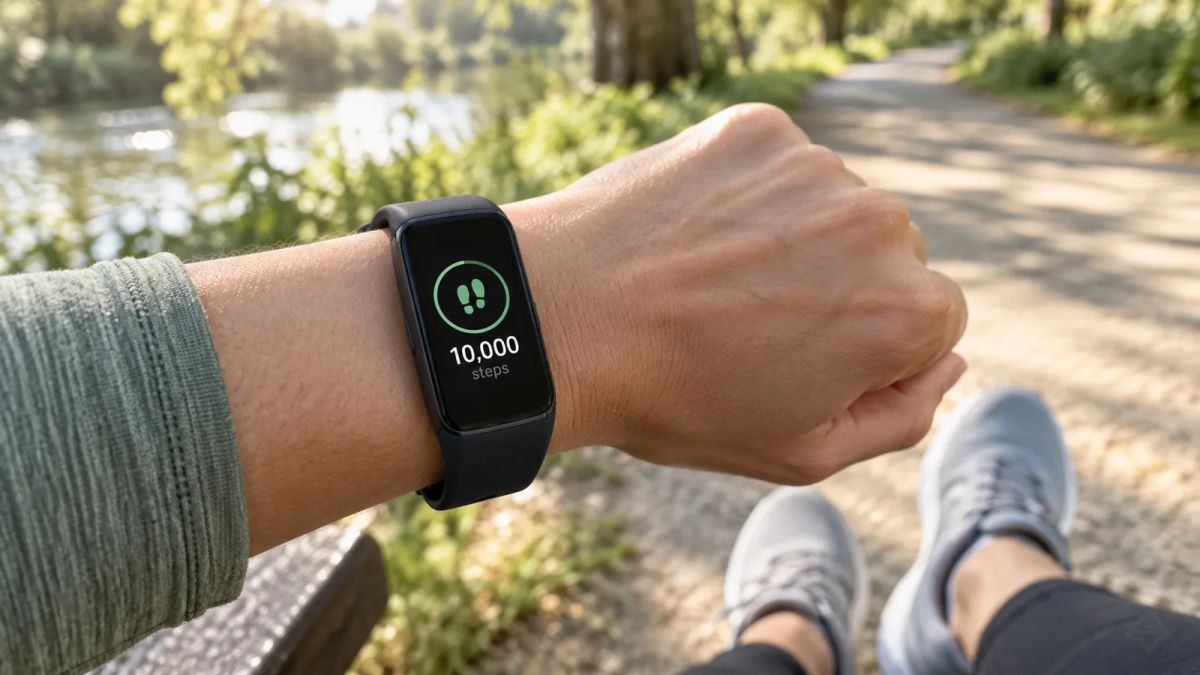
The 10,000 figure feels scientific because it is everywhere, but its roots are in advertising. Harvard Health traces it to a Japanese pedometer sold around the 1964 Tokyo Olympics called the manpo-kei, which translates as "10,000 steps meter". As the researcher I-Min Lee puts it in that piece, "the name was a marketing tool". The round number stuck, not because a study found it was the point where weight falls off, but because it was easy to remember and sat on the side of a device.
That does not make it a bad target. If a round number motivates you, keep it. What it was never designed to be is a weight-loss threshold, so crossing it does not switch on fat loss, and falling short of it does not mean the walk was wasted.
What the "around 8,500 steps" figure means
A newer number now circulates in place of 10,000, and it deserves the same careful reading. A 2026 systematic review pooled 18 randomised trials of adults with overweight or obesity, roughly 3,700 people, who took part in lifestyle programmes that changed both eating and activity. Participants reached about 8,454 steps a day during the weight-loss phase.
Here is the part the headlines tend to drop. The authors write that the threshold "should be considered as hypothesis-generating rather than prescriptive", which is a careful way of saying do not treat 8,500 as a dose. More striking still, the review found that stepping more during the weight-loss phase did not by itself drive the weight loss. The calorie changes did most of that work, while the higher step counts mattered more for holding weight steady afterwards.
Copy the step count on its own and you have copied one ingredient from a recipe that also involved food, support, and structure. That is worth sitting with before you pin your hopes on a single figure.
What the step research does support
Plenty of good research links walking to better health, and it is worth knowing what those studies measured, because it is rarely weight.
A large cohort study led by Amanda Paluch found that middle-aged adults taking at least 7,000 steps a day had roughly a 50 to 70 percent lower risk of dying over the follow-up period than those taking fewer, with no extra reduction once people passed about 10,000. Lee's own work in older women, described in that Harvard piece, saw a large drop in mortality risk at around 4,400 steps a day compared with the least active, and benefits that levelled off near 7,500.
Read those findings closely and two things stand out. The outcome being counted was death rates, not waistlines, so they cannot tell you how many steps will move your weight. And the benefits arrive at counts well below 10,000, which is quietly reassuring if that target has ever felt out of reach. More steps are associated with better health up to a point, and after that the returns flatten out.
Why diet and other factors carry most of the weight question
Weight change comes down to energy balance across everything you do and eat, not to one lever you can pull with your feet. The US Centers for Disease Control and Prevention explains that most weight loss comes from taking in fewer calories, and that the amount of activity a person needs varies a great deal from one body to the next.
Movement still earns its place. It supports the eating changes, protects your health while you lose weight, and helps keep weight off once it has shifted, which is the hardest part for most people. Walking on top of a poor diet, though, is a bit like bailing a boat while the tap runs, and that is a clue about where the biggest changes usually sit rather than a criticism of walking.
Sleep, stress, medication, hormones, and life stage all feed in too. This is a health and weight topic, so treat everything here as general information rather than advice for your situation. If weight is affecting your health, or you are unsure where to start, a GP can look at the whole picture in a way no step target can.
Pace does work a step count cannot see
A tally counts steps, not effort, and effort is where a lot of the benefit lives. The NHS describes a walk as brisk when you can still talk but cannot sing the words to a song, and a brisk ten-minute walk counts towards your week even if it barely moves the number on your counter.
For general health, NHS guidance for adults aged 19 to 64 suggests at least 150 minutes of moderate activity a week, or 75 minutes of vigorous activity, plus strengthening on two or more days. Those are health recommendations rather than a weight-loss prescription, and they make a better compass than any single daily total, because they reward how hard and how often you move rather than one number you might reach by pacing the kitchen.
Build a walking habit you can keep
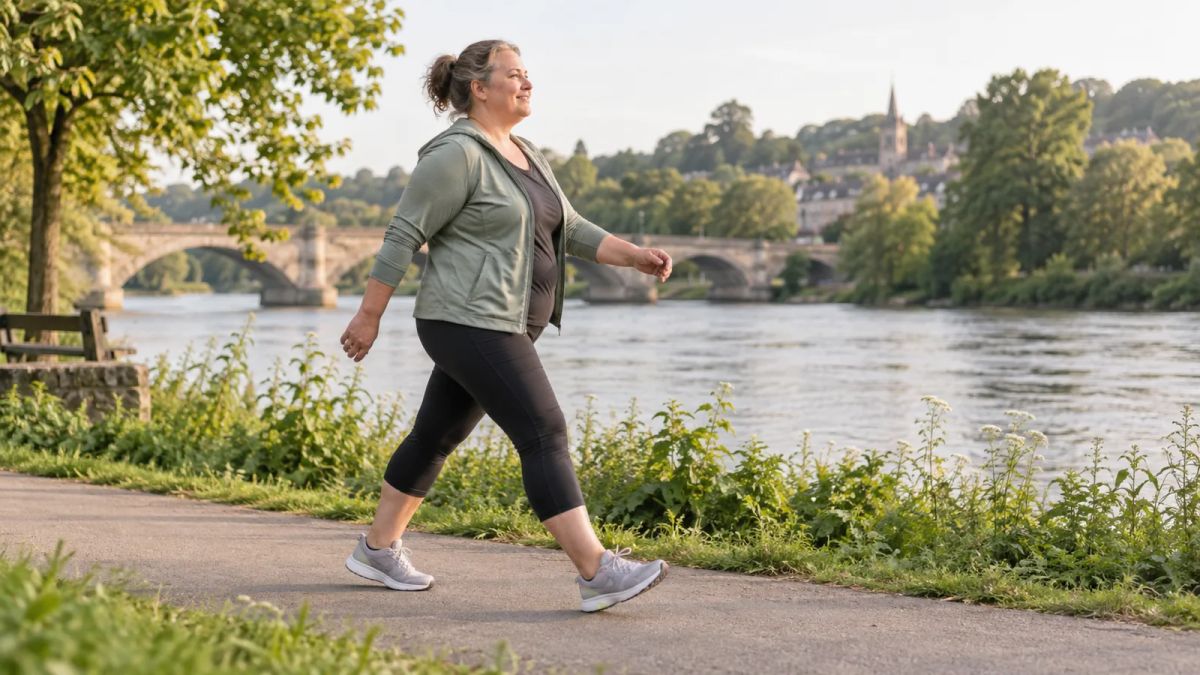
The habit matters more than the target, because any effect on your health or weight lives in the repeating, not in one big day. A walk you can manage most days beats a daily route march you drop by the second week.
Start by watching a few ordinary days. If you have a counter, notice the gap between a workday and a day off. If you do not, jot down when you already walk and roughly how long for. You do not need to buy anything to do this.
Then pick one place a short walk could slot in without a fight, and keep it small. A five-minute walk after lunch is a real beginning, not a promise about your body. The NHS advises building up gradually, so give a small addition a week or two before you decide whether to extend it.
Tie the walk to something already fixed in your day, so a routine you already have does the remembering. A short written plan helps here. Fill in a blank version like this:
Walk: _______ After I: _______ For: ___ minutes
And a filled example might read:
Walk: round the block After I: finish lunch For: 5 minutes
Mon ☐ Tue ☐ Wed ☐ Thu ☐ Fri ☐ Sat ☐ Sun ☐
Marking each walk gives you something concrete to look back on, and it works better than weighing yourself every morning and reading too much into the wobble. James Clear, who writes about habits, describes crossing off each day on a calendar as one of the oldest and most dependable ways to keep a habit going, because the mark itself becomes a small nudge to show up.
His other rule is worth borrowing for the days it falls apart: never miss twice. One skipped walk is an accident, and the move that counts is taking the next chance rather than trying to make up the distance you lost.
On a stretched day, take the shorter walk and record it as the shorter walk, so your log stays honest about what you did. A five-minute version on a hard day keeps the habit alive, and that is the whole job of a hard-day plan.
Meadow, without the streak

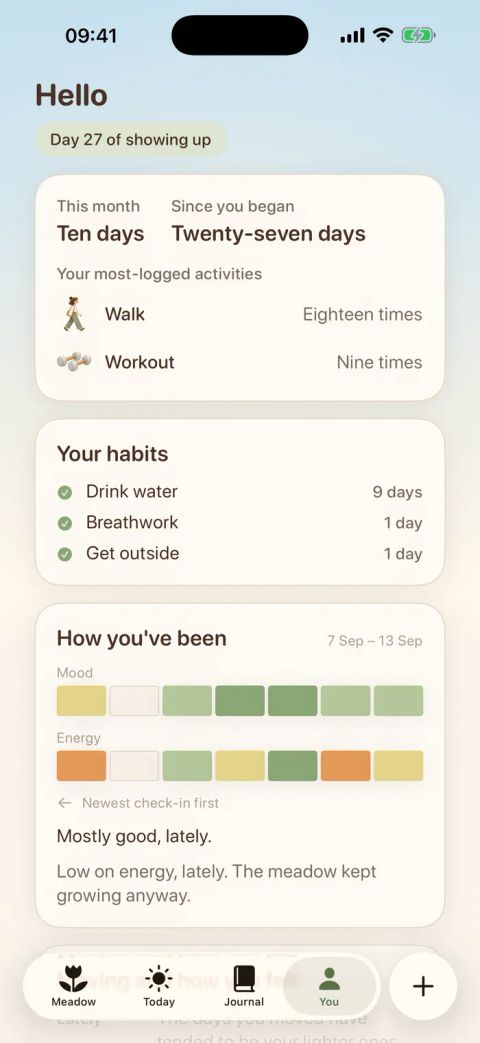
Another app worth checking out is Meadow, because it tracks a walk the way a habit tracker should when weight is the backdrop, which is gently. It is a habit tracker for iPhone made by Wildcard Wellness, where you tick off movement you enjoy, note your mood and a daily win, and watch a wildflower grow for each day you show up. There are no streaks, so a missed day resets nothing and your flowers never wilt, which matters when the point is a habit you keep for months rather than a number you defend. Meadow is $39.99 a year or $9.99 a month after a seven-day free trial.
That soft framing fits the theme of this guide. A tracker that punishes a missed day quietly teaches you that one gap is failure, when the research keeps pointing the other way.
What realistic expectations look like
If you walk most days and change nothing about how you eat, expect steadier energy, better mood, and health benefits that have little to do with the scales, and expect any weight change to be modest and slow. That is the honest picture, and it is a good outcome rather than a disappointing one.
Let any change in weight be a welcome side effect rather than the scoreboard. Walk because it steadies the rest of your life and because it is something you can repeat, and pair it with eating changes if losing weight is the goal. If the weight moves slowly, or not yet, the habit is still doing you good.
Common questions
How many steps a day should I take to lose weight?
There is no single number that works for everyone, and the honest answer is that steps support weight loss rather than deciding it. Many people find a target somewhere between 7,000 and 10,000 a comfortable stretch, but the count that matters most is the one you can repeat alongside changes to how you eat.
Is 10,000 steps a day necessary?
No. The mortality research finds health benefits arriving well below 10,000, and the figure began as pedometer marketing rather than a weight-loss rule. Use it if it motivates you, and drop it if it turns a decent day into a failure.
Will walking alone make me lose weight?
Sometimes a little, often slowly. The CDC notes that most weight loss comes from eating fewer calories, so walking tends to work best as a partner to diet changes rather than a substitute for them.
How long before I see results?
Health improvements like better mood and stamina can show up within a couple of weeks, while any weight change tends to be gradual and depends heavily on the rest of your routine. Judge the habit by whether you kept it, not by the scales in week one.
Do the steps have to be brisk?
Brisker walking gives you more health return for the same time, using the NHS talk-but-not-sing test, but any walking counts and beats none. Start where you are and let pace build on its own.
Write down one realistic slot for a short walk tomorrow, including when and where, then treat turning up as the whole of the goal. That is a walking habit starting, with no magic number attached to it.
If you want to go further, our guides on walking for weight loss, the 10,000 steps a day target, and the wider benefits of walking each pick up a thread of this one.
See how far you've come
Your habits, moods and little wins, all in one place
Meadow keeps track of the walks, the water and the good days, so you can look back and watch your effort add up.
Join the Meadow waitlist