Ask "how many steps a day should I walk?" and the useful answer is a method, not a magic number. The right target is one you build from your own week and then raise a little at a time, because a figure that ignores your job, your health and the shape of your days tends to leave you feeling behind rather than moving more. No single count fits everyone. What follows is a way to land on a number that belongs to you, with a worked example and a plan you can fill in before you close this page.
Step one: find your baseline
Before you choose a goal, look at what an ordinary week already holds. If your phone or a watch counts steps, scroll back over the past several days and pay attention to the spread rather than the best day. A shift on your feet reads very differently from a quiet day at a desk, and both belong in your real average.
Take a rough middle figure from a handful of normal days. Leave out the holiday, the big day out and the day you happened to walk for miles, because they flatter the picture. What you want is the honest, typical number your life produces when you are not trying to change it.
No tracker? You do not need to buy one to begin. Note when you walk and roughly how long for over three or four days, and you will have a fair sense of your usual movement. Precision is not the point of this stage. Setting your goal against your own life instead of a stranger's headline is, and that small shift is what stops a target from becoming a stick to beat yourself with.
Step two: add a realistic amount, not a leap
Once you know your baseline, add a modest amount on top. The British Heart Foundation suggests starting with around 1,000 steps more than you currently do rather than reaching for 10,000 overnight, and it notes that even small gains in step count make a difference. A thousand extra steps works out at roughly ten minutes of walking for most people, which is a change you can picture fitting into a normal day.
If your average sits near 3,000, aiming for 4,000 is a real move forward and far more likely to stick than a jump to a five-figure target you abandon by Wednesday. If you are already closer to 7,000, a smaller nudge or holding steady may suit you better. The value is in the direction and in choosing a number you can repeat, not in the roundness of the figure.
Pace is worth a mention while you are here. A plain step count cannot see how hard you were working, and effort matters. The BHF describes a brisk pace as one where you can talk comfortably but would be too out of breath to sing, so adding a little speed where you comfortably can gives you more than the tally alone suggests.
Step three: adjust for age, health, job and life
A goal that fits you takes account of more than your baseline.
Age is part of it. A large 2022 meta-analysis pooled 15 studies and around 50,000 people and found that the fall in early death risk levelled off at about 8,000 to 10,000 steps a day for adults under 60, and at about 6,000 to 8,000 for those aged 60 and over. More movement tended to help across the board, with the steepest gains when a fairly inactive person started doing more, and walking speed made little difference once the total was counted. Read those figures as a ceiling to relax about rather than a bar to clear. If you are 66 and settling around 6,500 comfortable steps, the evidence puts you in a good place, not short of some universal 10,000.
Your health matters too. If you are returning to activity after a long break, managing a condition, or unsure where to start, the NHS suggests speaking to your GP first, since a general target cannot account for your particular situation. A GP or physiotherapist can help you set a figure that is safe as well as encouraging.
Then there is the plain reality of your days. A job on your feet may hand you thousands of steps before you notice, while a desk job or long drives leave you to build them in on purpose. Shift work scatters walking across odd hours. Caring for someone, a tight budget, a disability, or a route that feels unsafe after dark all shape what is possible. A fair goal bends around these things instead of pretending they are not there. If a big daily number is out of reach, a smaller one you hit most days will do you more good than an ambitious figure you keep dropping.
For scale rather than a rule, the CDC still frames the week in time, at least 150 minutes of moderate activity plus muscle work on two days, and reminds everyone that some activity beats none. A step goal is one way to work towards that weekly total, not a replacement for it. A 2026 review of weight and lifestyle programmes found participants averaged around 8,500 steps a day, and even there the authors were clear this reflected diet and activity together, not a step target to copy across to your own life.
A worked example
Say you are Priya, a 42-year-old who drives to an office job. You check your phone and find your last five ordinary days read 2,900, 4,100, 3,300, 2,600 and 3,600 steps. The big number was a Saturday shopping trip, so you set that aside. Your typical weekday lands around 3,200, and that becomes your baseline.
You add 1,000 to make 4,200 your target for the next fortnight. To find the extra steps, you pick two slots that survive a normal day: a ten-minute loop after lunch, and parking at the far end of the car park. You decide the brisk-pace test applies to the lunch loop, where you can push a little, and not to the walk across the tarmac in work shoes.
Two weeks on, you have hit 4,200 on most days and it feels steady, so you raise the goal to 5,000. On a day when a late meeting swallows the lunch loop, you swap in a walk to the postbox and back and log it as the smaller walk it was. The number is climbing because it started from where you stood, not from where a headline told you to be.
Your fill-in plan
Copy this onto paper or into a note on your phone and fill in the blanks. Here is the blank version:
My baseline (typical day): ______ steps
My target (baseline + about 1,000): ______ steps
Where the extra steps come from: 1) ____________ 2) ____________
My smaller version for hard days: ____________
Review date (about two weeks off): ____________
And here is Priya's, filled in, so you can see the shape of a finished one:
My baseline (typical day): 3,200 steps
My target (baseline + about 1,000): 4,200 steps
Where the extra steps come from: 1) ten-minute loop after lunch 2) park at the far end
My smaller version for hard days: walk to the postbox and back
Review date (about two weeks off): the 30th
Progress gradually, and keep a record
Give any increase a couple of weeks before you decide whether to raise it. If the new figure feels comfortable and you are hitting it most days, nudge it up by another small amount. If it is a stretch you keep missing, hold where you are or ease back. Steady progress you can sustain beats a fast climb that fizzles by the end of the month.
A record makes this easier because it shows the pattern rather than one lonely day. That might be a tick on a wall calendar or a note in an app. Whatever you use, write down the walk you took, not the one you meant to take, so your goal keeps matching your real life.
Keep the smaller version ready for hard days rather than dreading them. A short walk to the end of the road, or a few minutes around the house, keeps the habit alive and your record truthful. A smaller walk logged plainly as a smaller walk is a success, not a failure.
If you miss a day, or a whole week, your steps still count when you pick them up again. There is no debt to walk off by doubling up tomorrow. Take the next reasonable chance and carry on from your baseline, which is the whole reason you set the goal against your own week in the first place.
Meadow, without the streak
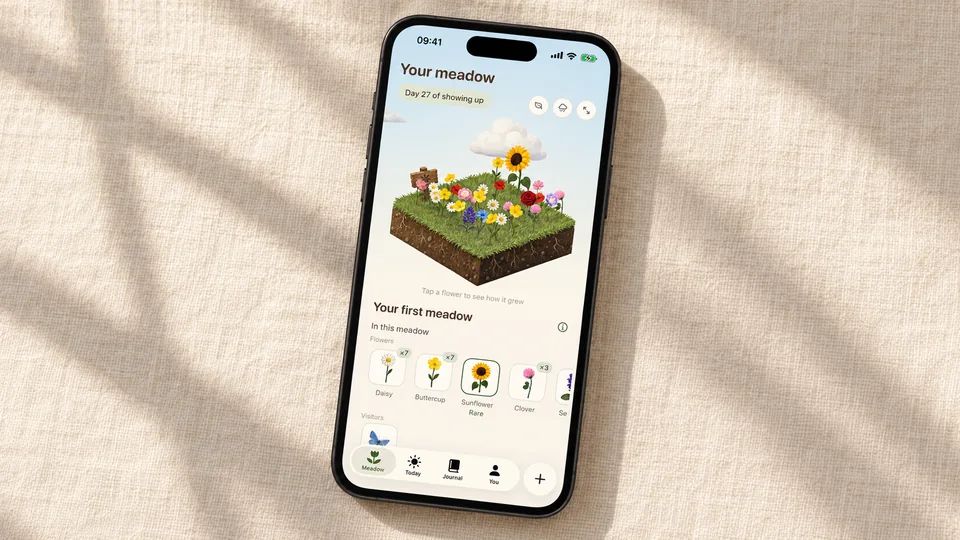
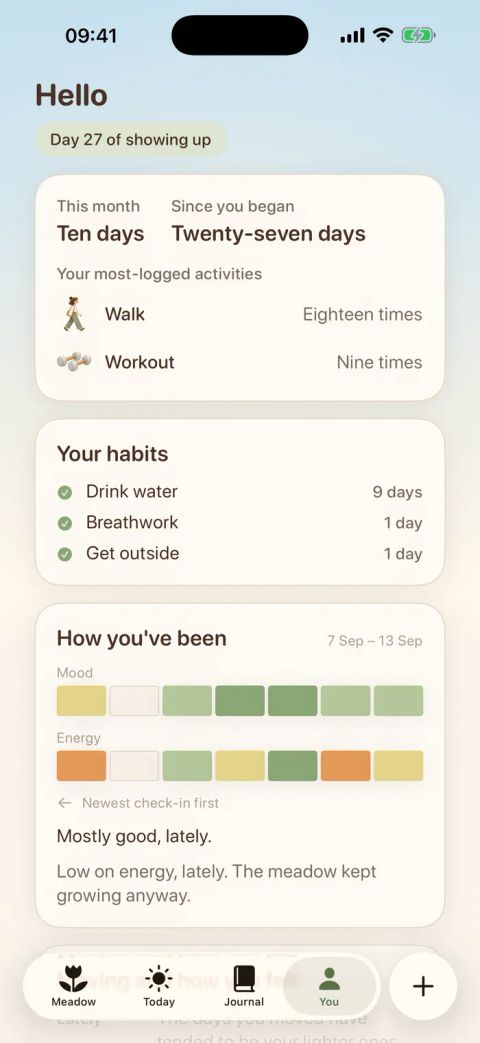
Another app worth checking out is Meadow, because it treats a walking habit the way this plan does, over weeks rather than perfect days. It is a gentle habit tracker for iPhone made by Wildcard Wellness. You log movement you enjoy, a walk, a dance, a little yoga, alongside small daily habits like drinking water or getting outside, and you can note your mood, a daily win and an affirmation. Every day you show up grows a wildflower, and rare flowers and little animal visitors appear along the way. There are no streaks, so a missed day resets nothing and your flowers never wilt. It costs $39.99 a year or $9.99 a month after a seven-day free trial, so you can find out whether it fits your week before you pay.
Common questions
Is 10,000 steps a day necessary?
No. The 10,000 figure began as a pedometer name in 1960s Japan, not a research finding, and studies since suggest benefits arrive well below it. If you want the fuller story, we cover the 10,000 target and what the research says about steps and health separately. For most people, a number built up from their own baseline is more useful than the round one.
How many steps should I add each week?
There is no fixed rule, but adding roughly 1,000 a day and holding it for a fortnight before raising it again is a gentle, repeatable pace. If a jump feels like a stretch you keep missing, add less. If it feels easy after two weeks, add a little more. You are looking for the largest increase you can hit most days, not the largest you can hit once.
Do steps count if I walk slowly?
Yes. Total steps are what the mortality research tracked, and speed made little difference once the total was counted. A brisk pace brings extra benefit and helps you reach a weekly activity target, but a slower walk still adds to your day and still counts on your plan. If your aim is weight, the picture is a little different, and we go into it in steps for weight loss and how far your steps are in miles.
One thing to do today
Open your phone or watch, look at the last few ordinary days, and settle on your rough baseline. Write one number a little above it, around a thousand steps more, as your goal for the next two weeks. That single figure, chosen from your own life, is worth more than any headline target you did not pick.
See how far you've come
Your habits, moods and little wins, all in one place
Meadow keeps track of the walks, the water and the good days, so you can look back and watch your effort add up.
Join the Meadow waitlist