A realistic goal is one you could keep in an ordinary week, not your best one. Most goals fall apart because they were built for a life you don't have: more time, more energy, fewer interruptions, a tidier version of you who never gets a bad Tuesday.
This has little to do with willpower. You pitch the goal at a size your real week can carry, then shrink it until the smallest version still counts on a rough day.
This guide covers how to right-size your ambition, why overreaching makes people quit sooner, how to fit a goal to the time you have, aiming at the action instead of the number, building in a bit of give, and turning the whole thing into a small daily habit. There's a right-size worksheet near the end you can fill in before you close the page.
For the broader mechanics, how to set goals walks through the full toolkit. This piece is about keeping the goal small enough to survive contact with a normal week.
Pitch it hard, but not out of reach
Edwin Locke and Gary Latham spent decades finding that harder goals pull more out of people than easy ones. There's a ceiling built into that finding, though.
A difficult goal only lifts performance while it stays inside your ability and you stay committed to it, and the principle they landed on is a goal that's difficult yet attainable. Push the target past what you can do and your effort stops climbing with it.
The sweet spot is a goal that stretches you a little on a normal day and that you'd still back yourself to hit when you're tired. "Run a marathon by spring" from a standing start sits at the wrong end of that scale. "Walk for twenty minutes most days and build from there" sits inside it.
Commitment is the other half of the picture. A goal you only half-believe in loses to the first busy week, so the thing you pick has to be something you'd pick on a flat evening, not one that only sounds good written down in January.
Overreaching makes people quit sooner
Aiming enormous feels like commitment. It often does the opposite. When people set out to change something and pin the target far beyond what's realistic, they tend to drop out earlier instead of pushing harder.
In research on people in weight-management programmes, those with the highest expectations at the start had the highest dropout a year later. One paid programme saw people who expected the biggest change drop out at 44 per cent, against 7 per cent for everyone else. The big target didn't keep them going. It set a bar the early weeks couldn't clear, and once they were behind it, stopping felt reasonable.
That pattern travels well past weight. A goal you'll miss for weeks before you see any sign of progress is a goal you'll abandon. One you can hit this week keeps you in the game long enough for the slower results to turn up. Small and boring beats big and abandoned.
Fit the goal to the week you have
Look at the week in front of you before you commit to anything. The real one, not the one you keep meaning to have.
Give it five minutes:
- Write out the seven days and block in what's already fixed: work, caring, the commute, the things that don't move.
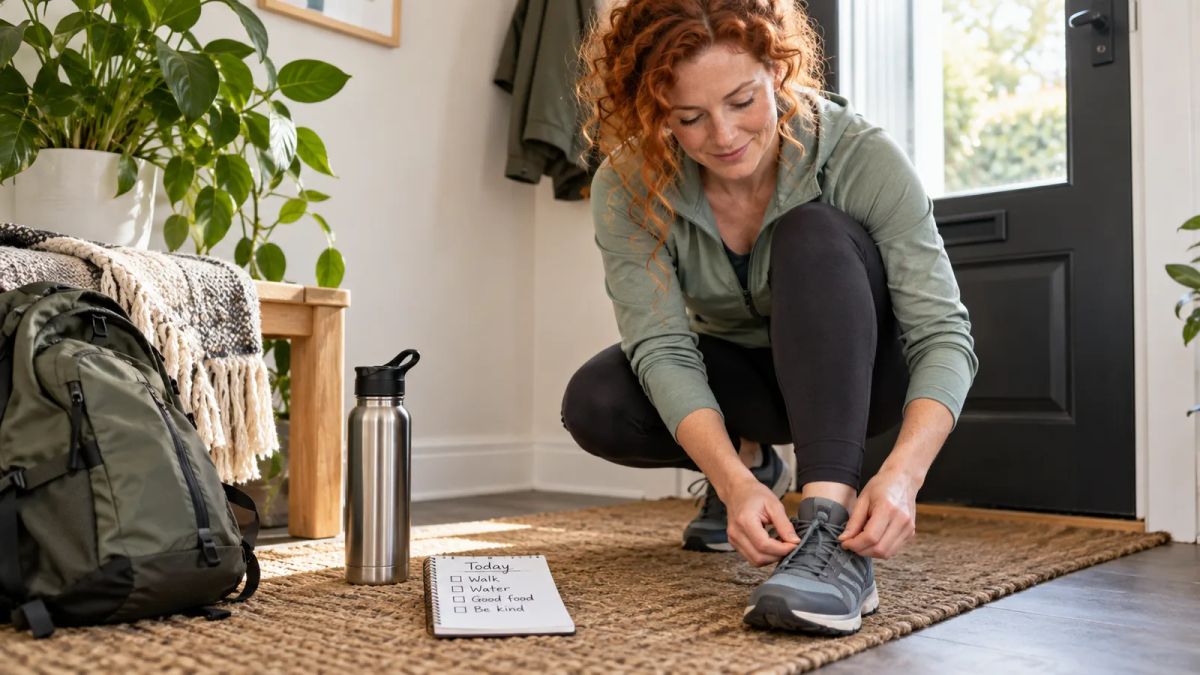
- Find the gaps that show up on most days, even small ones. Ten minutes after breakfast. The walk from the car park. The half hour before bed.
- Pick a gap that shows up on your worst days too, not the calm ones alone. That's where the goal goes.
- Size the action to fit that gap with room to spare, so a slightly bad day doesn't blow the whole thing.
A goal parked in a slot that only opens up on a quiet week will only happen on a quiet week. Put it somewhere that turns up whatever else is going on, and you've matched the plan to the life instead of hoping the life rearranges itself around the plan.
Aim at the action, not the number
An outcome you can picture is motivating and mostly out of your hands. Whether you lose weight, sleep better or get faster answers to sleep, stress, hormones and a dozen things today can't move. What you do control is whether you did the thing you set out to do.
James Clear's shorthand is that your goals set the direction and your daily system delivers the progress. Two people can hold the same goal and get different results, and the gap between them is the process each one runs day to day.
Keep the outcome as a compass, then leave it alone most days. Judge the week on whether you did the action, because that's the honest, doable thing to hold yourself to. The number will follow or it won't, but the action is the part you can guarantee.
Use the A and the R in SMART, and skip the worship
You've met SMART goals even if the name means nothing to you. The A and the R stand for achievable and realistic: a goal that stretches your abilities but stays possible, not one that needs a flawless run to reach. That's the part worth keeping here.
Don't turn the acronym into a rulebook that every goal has to obey. Forcing a rigid, measurable number onto something you're still learning can pile on stress and squeeze out the fun that keeps you coming back. The useful bit is the honesty check hiding in those two letters: could I do this in a normal week, or am I planning for a better person to show up and do it?
Build in a floor and a bit of give
A realistic goal bends. Set a floor first: the smallest version that still counts on a rubbish day. One lap of the block. Two minutes of stretching. A single page. The floor is what keeps the run alive on the days everything else falls over, and those are the days a goal has to live through.
Then face the thing most likely to stop you, before it turns up. Gabriele Oettingen found that only picturing the happy ending tends to drain the drive to chase it, because part of your mind treats the daydream as the reward and slackens off. Her fix, mental contrasting, holds the outcome you want next to the real obstacle in the way, then makes a plan for that obstacle.
Name yours in one line and write the if-then response. If I get home and want to flop on the sofa, then I keep my coat on and walk to the postbox first. If it's raining at eight, then I do the two-minute stretch indoors. You've decided in advance, so the bad moment doesn't get a vote.
Shrink it into a daily habit
The most realistic goal of all is one you stop having to decide on. A habit runs off a cue instead of willpower, and willpower is the thing that runs out on the days you most need it.
Bolt the new action onto something you already do without thinking. The American Heart Association's advice for making habits stick is to attach the behaviour to an existing routine, so a cue you can't miss sets it off. After the kettle boils, stretch. After the school run, walk. The old habit becomes the alarm for the new one.
Be patient with how long it takes to feel automatic. Work by Phillippa Lally's team, tracking people forming everyday habits, found the time varied hugely from one person and habit to the next, and that missing a single day didn't wreck the process. Ignore the tidy "21 days" you've been sold. Our guide to tiny habits covers why shrinking the action beats gritting your teeth, and if you're doing this at the turn of the year, new year habits has more on resolutions that outlast January.
A place for the small version to count
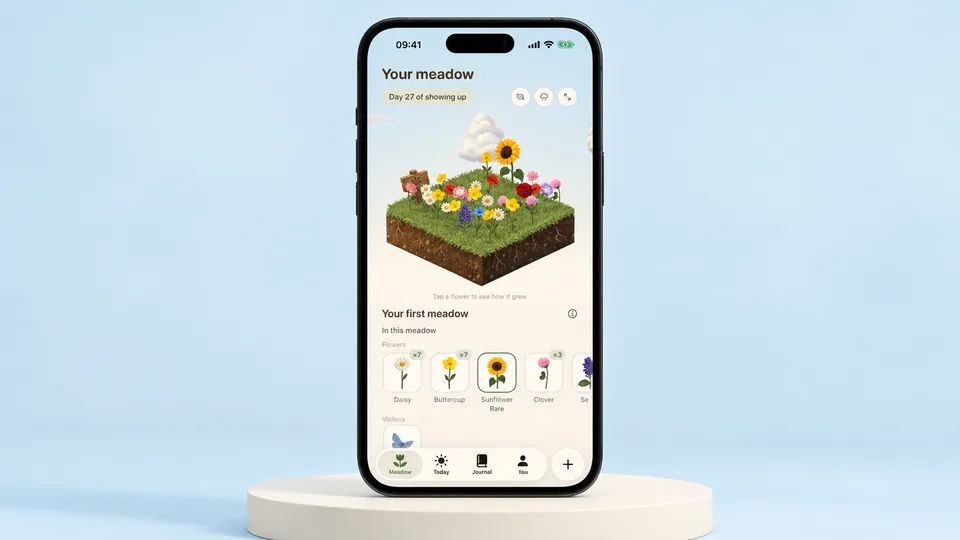
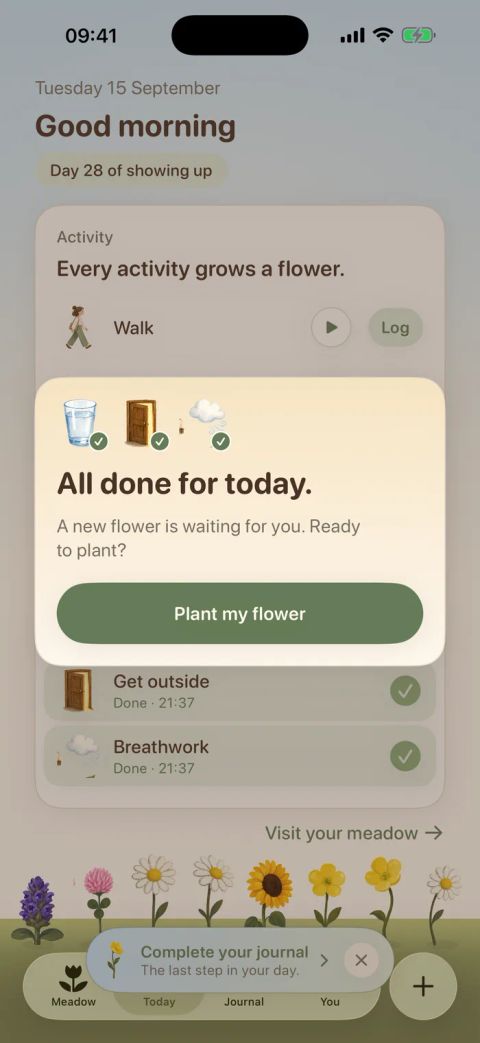
Some weeks go to plan and most don't, and Meadow is built for the ones that don't. It's a gentle iPhone app from Wildcard Wellness where you log a bit of movement or tick off a small habit, and every day you show up grows a new wildflower in a meadow that's yours. There are no streaks, so a missed day resets nothing and the flowers you've already grown stay put. That takes the sting out of the floor version of your goal, because two minutes on a bad day still earns you something. You can note your mood and energy while you're there, and try it at Meadow.
The right-size worksheet
You can pressure-test a goal on a scrap of paper in a couple of minutes. Fill in the blanks, and if the floor line feels doable on your worst day, the goal is the right size:
What I want in the end: ________
My action most days: ________
When and where it fits (a gap I get even on a bad day): ________
After I ________ , I will ________
The obstacle most likely to stop me: ________
If (obstacle) ________ , then I will ________
My floor (the smallest version that still counts): ________
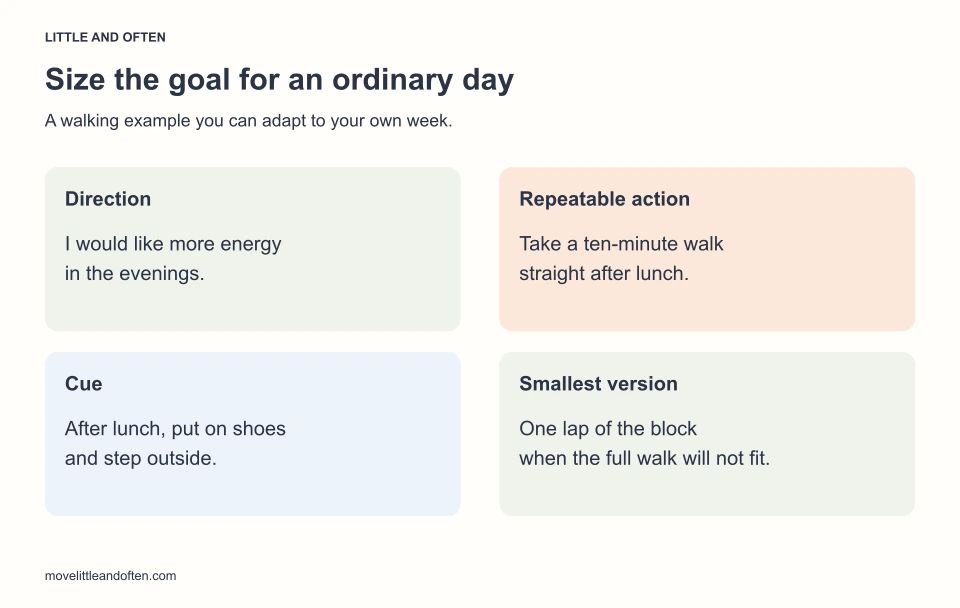
Filled in, it might read like this:
What I want in the end: More energy in the evenings
My action most days: A ten-minute walk
When and where it fits (a gap I get even on a bad day): Straight after lunch
After I finish lunch , I will put my shoes on and step outside
The obstacle most likely to stop me: I get stuck at my desk and the afternoon vanishes
If it's 1pm and I'm still at my desk , then I will shut the laptop and walk before I eat
My floor (the smallest version that still counts): One lap of the block
Common questions
How ambitious should a realistic goal be? Aim for something that stretches you a bit on a normal day and that you'd still expect to manage when you're tired. If a goal only works on your best week, it's pitched too high for the life you have.
Isn't aiming low giving up on big things? No. The big thing stays as your direction. You're only making the daily action small enough that it happens, and small actions repeated are what get you anywhere near a big outcome. A modest goal you keep beats a grand one you drop by February.
How do I know if my goal is too big? Two signs. You keep needing a perfect day to hit it, and you feel behind more often than you feel on track. When that's the case, cut the action in half rather than cutting yourself down.
What if I keep missing even the small version? Shrink it again, or move it to a better slot in the day. Missing the small version every day means the goal is still too big. That's a sizing problem, and the sizing is yours to change any time.
How many goals should I run at once? One, maybe two. Trying to fix your sleep, diet, movement and screen time on the same Monday spreads you too thin and most of it collapses by the second week. Get one action close to automatic, then add the next.
Pick one goal now and write a single line for it: after something you already do every day, I will do the smallest honest version of the action. Then name the one obstacle likeliest to stop you and write the if-then response for it. That's a right-sized goal, and it's small enough to finish setting up before you stand up.
AUTHOR
Co-founder of Meadow.
Ash is co-founder of Meadow, a habit and movement tracking app that turns small acts of self-care into a growing wildflower meadow.
Every little bit counts
Five minutes counts. So does a dance in the kitchen.
Log the movement you enjoy and the small habits that help you feel good, and watch them bloom into something you can see.
Download Meadow