The way to build a daily meditation habit is to make the first version almost too small to skip. Start with one or two minutes, tie it to something you already do every day, and let the habit grow from there instead of trying to sit for twenty minutes on day one.
Most people who quit meditation don't quit because they can't meditate. They quit because they set the bar at ten or twenty minutes, missed a few days, felt like they'd failed, and let the whole thing quietly lapse.
Here's the smallest version, to try right now. Sit where you are, close your eyes, and follow one slow breath in and out. Do that for a minute. That is a complete meditation, and doing it every day beats a long session you only manage once a fortnight.
This guide covers how long a beginner should sit, how to anchor the habit to a cue, a simple way to meditate, what to do when your mind won't settle, what the evidence does and doesn't show, and how to start again after a missed day.
Start with one or two minutes, not twenty
The length of your session matters far less than whether you come back tomorrow. A one-minute sit you repeat for a fortnight builds more of a habit than a twenty-minute sit you abandon after three days.
So set the bar low on purpose. One breath, then one minute, is a fine place to begin.
This feels wrong to a lot of people, because meditation gets sold in ten-minute and twenty-minute blocks by apps and classes. Those longer sessions are worth building up to. They're a terrible place to start, because a big daily commitment is the thing most likely to collapse the first busy week you hit.
Keep the early goal small enough that you'll do it on your worst day, not your best one. You can always sit longer when you feel like it. What you're protecting in the first few weeks is the streak of showing up at all, at whatever length.
Anchor it to something you already do
A new habit needs a reliable trigger, or you'll rely on remembering, and remembering fails. The fix is to attach meditation to a habit you already have.
James Clear calls this habit stacking, and the formula is after current habit, I will new habit. His own worked example happens to be meditation: "After I pour my cup of coffee each morning, I will meditate for one minute." Your existing routines are already wired in, so you borrow their reliability for the new thing.
Pick one cue that happens every day without fail and pin the sit to it.
After I switch on the kettle, I will sit and breathe until it boils.
After I sit down at my desk, I will meditate for two minutes before I open my laptop.
After I get into bed, I will take ten slow breaths with my eyes closed.
The cue does the heavy lifting. Choose one, write it down, and put your meditation right up against it in time so there's no gap for the day to slip into.
A simple way to meditate for beginners
You don't need a cushion, an app or a quiet room with candles. You need a minute and somewhere to sit.
- Sit down somewhere you won't be interrupted, on a chair or the edge of the sofa, back reasonably upright and hands resting in your lap.
- Set a timer for one or two minutes so you're not tempted to check the clock.
- Close your eyes, or lower your gaze to the floor, and let your breathing find its own pace without forcing it.
- Rest your attention on the feeling of the breath, the cool air at your nostrils or the gentle rise of your chest.
- When your mind wanders off, notice where it went, and bring your attention back to the breath. That noticing and returning is the meditation, not a sign you're doing it wrong.
- When the timer sounds, take one slower breath, open your eyes, and carry on with your day.
That's it. Repeat it tomorrow at the same cue.
If sitting in silence feels too bare at first, a guided recording can hold your attention while you learn, with a voice walking you through where to put your focus. The NCCIH notes many people find learning the technique with guidance especially helpful. Free guided tracks are easy to find, and there's no rule that says a beginner has to go it alone.
When your mind won't sit still
Your mind will wander constantly, and that is not a fault in your meditation. It's what minds do. The goal was never a blank, silent head. The goal is to notice you've drifted and come back, over and over, and each return is one rep of the actual skill.
New meditators often decide they're "bad at it" within a week, because they expected calm and got a running commentary about emails and dinner. Nothing has gone wrong. Noticing the noise is the point where meditation starts working.
There's a quieter benefit hiding in this. Mindfulness teaches you to spot a worried thought as a thought passing through, instead of a fact you have to act on. As one Harvard Health piece puts it, you learn to recognise, "oh, there's that thought again", and let it move on. That small gap between a thought and your reaction to it is a lot of what people are after.
Meditation doesn't suit everyone, and that's worth saying plainly. The NHS notes that while many find mindfulness helpful, some people find it does not help them or that it can make them feel worse. If sitting with your thoughts leaves you more agitated, not less, it's fine to stop, try a shorter sit, or come back to it another time.
What meditation can and can't do for you
Meditation has real evidence behind it, and it's also oversold, so it helps to hold both facts at once.
The best-known review pooled 47 well-designed trials with around 3,515 people and found mindfulness meditation produced small to moderate reductions in anxiety, depression and pain. The authors put the size of the effect in blunt terms, comparing it to "what would be expected from the use of an antidepressant" but without the side effects. The programmes in those trials were substantial, often eight weeks of training, so this is what regular practice can do, not one hopeful minute.
Small to moderate is the honest summary, and it's still worth having.
The wider picture from the US National Center for Complementary and Integrative Health is more mixed. Its round-up reports that mindfulness-based approaches can work about as well as established therapies for anxiety and depression, that stress and blood pressure show some benefit, and that meditation improved sleep quality more than general education but no better than proven options like cognitive behavioural therapy or exercise. Plenty of the underlying studies are small or low quality, so the confidence behind these findings is patchy.
There's a safety note too. The same NCCIH review found about 8 percent of people had a negative effect from meditating, most often more anxiety or low mood. For most people meditation is a low-cost wellbeing habit that takes a bit of the edge off. It isn't a treatment for a mental health condition. If low mood, anxiety or worry hangs around for weeks, gets in the way of daily life, or feels heavier than you can carry, talk to your GP, and treat that as a sensible next step, not a sign the meditation let you down.
Keep a light record of the days you show up
Open our free printable: Habit Tracker (PDF). Save or print it to use alongside this guide. No sign-up needed.
A simple record helps you see the habit forming, which is its own quiet encouragement in the weeks before it feels automatic. You don't need anything clever. A sheet on the fridge with the habit, the cue and a row of days works.
Habit: Two-minute meditation Cue: after I sit down at my desk
Mon ☐ Tue ☐ Wed ☐ Thu ☐ Fri ☐ Sat ☐ Sun ☐
Tick each day you sit, however short. A real week, gaps included, might look like this.
Habit: Two-minute meditation Cue: after I sit down at my desk
Mon ☑ Tue ☑ Wed ☐ Thu ☑ Fri ☑ Sat ☐ Sun ☑
The point of the record isn't a perfect row of ticks. It's to make your effort visible, so a quiet run of showing up feels like something. If a paper grid isn't your thing, our habit tracker guide runs through gentler ways to keep score, and tiny habits covers why small and attached to a cue beats big and vague.
A calm place to keep the daily sit
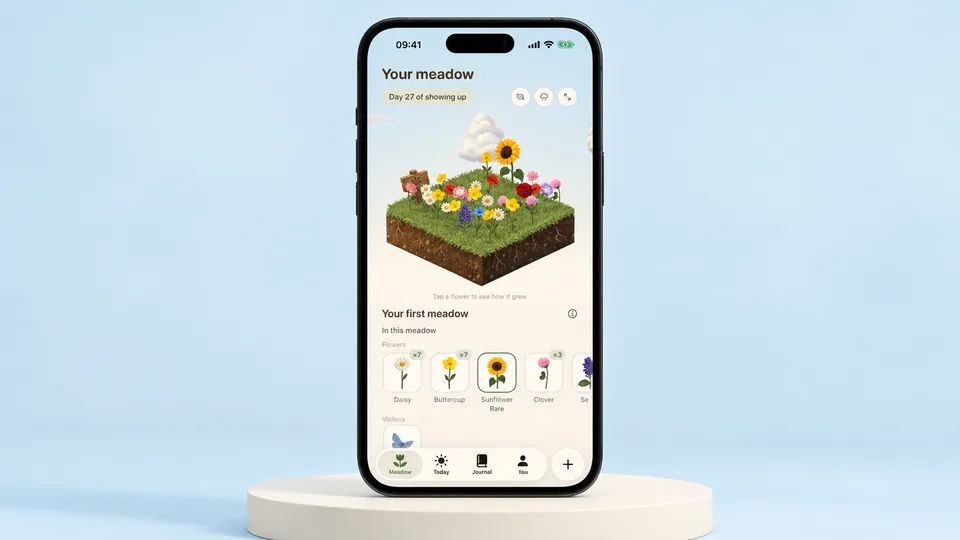
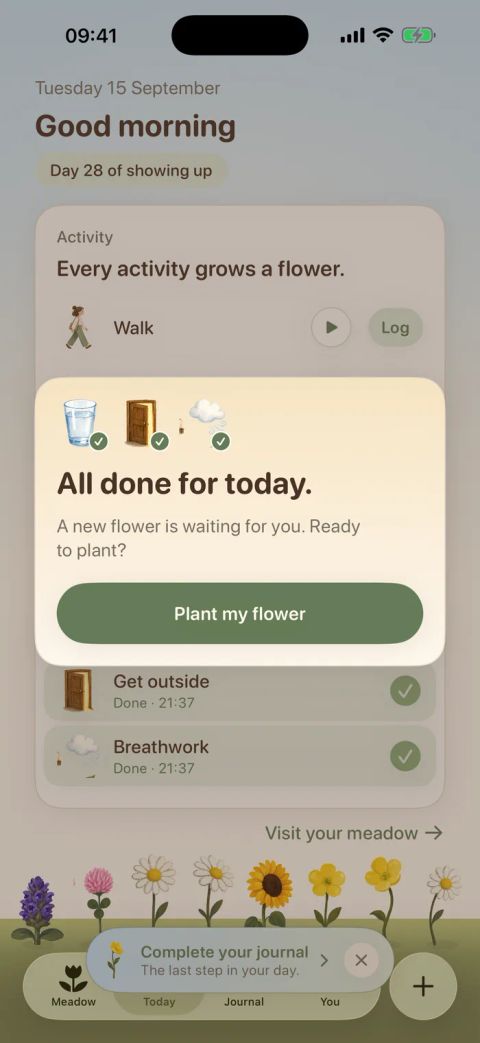
If you'd rather keep count on your phone, Meadow lets you tick off a small daily habit like your meditation and watch the days add up as a wildflower meadow you grow by showing up. Meadow is a gentle movement and habit app for iPhone, and it has a built-in breathwork feature, so a slow breathing session can sit right beside your meditation on the days you fancy both. You can also note your mood and energy and jot one good thing from the day. There are no streaks, so a day you skip resets nothing and your flowers never wilt.
When you miss a day
You will miss days, and it changes nothing, as long as you go back the next day. A single gap doesn't wipe out the habit you're building.
The research is reassuring on this. In the work behind the well-known habit-formation figures, missing one chance to do the behaviour didn't derail the process at all. Automaticity built up gradually over weeks, and one skipped day was a blip, not a reset. The same study is where the "66 days" figure comes from, but that was a median with a huge range, from 18 days to 254, so don't treat any fixed number as a deadline you've failed to hit.
Decide your smaller version now, before a hard day forces the choice. When two minutes feels beyond you, one slow breath with your eyes closed still counts and keeps the thread alive.
If you've drifted for a week or a month, skip the guilt and skip the grand restart. Sit for one minute today, at your usual cue, and let that be the whole comeback.
Frequently asked questions
How long should a beginner meditate?
One to two minutes a day to start. In the early weeks, showing up daily does more for you than a longer sit, so build the daily habit first and stretch the sessions later, once showing up is automatic.
What's the best time of day to meditate?
Whenever you can attach it to a reliable daily cue. Morning works for many people because the day hasn't filled up yet, but the best time is the one you'll keep, tied to something like your first coffee or getting into bed.
Is it normal that my mind won't stop during meditation?
Yes. A busy mind is not a failed meditation. Noticing your attention has wandered and bringing it back to the breath is the practice, and you'll do it many times in a single minute.
Do I need an app to meditate?
No. A timer and somewhere to sit are enough. Guided recordings can help while you learn where to put your attention, and a habit app can help you keep track, but neither is required to start.
How long before I feel a benefit?
Some people feel a little calmer the first week, and the steadier effects on stress and mood in the research came from weeks of regular practice, often eight weeks or more. Treat it as a slow, cumulative thing, not an instant fix.
Is meditation religious?
It doesn't have to be. The breath-focused practice in this guide is secular and used widely in healthcare settings, though meditation also has roots in various religious traditions if you want to follow that path.
The one thing to do today is small. Pick the cue your meditation will follow tomorrow, then sit and breathe for one minute now, so the habit has already started.
AUTHOR
Co-founder of Meadow.
Ash is co-founder of Meadow, a habit and movement tracking app that turns small acts of self-care into a growing wildflower meadow.
Every little bit counts
Five minutes counts. So does a dance in the kitchen.
Log the movement you enjoy and the small habits that help you feel good, and watch them bloom into something you can see.
Download Meadow