Realistic self-care is a handful of small, ordinary actions that steady you a little and fit the life you already have, not a spa day you never get round to booking. It works best when it costs almost nothing, asks for a few minutes rather than a free evening, and can shrink on the days you have least to give.
If you want one thing to try before you finish reading, drink a glass of water and step outside for two minutes, even if that means standing by an open door. That is the whole shape of it. One doable thing that leaves you slightly better than before, picked because it suits your actual week.
This is a generous menu to choose from, sorted into movement, rest, mind, connection, environment, the boring admin that buys you calm later, and small treats. You are not meant to do all of it. You pick what fits today.
Self-care is not selfish, and it is not a spa day
The bubble-bath version of self-care has done a lot of damage. It made a basic idea look like a luxury purchase, something you earn once the important people are sorted and there is money spare. For most people that moment never arrives, so the whole idea gets shelved as indulgent.
Looking after yourself is what keeps you able to look after everything else. A rested, watered, less frazzled version of you is easier to be around and better at the caring, the work and the patience your day demands. Treating your own needs as the thing you get to last is not noble. It is how people burn out.
None of what follows needs a candle, a subscription or a spare tenner. The most useful items on the list are free.
A menu to pick from, not a checklist
Different days leave you with different amounts of time, money and energy, so treat the categories below as options rather than instructions. Read for the one or two that fit how you feel right now, and let the rest wait.
Move in a way that counts
Movement does not have to mean a workout, and the mental payoff does not need much of it. The CDC is plain that some activity is better than none and that any amount brings some benefit, which takes the pressure off the idea that it only counts if you sweat.
A short walk is the easiest place to start. Harvard Health notes that everyday movement can reach the mood changes you are after through a kind of back door, without having to talk yourself into feeling better first. A walk to the postbox, a stretch between tasks, a dance to one song while the kettle boils. On a flat day, standing up and rolling your shoulders still shifts something. If you are returning to activity after a long gap or you live with a health condition, a word with your GP before you push the intensity is sensible.
Rest and protect your sleep
Rest is self-care that a busy culture treats as laziness, which is part of why so many people are running on empty. Lying down for ten minutes with your eyes shut is a reasonable thing to do, not a failure of productivity.
Sleep shapes how the next whole day feels, and the habit you can build is the wind-down around it. The National Sleep Foundation suggests starting a bedtime routine anywhere from thirty minutes to two hours before bed, doing the same calming things each night so your brain learns to read them as a signal that sleep is coming. Dimming the lights, a few pages of a book, phone set down across the room. The routine costs nothing and works with the evening you already have.
Steady your mind
When your head is loud, slowing down for sixty seconds helps more than it sounds like it should. The NCCIH's review of mindfulness and meditation finds these practices can ease stress and anxiety and work about as well as some standard therapies, while being straight that much of the research is preliminary and the long-term picture is less clear.
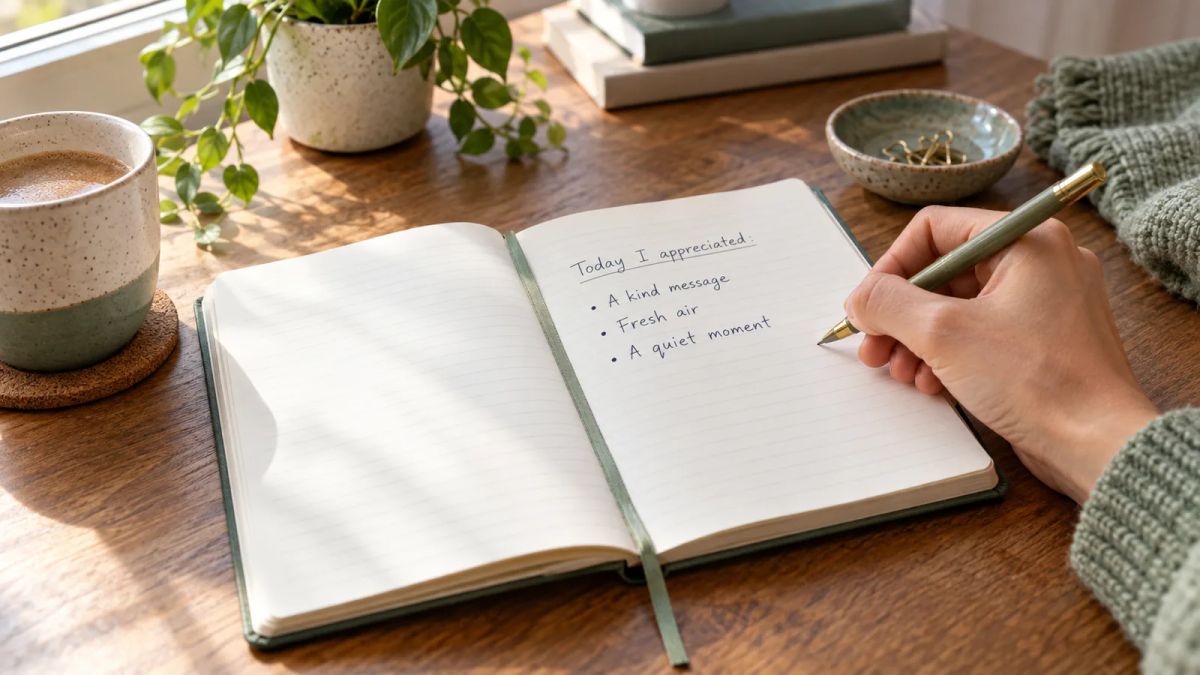
You can borrow the idea in the smallest way. Three slow breaths with a long exhale before you open your laptop. Noticing the warmth of the mug in your hands. A minute of writing down the one thing weighing on you. Some people find the same quiet in a short list of things they are grateful for, and our gratitude journal prompts give you lines to start from on the days a blank page feels like too much. Others prefer a single steadying line to repeat, and a few positive affirmations for women can do that job when your inner voice has turned sharp.
On a depleted day, the kindest mental self-care removes decisions rather than adding them. Rereading a book you love, rewatching a familiar show, colouring one shape. Familiar things ask nothing of a tired mind, and that relief is a rest from choosing, not a sign you are being lazy.
A little connection
A quick message to someone you like is self-care that happens to be free. It does not need to be a long call or a plan.
Connection is a real ingredient in wellbeing, not a nicety. The Greater Good Science Center at Berkeley lists social connection among its keys to wellbeing and points to research that even brief exchanges, including with strangers, can lift how we feel. A hello to a neighbour, a text that says you were thinking of someone, a two-minute chat at the shop counter. Small doses count, which is the point when a full social life is beyond this week.
Tend your environment
Your surroundings press on your mood more than you notice. Clearing one small surface, the kitchen worktop or the spot by the front door, gives a tired brain one less thing to trip over, and it is a five-minute job rather than a whole clean.
Getting outside belongs here too. A study of nearly twenty thousand people in England found that spending at least 120 minutes a week in nature was associated with better health and wellbeing, and it made no difference whether people got there in one long visit or several short ones. This is an observational link rather than proof that a walk fixes a hard week, but two hours across a whole week is a gentle target, and a park bench at lunch counts towards it.
Admin self-care
Some of the kindest things you can do for yourself are dull. Booking the appointment you have been putting off. Cancelling the subscription that nags at you. Replying to the email that has been sitting like a small stone in your shoe.
None of this feels like self-care in the moment, and all of it removes a low hum of stress from the days ahead. Picking one nagging task and clearing it is a gift to next week's version of you, and future you is worth being kind to as well.
Small treats, kept in proportion
Treats are allowed. A good coffee, ten minutes with your feet up, an episode of something daft, the nice biscuit rather than the plain one. Pleasure is a fair part of looking after yourself.
The bubble bath was never the problem. The problem was treating a treat as the whole of self-care while the sleep, the water and the walk went missing. Enjoy the small nice thing, and let it sit alongside the plainer items rather than standing in for them.
When you have almost nothing left
On the hardest days, even a short walk feels like a mountain. That is the moment for the tiniest version of an idea, not for dropping the idea altogether. Self-care that only works when you are already coping is not much use, so it helps to know your floor in advance.
If money is the constraint, everything above is free, and the ones that cost nothing at all are the water, the daylight, the breath, the tidy surface and the text.
If time is the constraint, each of these fits inside two or three minutes.
If energy is the constraint, drink the water, open a window, or send the message from where you are already sitting. A small thing done on a bad day counts for far more than a grand plan you cannot reach, and choosing the option that asks least of you is the skill, not the cop-out.
Turning one idea into a habit
Reading a menu is easy. Keeping any of it going is the harder part, and the way through is to stop treating it as seven new things to remember and pick one to make close to automatic.
The move that tends to work is attaching the new action to something you already do. The American Heart Association's advice on making habits stick is to anchor a new behaviour to an established routine, so it rides along on a cue that happens anyway. The NHS suggests aiming for six to eight glasses of fluid a day, and tea and coffee count, so hydration is an easy first target to pin to a cue you never skip. Write yours as one sentence.
My self-care habit: ____________________
After I ____________________ (something I already do), I will ____________________ (one small action from the menu).
Here it is filled in:
My self-care habit: Drink a glass of water in the morning.
After I switch the kettle on, I will fill and drink a glass of water while it boils.
Decide your smaller version now, while you are thinking clearly, so a rough day does not force the choice. If the two-minute walk is too much, the smaller version is standing outside the front door. If a wind-down routine is beyond you tonight, the smaller version is putting your phone across the room. A shrunken version keeps the thread alive, and keeping the thread alive is what turns a one-off into something you do. If you want a fuller starting frame, our morning routine ideas show how to stack a couple of these onto the start of the day.
When you miss a day, and you will, you have undone nothing. The next ordinary moment is a fresh start, so pick the next cue and carry on without the guilt tax.
Meadow, without the streak
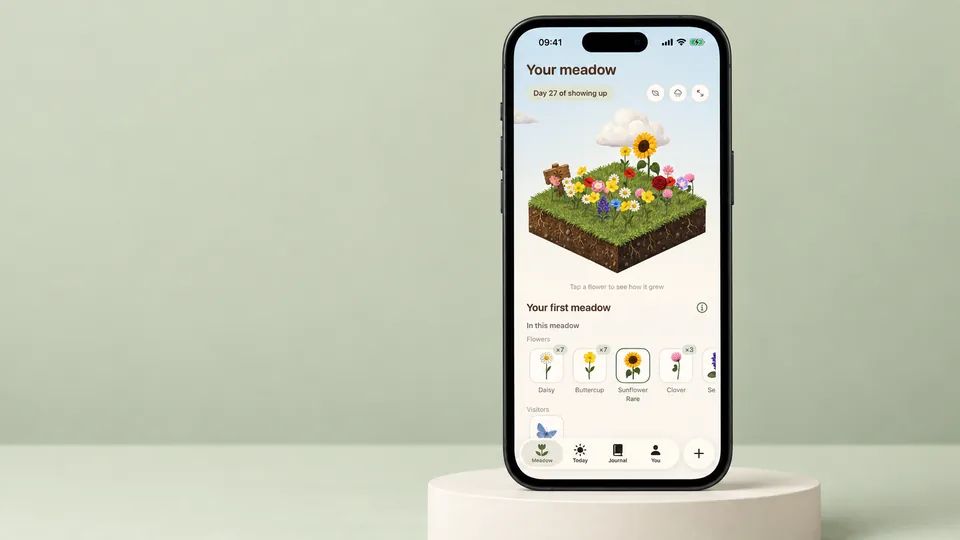
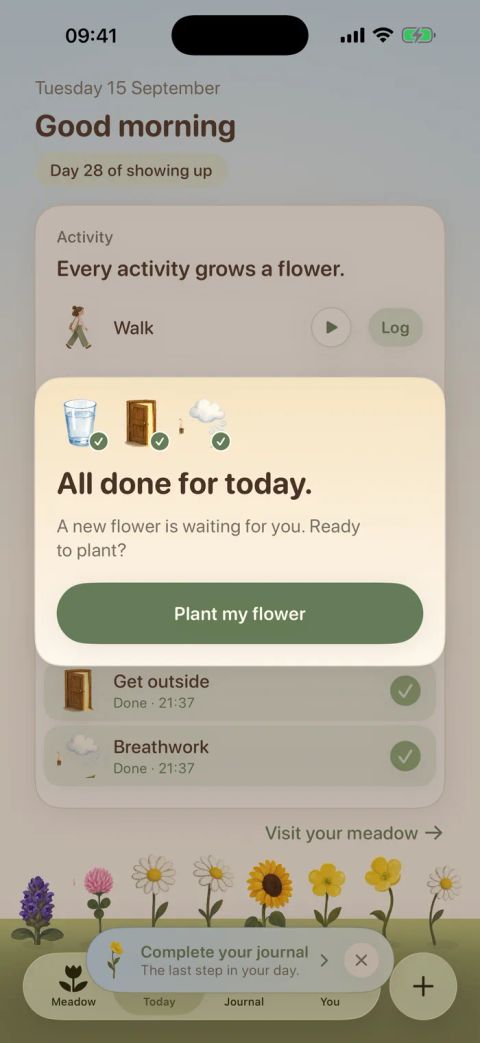
If seeing your progress helps you keep going, another app worth checking out is Meadow, because it is built around picking a habit back up rather than punishing the gap. It is a gentle habit tracker for iPhone from Wildcard Wellness. You log movement you enjoy, a walk, a dance, a little yoga, alongside small daily habits like drinking water or getting outside, and you can note your mood, a daily win and a daily affirmation. Every day you show up grows a wildflower, with rarer flowers and small animal visitors turning up over time. There are no streaks, so a missed day resets nothing and your flowers never wilt. Meadow costs $39.99 a year or $9.99 a month after a seven-day free trial.
When to reach for more
These ideas are everyday wellbeing, and that is where their honest value sits. They are not a treatment, and they will not fix a situation that is wearing you down, whether that is money, a caring load, or a job with no let-up. Reading them as a cure would be unfair to you.
If low mood or anxiety carries on for weeks, gets in the way of daily life, or feels heavier than you can carry, the NHS advice on low mood and depression is to talk to your GP. That is a sensible next step, not a sign the small things failed you. The menu and a doctor are not rivals.
Frequently asked questions
Is self-care selfish?
No. Looking after your own basic needs is what keeps you able to look after other people, and running yourself into the ground helps no one. Think of it as maintenance rather than indulgence.
What are some self-care ideas that cost nothing?
Plenty of the best ones are free. Drinking water, stepping outside for daylight, three slow breaths, a short walk, tidying one surface, a text to someone you like, and an earlier wind-down before bed all cost nothing and take minutes.
What can I do for self-care when I have no time or energy?
Shrink it. Drink a glass of water, open a window for a minute, or send one message from where you are sitting. On a hard day the tiniest version is the whole task, and it counts.
How often should I do self-care?
A little and often beats a big occasional effort. One small action tied to something you already do most days will outlast a spa afternoon you manage twice a year.
Does self-care have to be a bubble bath or a treat?
No, and treats are only one small part of it. Sleep, movement, water, connection and clearing a nagging task do more for how you feel than any single pampering session, though there is nothing wrong with enjoying a treat alongside them.
One thing to do today
Pick a single item from the menu, name the everyday moment it will follow tomorrow, and drink a glass of water while you decide. One line, one cue, one small action is the whole of realistic self-care begun.
Every little bit counts
Five minutes counts. So does a dance in the kitchen.
Log the movement you enjoy and the small habits that help you feel good, and watch them bloom into something you can see.
Join the Meadow waitlist