Motivation is a feeling, and feelings come and go. You start a goal on a wave of it, and a fortnight later the wave has gone and you're staring at the same task wondering where the drive went.
That doesn't mean you've failed. It means you're relying on the one thing least likely to be there when you need it.
The people who keep going haven't found a bottomless supply of motivation. They've set their days up so showing up asks for less of it, and so a flat week can't sink the whole thing. Here's how to do that with any goal, including the parts most advice skips: what to do when even the small version feels like too much, and how to come back after you drop off.
Why motivation fades in the first place
Motivation runs on novelty and mood. A fresh goal is exciting, so week one feels easy. Then the shine wears off, a bad night's sleep or a rough day at work flattens you, and the task that felt light on Monday feels like wading through treacle by Thursday.
That dip is the normal shape of things. Low drive is often a signal to slow down, not a verdict on your character.
Chasing the feeling back with sheer effort rarely holds, because you're trying to top up something that empties on its own schedule. The steadier move is to stop leaning on motivation and start building around it, so the days it deserts you aren't the days everything collapses.
Build a system that runs when you don't feel like it
The best defence against fading motivation is a routine plain enough to run on autopilot.
James Clear, who wrote Atomic Habits, makes the case for systems over goals. As he puts it, "Goals are good for setting a direction, but systems are best for making progress." A goal is the outcome you're after. A system is the small, repeatable action you do whether or not you're in the mood.
The move is to shrink the action until it barely needs a decision, then hook it onto something you already do every day. Not "go to the gym" but "shoes on after I finish my morning coffee." Not "write a novel" but "open the document and write one line after lunch." When the entry point is that light, a low-motivation day still ends with the thing done.
You can lean on the action to bring the mood back, too. Starting is usually harder than continuing, so a tiny first step often thaws the reluctance the rest was frozen behind. We go deeper on making the whole approach stick in how to be consistent, and on shrinking the action itself in tiny habits.
Track small wins so progress does the pulling
When motivation's low, you often can't feel your progress, and a thing you can't feel is easy to quit. A record fixes that. It hands you a small hit of done in the moment and, over weeks, shows you a pattern you'd otherwise miss.
This isn't wishful thinking. A meta-analysis of 138 studies found that prompting people to monitor their progress towards a goal improved how often they reached it. Watching the thing is part of doing the thing.
Keep it light enough to survive a bad day. One line, one tick, whatever takes two seconds where the action happens. Here's a week's win log you can copy onto paper. Write the goal, then the smallest honest version of it, then one word a day for what you managed:
This week's win log
Goal: ________ Smallest version: ________
Mon: ________ Tue: ________ Wed: ________
Thu: ________ Fri: ________ Sat: ________ Sun: ________
Filled in on a wobbly week, it might read:
This week's win log
Goal: run 5k Smallest version: shoes on, once round the block
Mon: ran 2k Tue: shoes on, one lap Wed: rest
Thu: ran 3k Fri: too tired, one lap Sat: ran 4k Sun: walked instead
Two ragged days in there, and the goal is still alive. That's a good week. Log the tiny days as carefully as the big ones, because they're the ones that keep the thread unbroken when your drive is gone.
Reconnect to a why that's your own
Goals borrowed from other people run out of fuel fast. If you're walking because a headline told you to, or cutting sugar because someone made you feel bad about it, the motivation was never yours to keep in the first place.
Self-determination theory, the long-running motivation research from psychologists Edward Deci and Richard Ryan, helps explain why. It holds that intrinsic motivation, doing something for its own interest or satisfaction, is more durable than doing it for an external reward or to avoid a telling-off. The theory points to three things that feed it: autonomy (it feels like your choice), competence (you can see yourself getting better at it), and relatedness (it connects you to people you care about). There's even a trap in the obvious fix. Bolt a big external reward onto something you already enjoyed and the enjoyment often drains away once the reward stops.
So make the why concrete and personal. "I want to keep up with my kids on a bike ride" pulls harder than "I should exercise." Write your version down and keep it where you'll see it on the days you've forgotten it. And design the goal so you get a taste of competence early, by starting small enough that you can see yourself improving within a week or two.
Protect the energy motivation runs on
Willpower and drive don't operate on empty. Skimp on sleep and the same tasks feel heavier, your patience thins, and the little version starts to feel like the big one.
The NHS notes that most adults need around 7 to 9 hours of sleep a night, and that getting enough supports your mood, energy and overall health, while too little leaves you tired and less able to cope. A roughly regular bedtime and a bit of wind-down time before it do more for tomorrow's motivation than any amount of pep talk.
Rest is part of the work, not a break from it. A planned day off keeps a routine sustainable, so you're recovering on purpose instead of crashing by accident. If your drive has been flat for weeks alongside low mood or poor sleep, that's worth a word with your GP, because low motivation can have a physical cause worth ruling out.
Treat a dip as normal, not a failure
You will lose motivation. You'll miss days. The people who last are the ones who've already decided that a gap is part of the process, not proof they can't do it.
The research is reassuring here. In a well-known study of how habits form, summarised by the British Psychological Society, one missed day had little effect on how automatic a behaviour eventually became, and the time it took to settle in ranged from 18 days to well over 200 depending on the person and the habit. There's no clean "21 days" or fixed finish line, so measuring yourself against one is a fast way to feel like you're failing when you aren't.
What does the damage is the story after the slip, the "I've blown it now" that turns one skipped day into a written-off month.
The tiny version for flat days
Decide now, while you're clear-headed, what the goal looks like on a day when even the small version is too much. A ten-minute walk becomes one lap of the garden. A page of writing becomes a sentence. It sounds almost too small to bother with, and that's exactly why it works. You keep the thread when the alternative is dropping it entirely. If it's specifically exercise you're wrestling with, there's more in exercise motivation.
Use a fresh start instead of waiting for one
There's a real pull to a clean slate. Researchers Hengchen Dai, Katherine Milkman and Jason Riis found a fresh start effect: gym visits, diet searches and goal commitments all rise after temporal landmarks like the start of a week, a month, a new year or a birthday. These moments file your past stumbles under "before" and let you begin again with a clean page.
Use that. Let Monday morning or the first of the month be your restart. But don't wait for one either, because the next fresh start is always the next meal, the next morning, the next time your routine comes round. Take it, keep the record you've already built, and carry on as though the gap was the exception it was.
Watch the quiet days still count
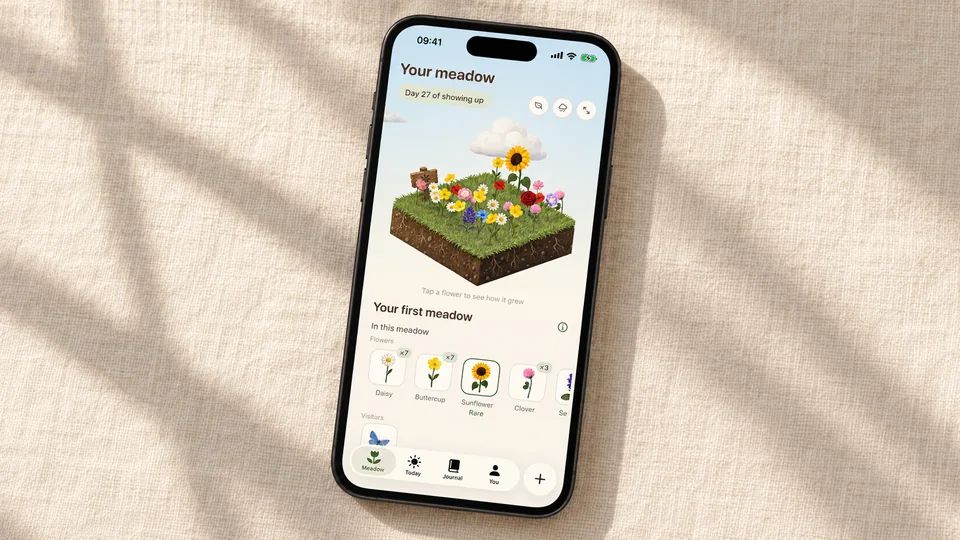
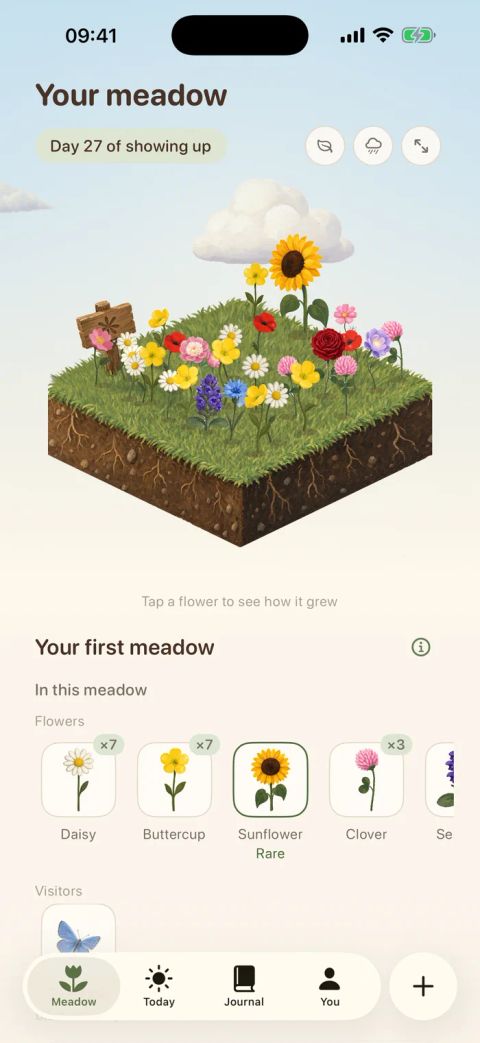
When your drive is low, the last thing that helps is an app scolding you for a gap. Meadow works the other way. It's a gentle iPhone app from Wildcard Wellness where each day you show up, by logging a little movement or ticking off a small habit, grows a new wildflower in a meadow that's yours, so the small wins you've been tracking turn into something you can watch build.
The part that fits a fading-motivation day is what happens when you miss. There are no streaks, so a flat week resets nothing and your flowers never wilt. You note your mood and energy while you're there, jot down one good thing, and pick the habit back up whenever you're ready, no clean slate required.
A few common questions
How do I get motivated when I have zero motivation? Don't try to feel it first. Do the smallest possible version of the task, the one-lap, one-line version, and let the action nudge the mood along. Starting is the hard part, and starting tiny gets you past it.
Is it normal to lose motivation so fast? Yes. Motivation naturally rises and falls with novelty, mood and energy. That's why the goal is to build a routine that doesn't depend on the feeling being there.
How long until it gets easier? It varies a lot, and there's no fixed number of days. Judge yourself on whether you're still turning up, not on whether it's clicked yet.
I've fallen off completely. Is it too late? No. The days you did before the gap still count, and the next rep is available right now. Falling off and climbing back on is the ordinary shape of this, not a sign you've done it wrong.
Pick one goal and write two lines: the smallest honest version you could do on your worst day, and the personal reason you care about it. Then do that smallest version today, before you feel ready. The feeling can catch up later.
AUTHOR
Co-founder of Meadow.
Ash is co-founder of Meadow, a habit and movement tracking app that turns small acts of self-care into a growing wildflower meadow.
Little and often, with Meadow
Consistency, not intensity.
Meadow turns the movement you enjoy and the habits that help you feel good into a meadow of wildflowers. No streaks to break, and your flowers never wilt.
Download Meadow