"Get fit" gives you nothing to do on Monday morning. It's a wish with no edges, so there's no obvious first step and no way to tell whether you've taken one. SMART is a way of squeezing that vagueness out until you're left with something you can act on this week.
SMART stands for specific, measurable, achievable, relevant and time-bound. Run "get fit" through those five filters and you get something like "walk briskly for 30 minutes, three lunchtimes a week, for the next eight weeks." Now there's a thing to do, a day to do it, and a way to know you did.
This guide takes each letter in turn with a fitness example, turns one vague intention into a goal you can start this week, hands you a template to fill in, and is honest about where SMART falls down and what to pair it with so the plan survives a flat week.
Where SMART came from
The acronym is older than the fitness blogs using it. It first turned up in a one-page article by George Doran in a 1981 issue of Management Review, written for managers setting company objectives, where the letters stood for specific, measurable, assignable, realistic and time-related. The A and R have drifted in the decades since, and most people now learn them as achievable and relevant.
That history is worth holding onto. SMART was built for boardroom targets, not for your knees or your parkrun time, which is part of why it can feel like a straitjacket once you push it too far.
Take SMART one letter at a time
The framework earns its keep on one job: turning a fuzzy intention into a concrete action. Here is what each letter asks of a fitness goal, with an example you can copy.
Specific: name the activity, the day and the place
Vague goals fall over here first. "Do more exercise" doesn't tell you whether to walk, swim or lift, or when any of it happens. Pin it to one activity and a slot in your week. Cleveland Clinic frames it as the gap between "I want to walk more" and "I want to walk 10,000 steps a day." One you can start today, the other you can't.
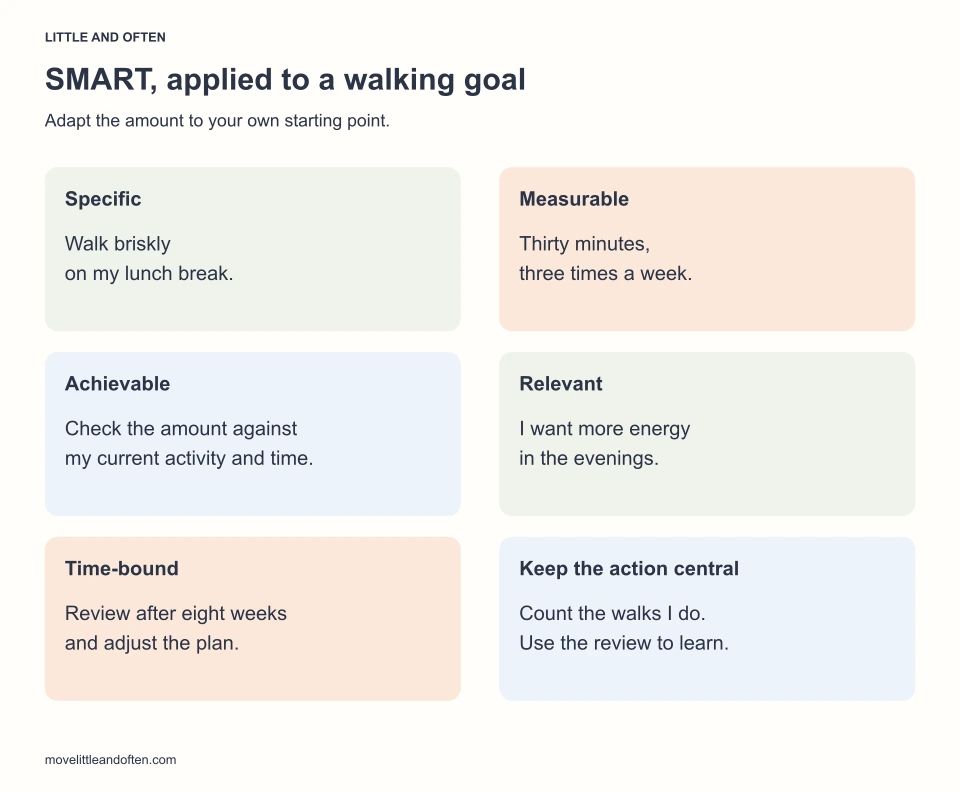
Our running example starts here: walk briskly on my lunch break.
Measurable: pick a number you can count
A goal you can't measure is a goal you can argue your way out of. Choose a number that fits the activity, whether that's minutes, steps, sessions a week, reps or weight on the bar. A big review of 138 studies found that keeping track of your progress toward a goal makes you more likely to reach it, with a stronger effect when you write the number down. So "30 minutes, three times a week" beats "a decent walk," because by Sunday you can tot it up.
Achievable: start from where you are, not where you wish you were
This is where beginners come unstuck. The CDC guideline for adults is 150 minutes of moderate activity a week plus muscle-strengthening on two days, but that's a destination, not a starting line. If you're coming back from nothing, Cleveland Clinic suggests 6,000 steps a day can be the right stretch when 10,000 would only set you up to fail. Pick a number you'd bet money you'll hit on an ordinary, tired day.
Relevant: connect it to why you're bothering
A goal that doesn't answer "why" is easy to drop the first time it's raining. Name the reason underneath it: more energy by the evening, keeping up with the kids, knees that complain less on the stairs. And match the action to that reason. If flexibility is the point, Cleveland Clinic notes you'd want a stretching routine, not more miles on the walk. Our example has a why now: so I've got more energy by evening.
Time-bound: set a review date, not a deadline
Open-ended goals drift. Put a date on it, eight weeks out, say, but treat that date as a point to stop and look rather than a pass-or-fail exam. On the day, you check what happened and decide what to change, and the goal carries on.
From "get fit" to a plan you can start this week
Stack those five answers and the wish becomes an instruction:
Walk briskly for 30 minutes, three lunchtimes a week, for the next eight weeks, so I've got more energy by evening.
Notice what kind of goal that is. It's built around the walking, the thing you do, not around a number on the scales or a dress size. That's a behaviour goal, and it's the version worth chasing, because the doing is the only part you control. Your weight and your resting heart rate answer to sleep, stress, hormones and a dozen things that aren't your effort today, while whether you did the walk is entirely up to you. James Clear puts it plainly in his guide to goal setting: goals set your direction, and your daily system delivers the progress.
So keep the outcome in view as a compass and run your days on the behaviour. Three walks a week is the job. If they happen, the goal is working, whatever the scales say this fortnight.
A SMART fitness goal template you can fill in now
You can build a whole goal on a scrap of paper in two minutes. Fill in the blanks, then stick it where the action happens.
Activity (Specific): ________
Number I'll count (Measurable): ________
Starting level I'm sure I can hit (Achievable): ________
Why it matters to me (Relevant): ________
Review date (Time-bound): ________
My bad-day version: ________
Filled in, it might read:
Activity (Specific): A brisk lunchtime walk
Number I'll count (Measurable): 30 minutes, three weekdays
Starting level I'm sure I can hit (Achievable): 20 minutes if 30 feels like a push
Why it matters to me (Relevant): More energy for the evenings
Review date (Time-bound): Eight weeks from today
My bad-day version: One lap of the block
That bad-day line is doing quiet, important work, and we'll come back to it.
Where SMART lets you down
Here's the part the productivity posts skip. There's surprisingly little evidence that the full SMART formula raises motivation or results for exercise, and in some cases it makes things worse.
Christian Swann, a psychologist who researches goal setting, argues in Psyche that SMART goals are style over substance. The framework wasn't built on psychological theory the way Locke and Latham's goal-setting research was, and when his team looked at how it's used in physical-activity programmes they found 34 different terms standing in for the five letters, which tells you how loose the whole thing has become.
The bigger problem is what a rigid number does to a beginner. Swann points to research showing that specific goals can leave less-active people feeling more pressure and less pleasure while they exercise. If you can barely swim a length, "swim 20 lengths three times a week" isn't a target, it's a way to feel like a failure by Wednesday. For a task you're still learning, an open goal like "see how many lengths feels good today" can produce performance as good as a SMART goal, with more enjoyment and less stress.
Enjoyment isn't a soft extra here. It's the thing that gets you back tomorrow. A SMART goal that squeezes out the part you liked about moving is a bad trade, however tidy it looks written down. Use SMART to sharpen a vague intention into a first action, and drop the strictness the moment the number starts crowding out the fun or the flexibility to change your mind.
Pair it with process goals and habits
A SMART goal tells you what you're aiming at. It doesn't make you do it on a cold, dark Tuesday when the sofa is winning. For that you need the action to become a habit, something that runs without a fresh decision each time.
The move is to bolt the new action onto something you already do. The American Heart Association's advice for making habits stick is to attach the behaviour to an established routine so a cue you can't miss prompts it. After I shut the laptop for lunch, I put my trainers on. After the school run, I walk. The old habit becomes the alarm clock for the new one.
Then shrink the action below what feels worth doing, so it survives your worst day. That's the bad-day version on the template. On a flat evening you do one lap of the block instead of the full 30 minutes, and the point isn't the exercise, it's that you didn't break the thread. If you're building from a standing start, our guide to how to start exercising walks through the first few weeks, and how to stay consistent with exercise covers keeping it going when life gets in the way.
Be patient about how long it takes to feel automatic. Work by Phillippa Lally's team, tracking people forming everyday habits, found the time varied hugely from person to person and that missing a single day didn't derail the process. Ignore the neat "21 days" you've heard. Judge yourself on whether you're still turning up. For the wider setup around a goal, from if-then plans to reviews, see our guide on how to set goals that stick.
Somewhere to log the sessions

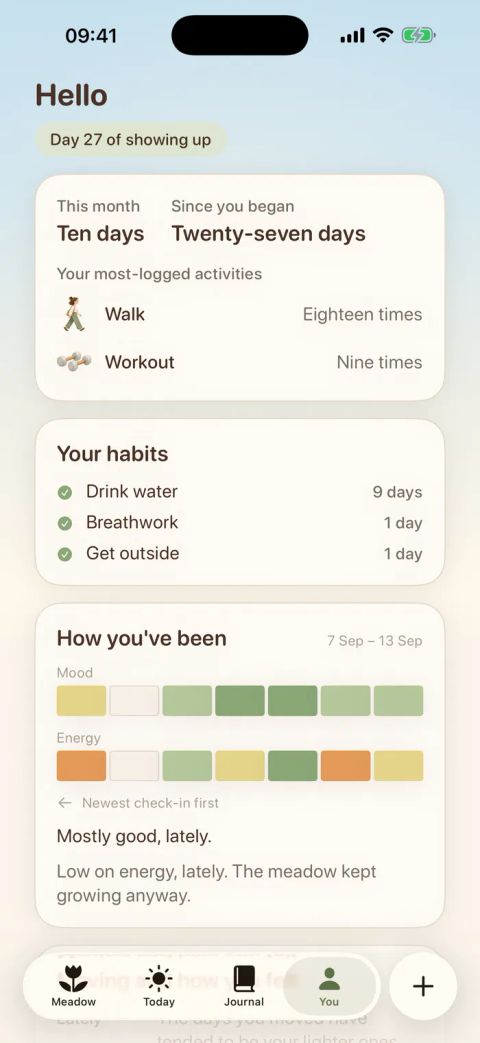
A fitness goal starts to feel real once it becomes a thing you tick off on ordinary days, and that's the idea behind Meadow, a gentle iPhone app from Wildcard Wellness. You log a walk or a few minutes of movement, tick off the small habits around it, and every day you show up grows a new wildflower in a meadow that's yours. It's built for consistency, so there are no streaks to break, which means the flat evening when you only managed one lap of the block still counts and a missed day resets nothing you've grown. You can try it at Meadow.
Common questions
How many fitness goals should I set at once? One, maybe two. Trying to overhaul your cardio, strength, flexibility and diet from the same Monday spreads your attention thin, and most of it collapses by week two. Get one behaviour running until it's close to automatic, then add the next.
What if I set the number too high and keep missing? Lower it without guilt. A goal you hit four weeks running does more for you than an ambitious one you abandon. Drop to the bad-day version as your new normal for a fortnight, then nudge it back up once it feels easy.
Should I use SMART goals or open goals? Use SMART to turn a vague wish into a concrete first action, especially if you already know the activity. If you're a beginner or you want the movement to stay enjoyable, a looser open goal like "walk and see how far feels good" often works better and feels less like a test.
Should my goal be about weight or about the workout? Build it around the workout. You control whether you do the session, not what the scales show, so make the behaviour the goal and let any change in weight or fitness follow from that. This also keeps a rough week from feeling like proof you've failed.
I've missed a whole week. Do I start over? No. There's nothing to reset. Look at what got in the way, adjust the plan for it, and pick the goal back up at the next chance, the next lunch break or the next morning, not the first of next month.
Pick your activity right now and write one line: this week I'll [activity] for [number] on [which days], and if the day goes sideways I'll do [the bad-day version]. That single sentence is a SMART fitness goal with a safety net built in, and it's small enough to finish before you close the page.
AUTHOR
Co-founder of Meadow.
Ash is co-founder of Meadow, a habit and movement tracking app that turns small acts of self-care into a growing wildflower meadow.
See how far you've come
Your habits, moods and little wins, all in one place
Meadow keeps track of the walks, the water and the good days, so you can look back and watch your effort add up.
Download Meadow