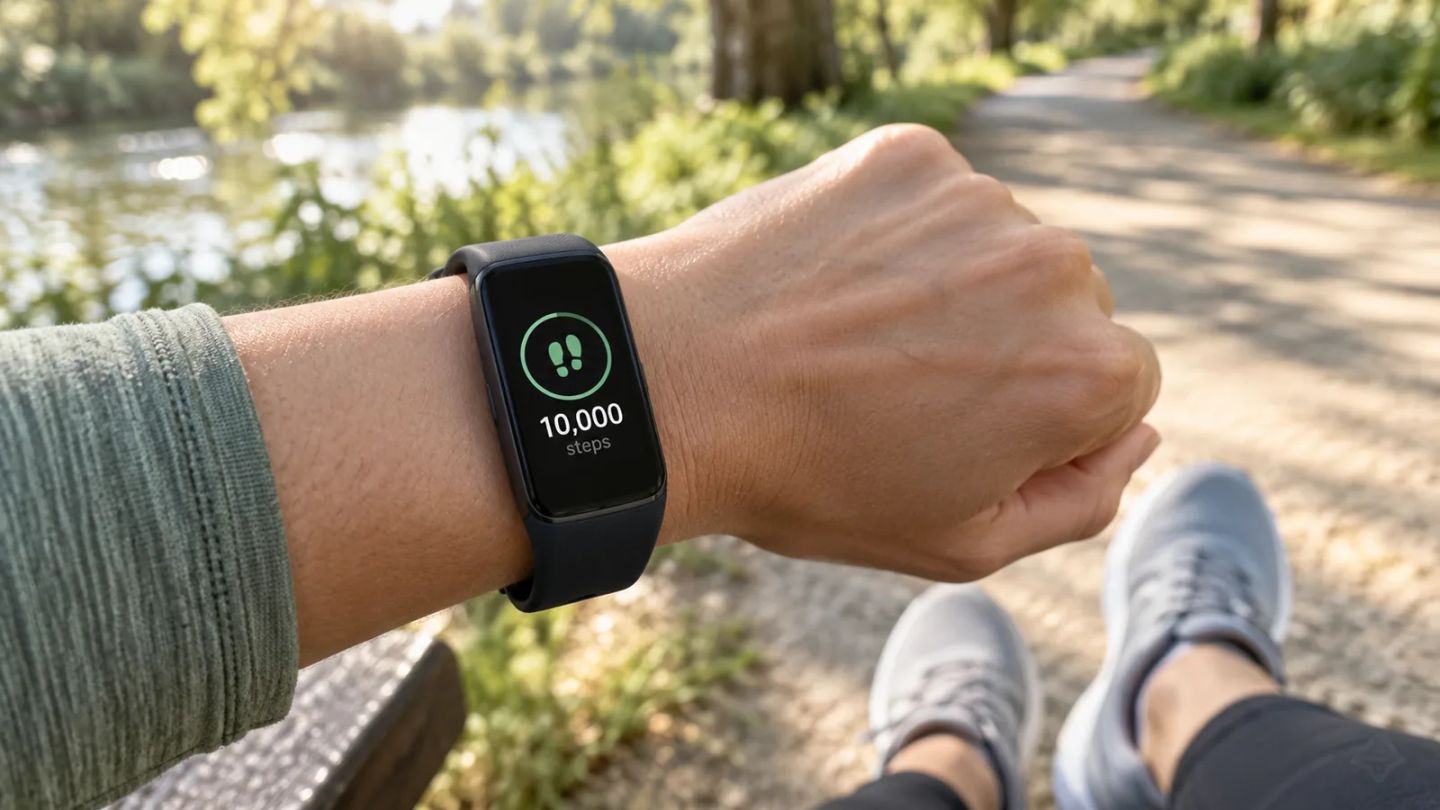
No, you do not need 10,000 steps a day to be healthy, and the number was never meant as a health rule in the first place. It began as a slogan on a Japanese pedometer in the 1960s, and the research that arrived decades later points to a lower, gentler figure for most people. That does not make 10,000 useless. It makes it one option among several, and knowing where it came from helps you decide whether it deserves a place in your week or whether a smaller target would serve you better.
Where the 10,000 figure came from
The number traces back to 1965, when a Japanese company launched a pedometer named the Manpo-kei, which translates as "10,000 steps meter". Harvard Health reports that the name was a marketing tool rather than a research finding, and one of the researchers it quotes says so plainly. The round figure was memorable, easy to print on a box, and it happened to launch around the time of the 1964 Tokyo Olympics, when interest in fitness was high.
From there it spread. Fitness trackers later shipped with 10,000 set as the default daily goal, which quietly turned a sales pitch into something that felt official. No study drew a line at 10,000 and declared everything below it unhealthy. A product name stuck, and the world treated it as medicine.
So if that total has ever left you feeling behind on an otherwise active day, the history is worth holding onto.
Do you need 10,000 at all?
The benefits of walking appear to start well below 10,000, and they tend to level off before you reach it.
One widely cited study, led by I-Min Lee and published in JAMA Internal Medicine, followed 16,741 older women who wore step trackers. Compared with the least active group, who averaged around 2,700 steps a day, women who managed roughly 4,400 steps had a lower risk of dying over the follow-up period. The benefit kept improving as steps rose, then flattened at about 7,500 a day. More steps beyond that point were not linked to further gains in this group. The study also found that walking faster made no clear difference once total steps were accounted for.
A larger picture came from a 2022 meta-analysis pulling together 15 studies and nearly 50,000 people, summarised by the UNC Gillings School of Global Public Health. It found that the point where the risk of early death stopped falling depended on age. For adults aged 60 and over, the benefit levelled off at around 6,000 to 8,000 steps a day. For younger adults it settled higher, at roughly 8,000 to 10,000. In other words, a fit 30-year-old and a 70-year-old sensibly have different numbers to aim at, and 10,000 sits near the top of the range rather than in the middle.
More recent work has pushed the practical figure lower still. A 2025 review in The Lancet Public Health, covered by EurekAlert, combined 57 studies and about 160,000 adults. At roughly 7,000 steps a day, compared with about 2,000, it recorded lower rates across a spread of outcomes: a 47% lower risk of death from any cause, 25% for cardiovascular disease, 38% for dementia, 22% for depression, 14% for type 2 diabetes and 28% for falls. The authors suggested 7,000 may be a more realistic target than 10,000, especially for people who are not very active.
A few honest caveats belong here. These are observational studies, which means they can show that more steps tend to go with better health without proving the steps alone caused it. People who walk more may differ in other ways. Several of the disease findings rest on a small number of studies and carry low certainty. What holds across all of them is the shape of the pattern rather than any exact figure. More movement beats less, the largest gains come when a very inactive person starts doing a bit more, and the returns flatten out somewhere well short of 10,000.
10,000 versus fewer, in plain terms
Picture the difference. Around 7,000 steps is roughly three miles for many people, or a little over an hour of walking spread across a day. Ten thousand adds another mile and a half or so on top. That extra stretch is not wasted, and if you enjoy it, it counts. The evidence does not show it buying much additional protection for the average person once you are already moving a decent amount.
This matters most for the days that go sideways. Someone who walked 8,000 steps and calls it a failure has done their body more good than the numbers suggest, and the disappointment is the only thing they got wrong. If you want a fuller breakdown of the general question, our guide to how many steps a day walks through the ranges, and how many miles should you walk a day covers the distance side if that framing suits you better.
Should you still aim for 10,000?
You can, and for some people it works nicely as a target. A round number gives you something to push towards, and if hitting it keeps you cheerful and moving, there is no reason to abandon it. The shift worth making is in how you read the figure. Treat it as a record of movement rather than a verdict on your worth, and let it flex with your life instead of ruling it.
If a lower goal fits your body or your schedule better, that is a sound choice backed by the research, not a compromise. Picking a personal target you will meet most days tends to serve you better than a headline number you dread. Our piece on how many steps a day should I walk goes deeper on choosing that number.
If you are returning to activity after a long break, are pregnant, or live with a health condition, it is sensible to check with your GP before setting any target, since a general figure cannot account for your particular situation.
Practical ways to reach 10,000 if you want it
Reaching 10,000 rarely means one long march. It usually means finding steps in corners of the day you already have. The trick is to attach walking to things you do anyway, so it does not depend on willpower or a spare hour you may not get.
Here is a working checklist of small additions. Tick the ones you can slot in without rearranging your whole day.
Ways to add steps
☐ A ten-minute walk after lunch, same time each day
☐ Getting off the bus or tube one stop early
☐ Parking at the far end of the car park
☐ Taking the stairs when the climb is short
☐ Walking during phone calls you do not need to sit for
☐ A loop around the block before or after the school run
☐ Pacing while the kettle boils or an advert plays
☐ Walking the long way to the kitchen, the printer, the postbox
Most people find that two or three of these, done daily, close a surprising gap. If you want to see where your steps come from, sketch a rough plan for a single day. A blank version looks like this:
Morning: ____ (e.g. walk to the station), approx ____ steps
Midday: ____, approx ____ steps
Evening: ____, approx ____ steps
And a filled example, aiming for around 8,000 rather than a strict 10,000:
Morning: walk to the station and back, approx 3,000 steps
Midday: ten-minute loop after lunch, approx 1,200 steps
Evening: walk to the shop and a short stroll after dinner, approx 3,800 steps
Build up gradually rather than leaping to 10,000 overnight. The NHS describes a brisk walk as a pace where you can still talk but not sing, and it notes that even a short brisk walk counts towards your week. That effort matters in a way a step counter cannot see. Ten brisk minutes barely moves a step total yet does real work, so treat the number as one signal rather than the whole truth. For the wider picture, national guidance from the CDC suggests adults aim for 150 minutes of moderate activity a week plus muscle-strengthening on two days, none of which a step count fully captures.
Meadow, if you like watching progress build

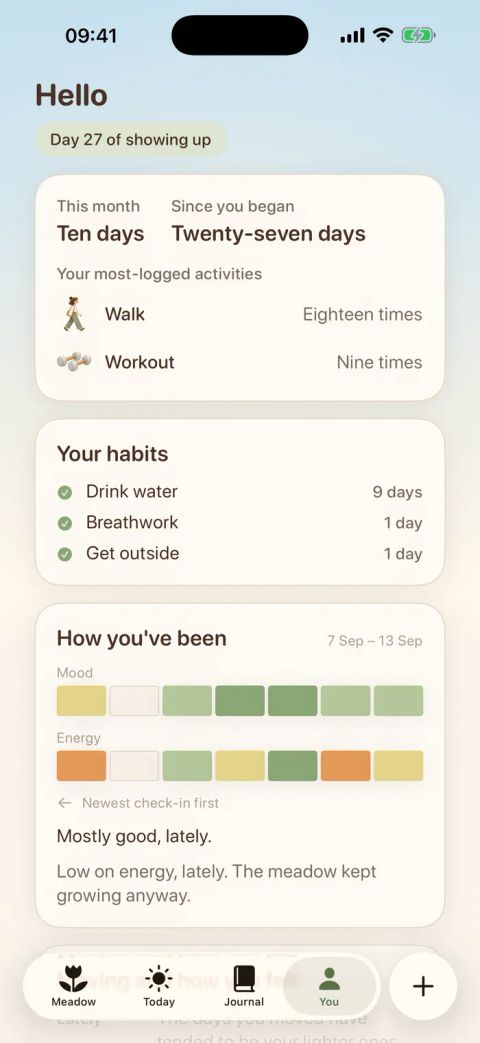
Marking each walk gives you something steady to look back on, which tends to help more than staring at the same daily figure. A tick on a wall calendar does the job. So does an app.
Another app worth checking out is Meadow, because it is built around showing up rather than chasing a perfect run. Made by Wildcard Wellness for iPhone, it lets you log movement you enjoy, a walk, a dance, a little yoga, alongside small daily habits and a note on your mood, a daily win and an affirmation. Every day you show up grows a wildflower, and rare flowers and small animal visitors turn up over time. There are no streaks, so a missed day resets nothing and your flowers never wilt. Meadow costs $39.99 a year or $9.99 a month after a seven-day free trial.
On hard days, and after a gap
Some days the full walk will not happen, and that is worth planning for rather than dreading.
Keep a smaller version ready. If your usual loop is too much, step outside for three minutes, or walk to the end of the road and back. A short walk recorded plainly as a short walk keeps the habit alive and keeps your log truthful about the day you had.
If you miss a day, or a week, the walking still counts when you pick it up again. There is no streak to protect and no debt to repay by doubling your steps tomorrow. Take the next reasonable chance and carry on. What you are after is a pattern you can return to, not an unbroken chain.
Frequently asked questions
Is 10,000 steps a day scientifically proven?
No. The figure came from a 1960s pedometer name, not from a study. Research since then, including the JAMA Internal Medicine work on older women, tends to show benefits levelling off below 10,000, often around 7,000 to 7,500 for many people.
How many steps a day is enough?
It depends on your age and starting point. Benefits appear from as few as 4,000 steps compared with very low activity, with much of the gain banked by around 7,000. Older adults may see the curve flatten earlier, nearer 6,000 to 8,000. If your main goal is weight, our guide to how many steps a day to lose weight sets steps in the context of diet and energy balance, which the CDC notes varies a lot from person to person.
How far is 10,000 steps?
For many adults it works out at roughly four to five miles, depending on height and stride, and around 90 to 100 minutes of walking spread through the day.
Does it matter how fast I walk?
Faster walking has its own benefits, but the older-women study found stepping intensity was not clearly linked to lower mortality once total steps were accounted for. Total movement seems to carry most of the weight, so a gentle pace still counts.
Should I still use 10,000 as my goal?
If you like it and reach it comfortably, keep it. If it leaves you feeling behind, pick a lower number you will meet most days. The best target is the one you will walk.
Your first step this week is small. Choose one line from the checklist above, decide when and where it will happen tomorrow, and write it down. One realistic addition, attached to something you already do, is a walking habit beginning, with no particular number required.
See how far you've come
Your habits, moods and little wins, all in one place
Meadow keeps track of the walks, the water and the good days, so you can look back and watch your effort add up.
Join the Meadow waitlist