"Read more" is a wish with no edges. There's nothing to do about it tonight and no way to tell, by Sunday, whether you did it. SMART is a small set of five questions you run a goal through until the wish turns into an instruction you can act on this week.
SMART stands for specific, measurable, achievable, relevant and time-bound. Push "read more" through those five filters and you land on something like "read ten pages after dinner on weeknights for the next month." Same intention. One of them you can start tonight.
This guide takes the five letters one at a time with everyday examples, turns a vague goal into a SMART one you can fill in on a scrap of paper, is honest about where the framework falls down, and shows what to pair it with so the plan survives a flat week.
Where SMART came from
The acronym is older than the productivity blogs using it. It first appeared in a one-page article by George Doran in a 1981 issue of Management Review, written for managers setting company objectives, where the letters stood for specific, measurable, assignable, realistic and time-related. The A and R have wandered since. Most people now learn them as achievable and relevant, and the "assignable" idea, deciding who's responsible, quietly dropped off when the tool moved from the office to personal life.
Hold on to that history. SMART was a memory aid for writing business targets, not a theory of how humans change. That's part of why it works so well for some goals and feels like a straitjacket around others.
Take SMART one letter at a time

The framework does one job well: it squeezes the vagueness out of a goal so the next action is obvious. Here's what each letter asks, with an example you can copy. We'll build one running goal, reading more, as we go.
Specific: name the what and the when
Vague goals fall over here first. "Read more" doesn't say what, or when, or how much. Pin it to one action and a slot in your day. "Read a novel for a bit" becomes "read ten pages of my book." You've named the thing you'll do.
Measurable: pick a number you can count
A goal you can't count is a goal you can talk your way out of. Choose a number that suits the action: pages, minutes, sessions a week, pounds saved, glasses of water. A review of 138 studies found that keeping track of your progress towards a goal makes you more likely to reach it, with a stronger effect when you write the number down. "Ten pages" beats "a good read," because on Sunday you can add it up.
Achievable: start from where you are
This is where ambition trips people up. Set the bar at a level you'd bet money you'll clear on an ordinary, tired day, not on your best one. If you haven't opened a book in a year, fifty pages a night is a way to feel like a failure by Wednesday. Ten pages you can do half-asleep. You can raise it later. You can't un-quit.
Relevant: connect it to why you're bothering
A goal that doesn't answer "why" is easy to drop the first rainy evening. Name the reason underneath it and check the action matches. If the point is to wind down off your phone before bed, a paperback fits and an audiobook on your commute doesn't. Our example gets a why: so I switch off screens before sleep.
Time-bound: set a review date, not a deadline
Open-ended goals drift out of view. Put a date on it, a month out, say, but treat that date as a moment to stop and look, not a pass-or-fail exam. On the day, you check what happened and decide what to change. The goal carries on.
Turn a vague goal into a SMART one
Stack those five answers and the wish becomes a line you can act on:
Read ten pages after dinner on weeknights for the next month, so I switch off screens before bed.
You can build a goal like that on the back of an envelope in two minutes. Fill in the blanks, then stick it where the action happens:
What I'll do (Specific): ________
Number I'll count (Measurable): ________
Starting level I'm sure I can hit (Achievable): ________
Why it matters to me (Relevant): ________
Review date (Time-bound): ________
My bad-day version: ________
Filled in, it might read:
What I'll do (Specific): Read my book
Number I'll count (Measurable): Ten pages, five weeknights
Starting level I'm sure I can hit (Achievable): Three pages if I'm shattered
Why it matters to me (Relevant): Less screen time before sleep
Review date (Time-bound): Four weeks from today
My bad-day version: One page
That bad-day line is doing quiet work, and we'll come back to it.
The same template, other corners of life
SMART isn't only for exercise or work. The five questions sharpen any fuzzy intention. A few worked examples:
- Money. "Save more" becomes "move £50 into savings on payday each month for six months, so I've got a cushion for the car."
- Water. "Drink more water" becomes "fill a one-litre bottle after breakfast and finish it by lunch on workdays." Our guide to drinking more water has more on this one.
- Home. "Tidy up" becomes "clear one drawer or shelf every Sunday morning until the spare room's done."
- People. "Stay in touch" becomes "ring one friend or relative on my Wednesday walk home, working down a short list."
Notice these are all things you do, not results you hope arrive. That distinction is where SMART either helps or quietly hurts, so it's worth its own section.
Where SMART lets you down
Here's the part the templates skip. There's surprisingly little evidence that the full SMART formula raises motivation or results, and in some settings it makes them worse.
Christian Swann, a psychologist who studies goal setting, argues in Psyche that SMART goals are style over substance. The framework was never built on psychological theory the way Edwin Locke and Gary Latham's research on specific, challenging goals was, and Doran's original article didn't mention any. When Swann's team looked at how SMART is used in practice, they found 34 different terms standing in for the five letters, which tells you how loose the whole thing has gone.
The sharper problem is what a rigid number does to a beginner. Swann points to research showing specific goals can leave less-active people feeling more pressure and less pleasure while they move. If you can barely swim a length, "swim twenty lengths, three times a week" isn't a target, it's a countdown to giving up. For something you're still learning, an open goal like "see how far feels good today" can produce results as good as a fixed one, with more enjoyment and less stress.
Enjoyment isn't a soft extra. It's the thing that brings you back tomorrow, and a tightly measured target can crowd it out along with the room to change your mind. SMART also has little to say about big, open-ended ambitions where you can't yet name the number, like "get better at painting" or "be a calmer parent." Use it to turn a vague intention into a concrete first action, then loosen the grip the moment the counting starts flattening the fun.
Pair SMART with process goals and habits
A SMART goal tells you what you're aiming at. It doesn't get you off the sofa on a cold Tuesday. For that, the action has to become a habit, something that runs without a fresh decision every time.
Split the goal in two. The outcome is the result you want, a full savings pot, a finished book. The process is the repeated action that might get you there, £50 on payday, ten pages a night. You don't fully control the outcome, because savings answer to surprise bills and reading speed answers to how tired you are. What you control is whether you did today's action. James Clear puts it plainly in his guide to goal setting: your goals set the direction, and your daily system delivers the progress. So keep the outcome as a compass and run your days on the process.
The move that makes the process stick is to bolt the new action onto something you already do. The American Heart Association's advice for making habits stick is to attach the behaviour to an established routine, so a cue you can't miss sets it off. After I do the washing-up, I read. After my alarm goes, I fill the water bottle. The old habit becomes the alarm clock for the new one.
Then shrink the action below what feels worth doing, so it survives your worst day. That's the bad-day version on the template: one page instead of ten, a splash of water instead of the litre. On a flat night the point isn't the reading, it's that you didn't break the thread. Be patient about how long the thread takes to feel automatic. Work by Phillippa Lally's team, tracking people forming everyday habits, found the time varied hugely from person to person, and that missing a single day didn't derail the process. Ignore the tidy "21 days" you've heard, and judge yourself on whether you're still turning up. For the wider setup around a goal, from if-then plans to weekly reviews, see how to set goals that stick, and how to achieve goals for keeping one going once the novelty wears off.
Somewhere for the goal to live
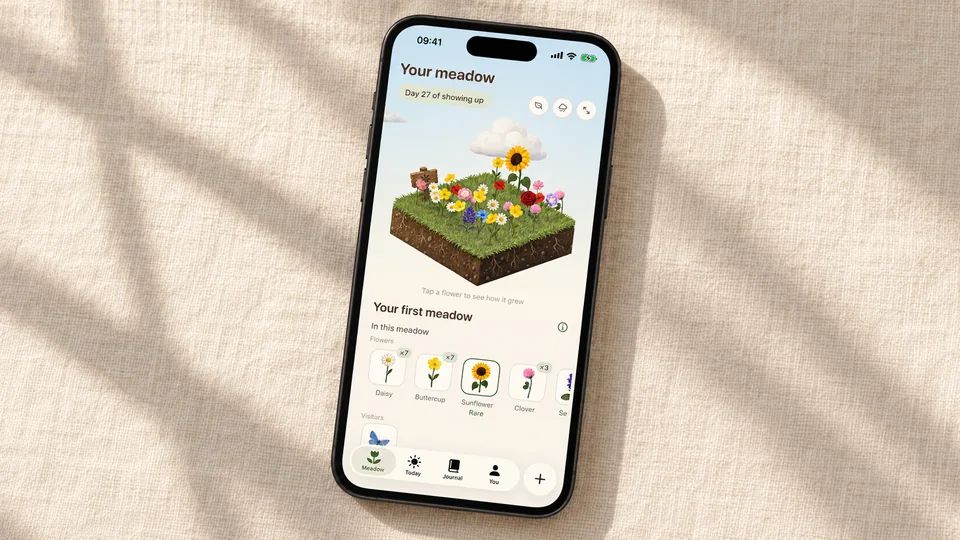
A goal starts to feel real once it becomes a thing you tick off on ordinary days. That's the idea behind Meadow, a habit and movement app for iPhone from Wildcard Wellness. You log a little movement, tick off the small daily actions your goal breaks down into, and note your mood and energy if you fancy it, and every day you show up grows a new wildflower in a meadow that's yours. It's built for consistency, so there are no streaks to break, which means the flat night when you managed one page still counts and a missed day resets nothing you've grown. You can try it at Meadow.
Common questions
How many SMART goals should I set at once? One, maybe two. Overhauling your money, reading, sleep and fitness from the same Monday spreads your attention thin, and most of it collapses by week two. Get one action close to automatic, then add the next.
Is SMART the same as a goal I'm learning? Not quite. SMART shines when you already know how to do the thing and only need to pin down how much and by when. For a skill you're still picking up, a looser learning goal like "practise and see what improves" often beats a fixed number and feels less like a test.
What if I set the number too high and keep missing? Lower it, and skip the guilt. A goal you hit four weeks running does more for you than an ambitious one you abandon. Drop to the bad-day version as your new normal for a fortnight, then nudge it up once it feels easy.
Are SMART goals worth using for fitness? They can be, with the same caution about beginners and enjoyment. We go deeper on that in our guide to SMART fitness goals.
I've missed a whole week. Do I start over? No. There's nothing to reset. Look at what got in the way, adjust the plan for it, and pick the goal back up at the next chance, the next evening or the next payday, not the first of next month.
Pick one goal right now and write a single line: this [timeframe] I'll [action] for [number] on [which days], and if the day goes sideways I'll do [the bad-day version]. That sentence is a SMART goal with a safety net built in, and it's short enough to finish before you close the page.
AUTHOR
Co-founder of Meadow.
Ash is co-founder of Meadow, a habit and movement tracking app that turns small acts of self-care into a growing wildflower meadow.
See how far you've come
Your habits, moods and little wins, all in one place
Meadow keeps track of the walks, the water and the good days, so you can look back and watch your effort add up.
Download Meadow