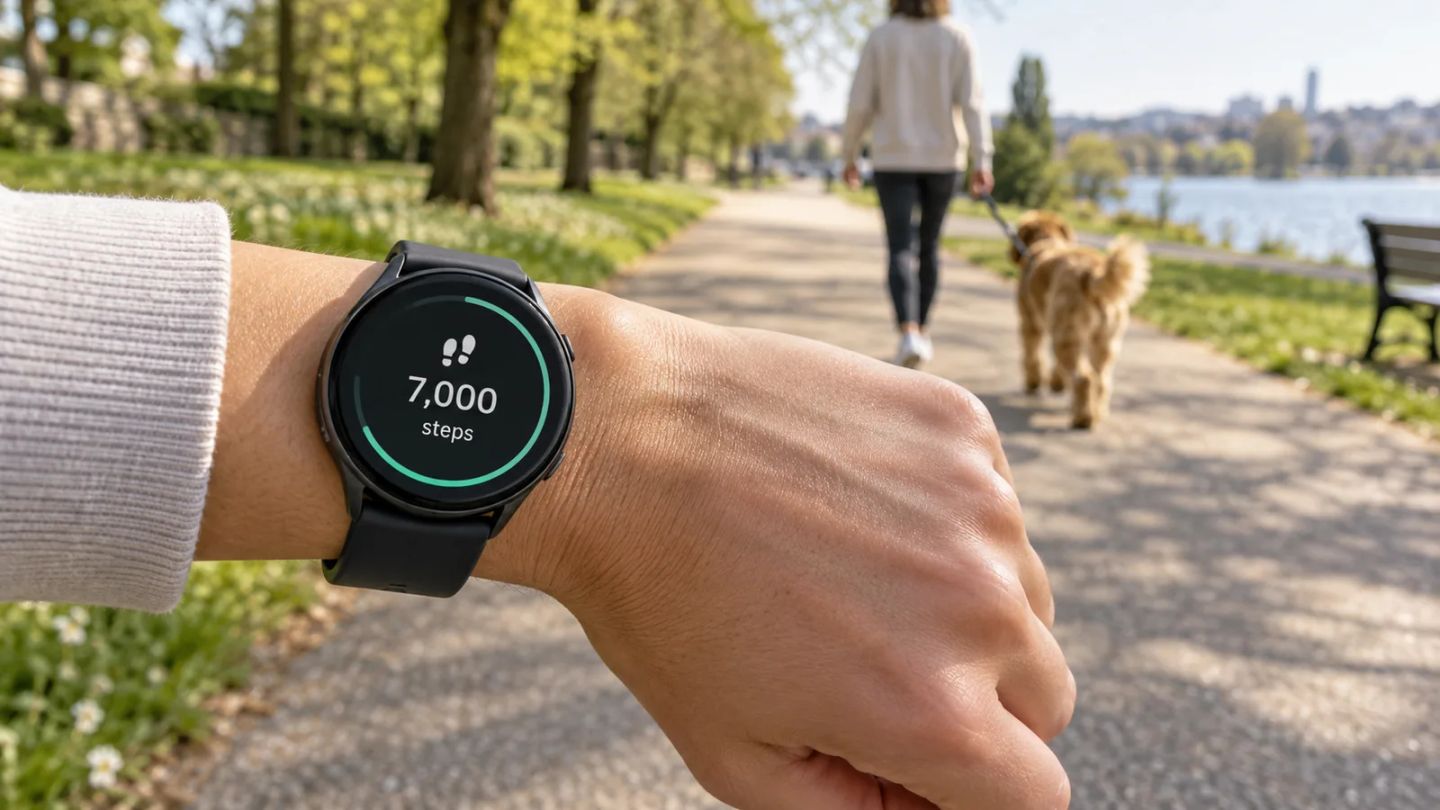
Is 7,000 steps a day good? Yes, and the evidence behind it is unusually strong. It is one of the best studied step targets we have, and it sits at the point where most of the health return on walking has already landed, which makes it a sensible aim for the majority of people, not a number pulled from a fitness slogan.
That answer comes with useful detail. It helps to know where the figure comes from, what happens below and above it, who it suits, and how to build up to it without turning a walk into a chore.
What the evidence says about 7,000 steps
The clearest backing arrived in August 2025, when a dose-response review in The Lancet Public Health pooled 57 studies covering more than 160,000 adults whose steps were measured by wearable devices. Reporting on the findings, Harvard Health notes that people managing around 7,000 steps a day had a 25 percent lower risk of cardiovascular disease and a 47 percent lower risk of dying from any cause, compared with those walking about 2,000 steps.
The benefits stretched well beyond the heart. A summary from EurekAlert lists lower risk at 7,000 steps across a spread of outcomes: roughly 6 percent for cancer, 14 percent for type 2 diabetes, 38 percent for dementia, 22 percent for depression and 28 percent for falls. Few single habits touch that many parts of health at once.
A note on what these numbers can and cannot say. This is observational evidence, so it shows that more steps went hand in hand with better health without proving the steps alone caused it. People who walk more often differ in other ways too. Read the figures as a strong, consistent signal rather than a personal guarantee.
Is 7,000 better than 10,000?
For most people, choosing 7,000 over 10,000 costs you very little in health terms and gains you a target you can reach. The 2025 review found that walking more, up to 10,000 steps, did bring further gains, but they were modest for most outcomes once you were past 7,000.
The lead researcher put it plainly. Professor Melody Ding of the University of Sydney told ScienceDaily that "aiming for 7,000 steps is a realistic goal", while her colleague Dr Katherine Owen added that "beyond 7,000 steps, the extra benefits for most of the health outcomes we looked at were modest".
There is a fair exception. For some conditions, heart disease among them, the benefit kept climbing past 7,000. So if you are already comfortable at higher counts, there is no reason to pull back. The 10,000 figure itself was never a health rule anyway, and if the history interests you we cover it in 10,000 steps a day.
What if you cannot reach 7,000 yet?
Do not treat 7,000 as a pass mark you are failing until you hit it. The steepest part of the benefit curve sits at the low end, which means the biggest single improvement comes from a fairly inactive person doing a bit more, not from an active person doing even more.
The same 2025 review measured everything against roughly 2,000 steps, so every thousand you add above a low baseline is doing work. If you are at 3,000 now, a move to 4,500 is real progress you can feel proud of, and it puts you on the road to 7,000, not stranding you short of it.
On any given week, the direction of travel is what to watch, not the destination. A larger picture of how the gains build from low counts sits in how many steps a day for good health.
Who 7,000 steps suits, and where age comes in
For a broadly healthy adult who wants a single number to aim at, 7,000 is a good one. It is high enough to move the health needle across the outcomes above and low enough to fit around work, family and an ordinary amount of tiredness.
Age nudges the target a little. A meta-analysis led by Amanda Paluch, pooling 15 studies and nearly 50,000 people, mapped where the longevity benefit tends to level off. Reporting the work, the UNC Gillings School of Global Public Health explains that for adults aged 60 and over the risk of early death flattened at around 6,000 to 8,000 steps, while for adults under 60 it settled at roughly 8,000 to 10,000. Across the more active groups, the reduction in death risk ran from 40 to 53 percent.
Read together, that puts 7,000 comfortably inside the healthy band for an older adult and a touch below the plateau for a younger one. Either way it is a solid target, and nobody needs to treat it as a minimum they have failed to meet.
One caveat belongs here. If you are returning to activity after a long break, are pregnant, or live with a health condition or any concerns, it is worth a word with your GP before you build up. A general figure cannot account for your particular situation, and a short conversation can set a starting point that fits you.
How to reach 7,000 steps a day
The target sticks when it grows out of your real week, not an app default. Start by finding your baseline. If your phone counts steps, look back over a normal seven days and note your rough average across a busy day and a quiet one.
Then close the gap in stages, not one leap.
- Add about 1,000 steps to your daily average and hold it for a week or two until it feels normal.
- Once that settles, add another 1,000, and repeat until you are near 7,000.
- Anchor the extra steps to things you already do, so they need no fresh willpower.
That last point does most of the heavy lifting. A loop of the block after lunch, getting off the bus a stop early, a walk to the postbox, pacing the kitchen while the kettle boils, a phone call taken on your feet. Ten unhurried minutes of walking adds roughly 1,000 steps for many people, which turns 7,000 from a wall into three or four small errands stitched through the day.
Effort counts alongside the tally. UK guidance leans on time and intensity, not steps, and the NHS suggests adults aim for at least 150 minutes of moderate activity a week plus strengthening on two or more days. Brisk walking, the kind where you can talk but not sing, ticks the moderate box, so a step counter and the clock are pointing at the same habit from different angles.
It is worth remembering the number is not the whole story. The CDC notes that the activity a person needs "varies greatly from person to person", which is the case for a personal figure over a universal one. If your aim is weight, not general health, the balance shifts towards diet and effort, which we cover in how many steps a day to lose weight.
Smaller on hard days, and starting again after a gap
Some days 7,000 will be out of reach, and that is worth planning for, not dreading. Keep a smaller version ready. If the day falls apart, walk to the end of the road and back, or step outside for three minutes. A short walk logged as a short walk keeps the habit breathing in a way a blank day does not.
Miss a day, or a week, and the walking still counts when you pick it up. There is no debt to repay by doubling your steps tomorrow. Take the next reasonable chance and carry on at whatever figure fits the day in front of you.
See the walks stack up

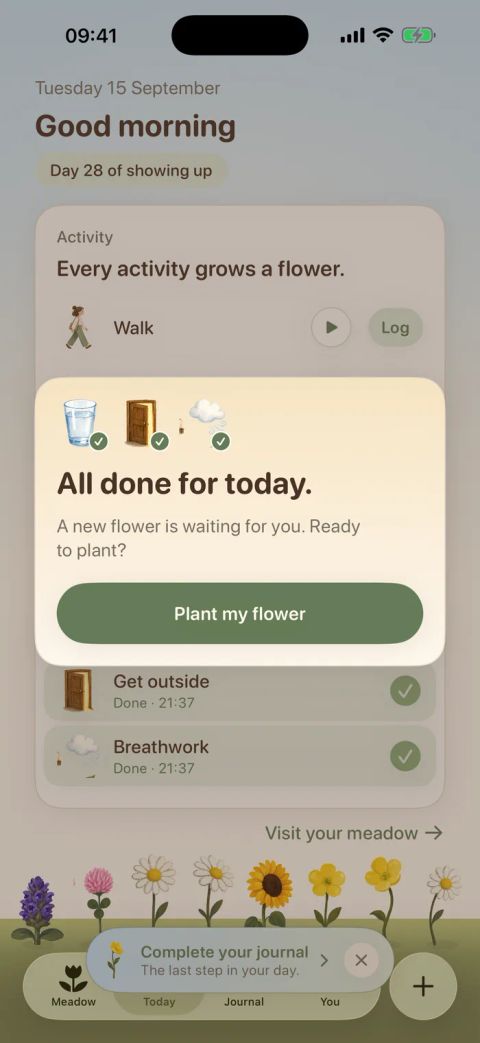
Marking each walk gives you something honest to look back on, which tends to help more than staring at a single daily total. A tick on a wall calendar does the job. If a number on a tracker leaves you cold, Meadow gives the habit a friendlier shape by growing a wildflower for each day you move. It is a gentle habit app for iPhone from Wildcard Wellness, where you log a walk, tick off small daily habits, and note your mood, a daily win and an affirmation. It is built around a pattern held over weeks rather than a flawless week, so there are no streaks and a missed day resets nothing and your flowers never wilt.
Common questions
Is 7,000 steps a day enough exercise?
For general health it does a lot, and the evidence linking it to lower mortality and disease risk is strong. It is not the whole picture though. The guidelines also ask for muscle-strengthening activity on two or more days a week, because steps and strength work cover different needs. Think of 7,000 as a strong aerobic base, not the entire job.
How long does it take to walk 7,000 steps?
Most people cover roughly 1,000 steps in around 10 minutes of walking, so 7,000 steps works out at a little over an hour of movement spread across a day. That total rarely happens in one go. It adds up from short walks, errands and moving around the house.
Is 7,000 steps a day good for weight loss?
Steps help, but weight change leans more on overall energy balance, where diet plays the larger role. Walking supports the effort and is well worth keeping, though 7,000 steps on its own is no guarantee of weight loss. For the detail, see how many steps a day to lose weight.
Do the steps need to be brisk to count?
Every step counts towards your total, and the research found step count mattered more than pace once the total was accounted for. Brisk minutes still add value a raw count cannot see, which is why UK guidance leans on 150 minutes of moderate effort. A mix of gentle and brisk walking is fine.
For your first step this week, check your typical daily count, then set an aim about 1,000 steps above it and hold it there until it feels ordinary. Seven thousand becomes reachable one small nudge at a time, starting from your own week, not a number off a screen.
AUTHOR
Co-founder of Meadow.
Ash is co-founder of Meadow, a habit and movement tracking app that turns small acts of self-care into a growing wildflower meadow.
Every little bit counts
Five minutes counts. So does a dance in the kitchen.
Log the movement you enjoy and the small habits that help you feel good, and watch them bloom into something you can see.
Download Meadow