Starting strength training after 40 works much the same way it does at any age, with a few sensible adjustments for how your body recovers. Two short full-body sessions a week, using your own bodyweight and a pair of dumbbells, is enough to hold on to muscle and bone that would otherwise slip away quietly in the background.
You don't need a gym, a barbell, or an hour you can't spare. You need a handful of simple movements, done regularly, with a bit of patience.
This guide covers why 40 is the age muscle and bone start asking for attention, a starter routine you can do at home, how to add difficulty without overdoing it, why recovery changes as you get older, and what's different for women moving through perimenopause and menopause. If you want the movement mechanics from scratch, our general strength training for beginners guide sits alongside this one.
Why 40 is when this starts to count
Somewhere in your thirties, your body begins letting go of muscle. Harvard Health puts the pace at as much as 3% to 5% per decade after age 30, and the drop tends to speed up the longer you leave it. The clinical name for that age-related loss is sarcopenia.
Left alone, it's the reason stairs feel steeper at 55 than they did at 35, and the reason a stumble at 70 is more likely to end in a broken wrist. Harvard's own review links low muscle to 2.3 times the risk of a low-trauma fracture from a fall.
Bone travels the same road. Bone is living tissue that responds to being loaded, and a review of physical activity for older adults describes how mechanical force from exercise triggers the cells that build new bone. Sit still and the signal to keep bone dense fades. Load it, and the signal comes back.
Strength training is the one thing that pushes against both at once. A review of resistance training in older adults calls it a safe and effective method to slow the progress of sarcopenia, improving strength, power and everyday functionality. The same review notes older adults still adapt to training in a way that's comparable to younger people. You haven't missed the window.
It is never too late to start
The most common worry among people starting at 40, 50 or 60 is that they've left it too long. They haven't.
Your muscles keep the ability to grow well into later life. The Harvard analysis found men aged 50 to 83 who did progressive resistance training gained an average of 2.4 pounds of lean body mass. Beginning unfit is an advantage in one sense, because the early progress comes quickly when your body has the most to respond to.
A starter routine you can do at home
Here's a full-body session built from movements you already make every day, dressed up slightly. All you need is a sturdy chair, a wall or kitchen counter, and a pair of light dumbbells. Two full water bottles or a couple of tins in a bag work perfectly well to begin with.
Do two sets of each, resting a minute or so between them, twice a week with a rest day in between. Aim for 8 to 10 slow, controlled reps, and stop a rep or two before you couldn't do another.
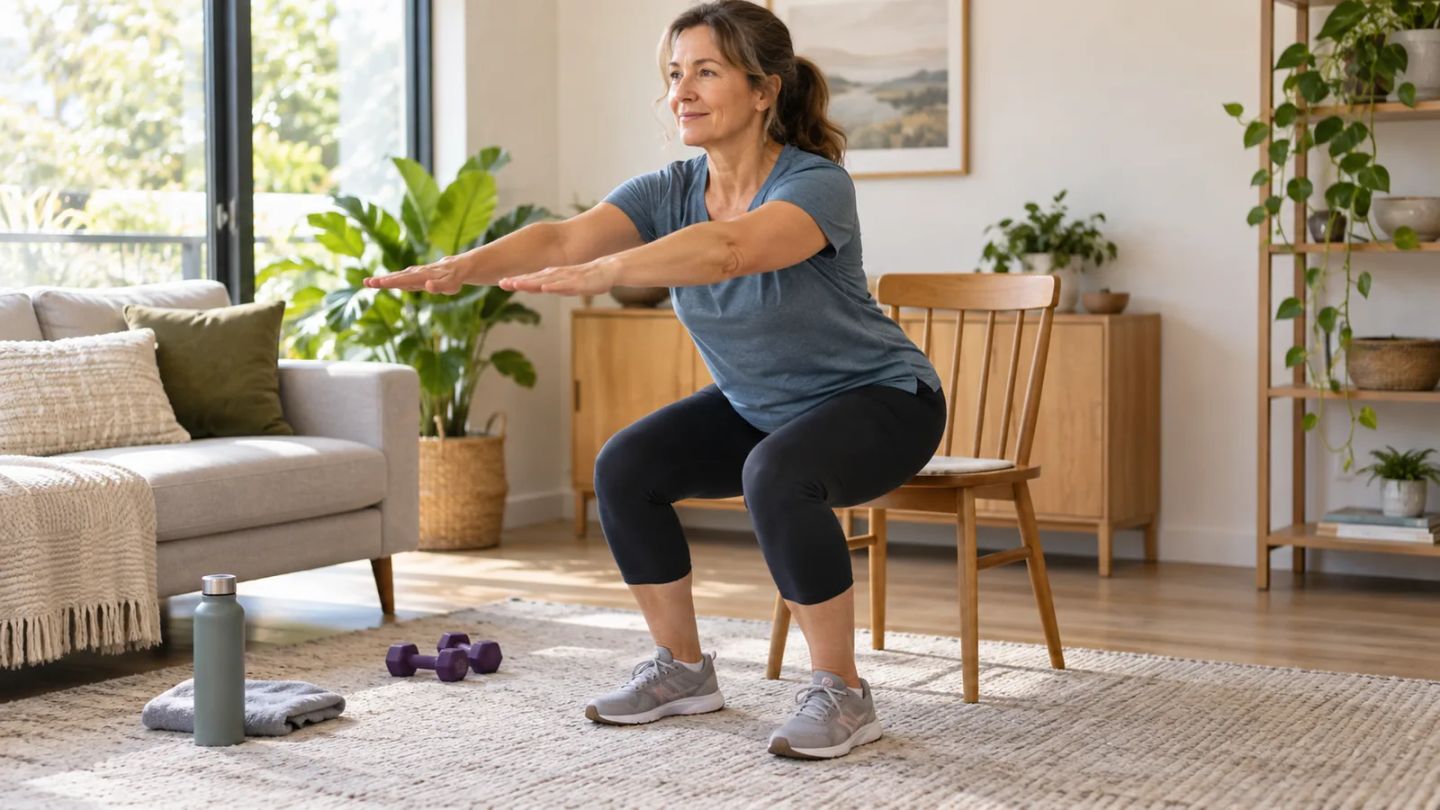
1. Sit-to-stand
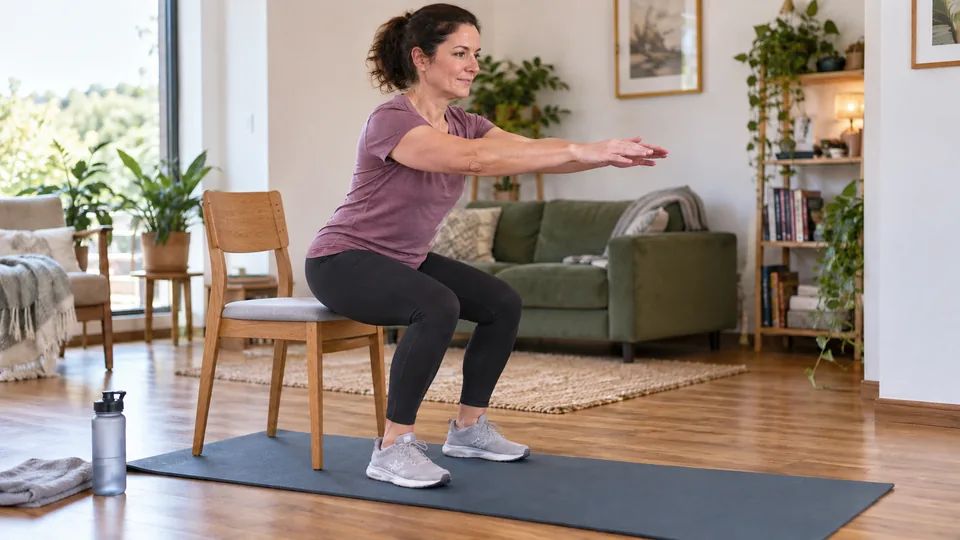
Sit on the chair, stand up without using your hands, sit back down with control. This is a squat in disguise and it builds the legs you rely on for stairs.
2. Counter or wall push-up
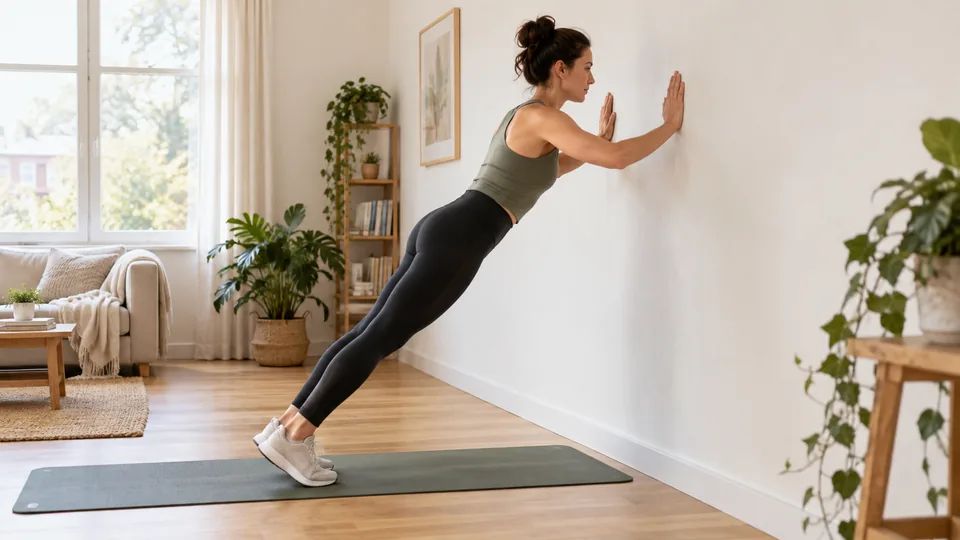
Hands on a kitchen counter or wall, body straight, bend the elbows to lower your chest, press back up. Lower the surface as you get stronger.
3. Dumbbell row
Hinge forward with a hand on the chair for support, pull the weight up towards your hip, lower it slowly. Do one side, then the other.
4. Hip hinge
Hold a weight at your thighs, push your hips back while keeping your back flat, then stand tall by squeezing your backside. This trains the whole back of your body.
5. Overhead press
Stand tall, press the dumbbells from shoulder height up overhead, lower them under control.
6. Step-ups
Step up onto a low, stable step one foot at a time, step back down. Hold the wall if you need to.
7. Bird-dog
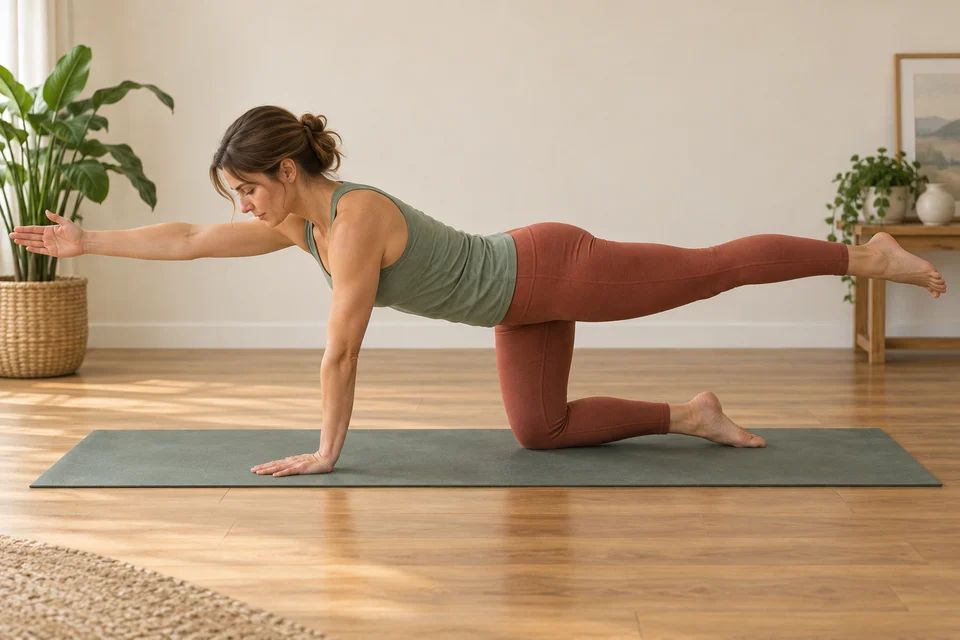
On all fours, reach one arm and the opposite leg out level with your body, hold for a breath, swap sides. This looks after the deep muscles that steady your spine.
That's it. Seven movements, roughly twenty minutes, covering all the major muscle groups the NHS says strengthening work should target: legs, hips, back, abdomen, chest, shoulders and arms.
How to make it harder, slowly
The magic isn't in any one session. It's in nudging the difficulty up over weeks, a principle called progressive overload.
The 2026 resistance training guidance from the American College of Sports Medicine makes the reassuring point that the biggest gains come from moving from no training to any training, and that training the major muscle groups at least twice a week counts for more than any clever plan. So the first job is turning up twice a week. Only once that's steady do you worry about progression.
When you do, add difficulty in this order:
- Add a rep or two to each set until you're comfortably doing 12.
- Once 12 feels manageable for two sessions running, add a small amount of weight and drop back to 8 reps.
- Add a third set before you add much more weight.
Small steps. A jump that leaves you sore for four days is a jump too big.
Recovery is the part that changes with age
The training itself is familiar. What shifts after 40 is how long your body takes to bounce back, and that's the bit beginners tend to get wrong by training the same muscles day after day.
Leave at least a day between strength sessions so the muscle can repair and come back stronger. The resistance training review in older adults is explicit that recovery times can be longer than in younger people, even though the capacity to adapt is much the same. Two well-recovered sessions beat four rushed ones.
Sleep does a lot of the repair work, so protect it. Protein feeds it, and Harvard notes older adults who train benefit from around 1 to 1.3 grams of protein per kilogram of body weight a day, a little more than someone sedentary. Spread it across your meals rather than loading it all at dinner.
Some stiffness a day or two after a new session is normal and passes. Sharp pain during a movement, or an ache that lingers for days, is a sign to ease back.
Form that's kind to your joints
Older joints reward good technique and punish rushing. None of this is complicated.
Warm up for five minutes first with a brisk walk on the spot and a few arm circles, so you're not lifting cold. Move through the range you can control comfortably, not the deepest range you can force. Breathe out on the effort. Keep the weights light enough that the last rep looks like the first, because control is where the safety lives.
If a movement nags at a knee, hip or shoulder, work around it rather than through it, and spend a little time on the joints that feel tight. Our mobility exercises for seniors are a good warm-up companion, and if you'd like something low-impact that builds control and core strength on the days between, the benefits of Pilates are worth a look. The NHS counts Pilates as strengthening work in its own right.
What's different for women through perimenopause and menopause
For women, the years around menopause add a second reason to lift, and a more urgent one.
As oestrogen falls through the menopause transition, both muscle and bone come under extra pressure. A review of exercise beyond menopause describes postmenopausal women losing around half a pound of muscle a year and bone thinning as oestrogen's protective effect fades. That's the stretch of life when the risk of osteoporosis climbs fastest.
Strength training answers both. The same review concludes that strength training and impact activities help offset the decline in bone mineral density and prevent osteoporosis, and the older-adult bone review found progressive resistance training raised bone density most reliably in women, with one supervised programme improving hip and spine density by roughly 3%. Loading your muscles is one of the few things within your control here. If you're managing menopause symptoms or have been told your bone density is low, it's worth raising with your GP, who can point you towards the right intensity for you.
Keep two sessions a week in view

Twice a week sounds easy until a fortnight goes by and you realise you've done it once. Seeing the sessions add up somewhere helps them stick.
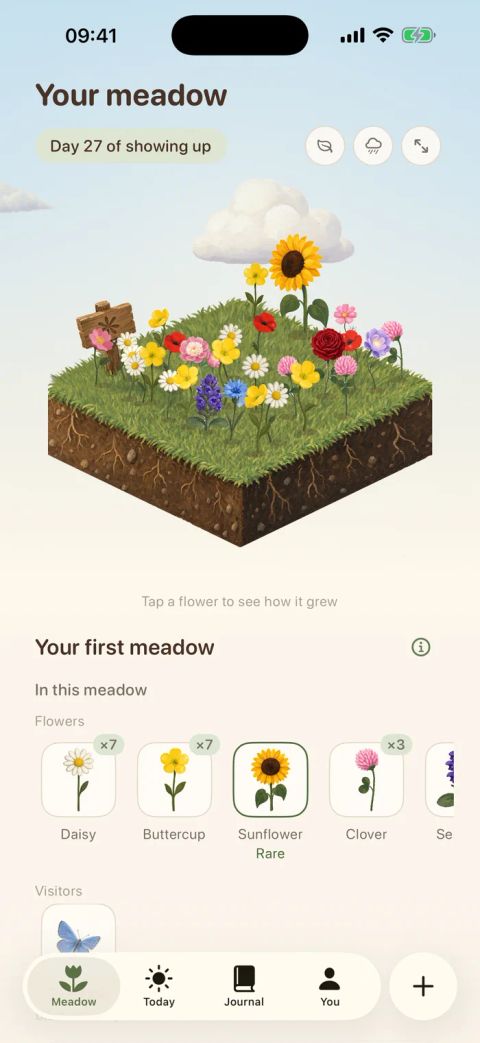
Meadow is a movement and habit app for iPhone where each day you show up grows a wildflower in a meadow that's yours. You can log a strength session as movement with a timer, tick "did my two sets" off as a daily habit, and note how your energy sits afterwards. It's built for consistency, so there are no streaks to break: skip a week while your shoulder settles and nothing you've grown disappears, which suits a practice you'll sometimes pause and pick back up.
Your first four weeks
Open our free printable: Your first four strength weeks (PDF). Save or print it to use alongside this guide. No sign-up needed.
A rough map takes the daily guesswork out of it. Here's a gentle first month using the routine above, building only when the last week felt steady.
Week 1: Two sessions, one set of each movement, bodyweight or the lightest weight. Learn the shapes.
Week 2: Two sessions, two sets of each, same load. Get comfortable.
Week 3: Two sessions, two sets, add a rep or two where 8 felt easy.
Week 4: Two sessions, two sets, nudge the weight up on one or two movements and drop back to 8 reps.
Build your own version by deciding these three things in advance, so a busy week has an answer ready:
My two days: ________ and ________
My anchor (something I already do on those days): ________
My bad-day version (when everything's gone wrong): one set of sit-to-stands and wall push-ups
That bad-day version is the one that keeps the habit alive. On a flat week, a single set of two movements still counts as showing up, and showing up is the whole game.
When to check with your GP first
Most people over 40 can start gentle strength work at home safely today. Some should have a word first.
The NHS advises you to speak to your GP before you begin if you haven't exercised for some time, or if you have a medical condition or concern. That's worth doing if you're returning after a long gap, have a heart or lung condition, joint problems, osteoporosis or low bone density, or you're in the thick of menopause and unsure what's sensible. Stop and get advice if a session brings on chest pain, dizziness or unusual breathlessness.
Common questions
Can you build muscle after 40? Yes. Your muscles keep responding to training throughout life, and beginners often see the quickest early gains because there's the most room to improve. The Harvard review found meaningful lean-mass gains in men well into their 80s.
How often should someone over 40 lift? Two full-body sessions a week is a strong start and enough to hold on to muscle and bone. The ACSM guidance treats training each major muscle group twice a week as the target that counts, and the CDC likewise recommends muscle-strengthening on at least 2 days a week across all the major muscle groups. Add a third session later if you want to, not at the beginning.
How much weight should I start with? Light enough that the last rep of a set looks as controlled as the first. For many people that's bodyweight or a pair of small dumbbells to begin. You'll know it's time to go heavier when 12 reps stops feeling like work.
Is strength training safe if I have joint pain or arthritis? Often it helps, because stronger muscles support the joint. Work in a pain-free range, favour controlled movements, and take anything sharp or new to your GP or a physiotherapist first.
Will lifting make me bulky? No. Building large amounts of muscle takes years of dedicated, heavy training and a lot of food. Two home sessions a week builds strength and firmness, not bulk, particularly after 40 when the body is inclined to shed muscle in the first place.
Pick your two days for next week now, write them where you'll see them, and do the seven-movement routine once at bodyweight before you think about weights. That first session is the whole start.
AUTHOR
Co-founder of Meadow.
Ash is co-founder of Meadow, a habit and movement tracking app that turns small acts of self-care into a growing wildflower meadow.
Little and often, with Meadow
Consistency, not intensity.
Meadow turns the movement you enjoy and the habits that help you feel good into a meadow of wildflowers. No streaks to break, and your flowers never wilt.
Download Meadow